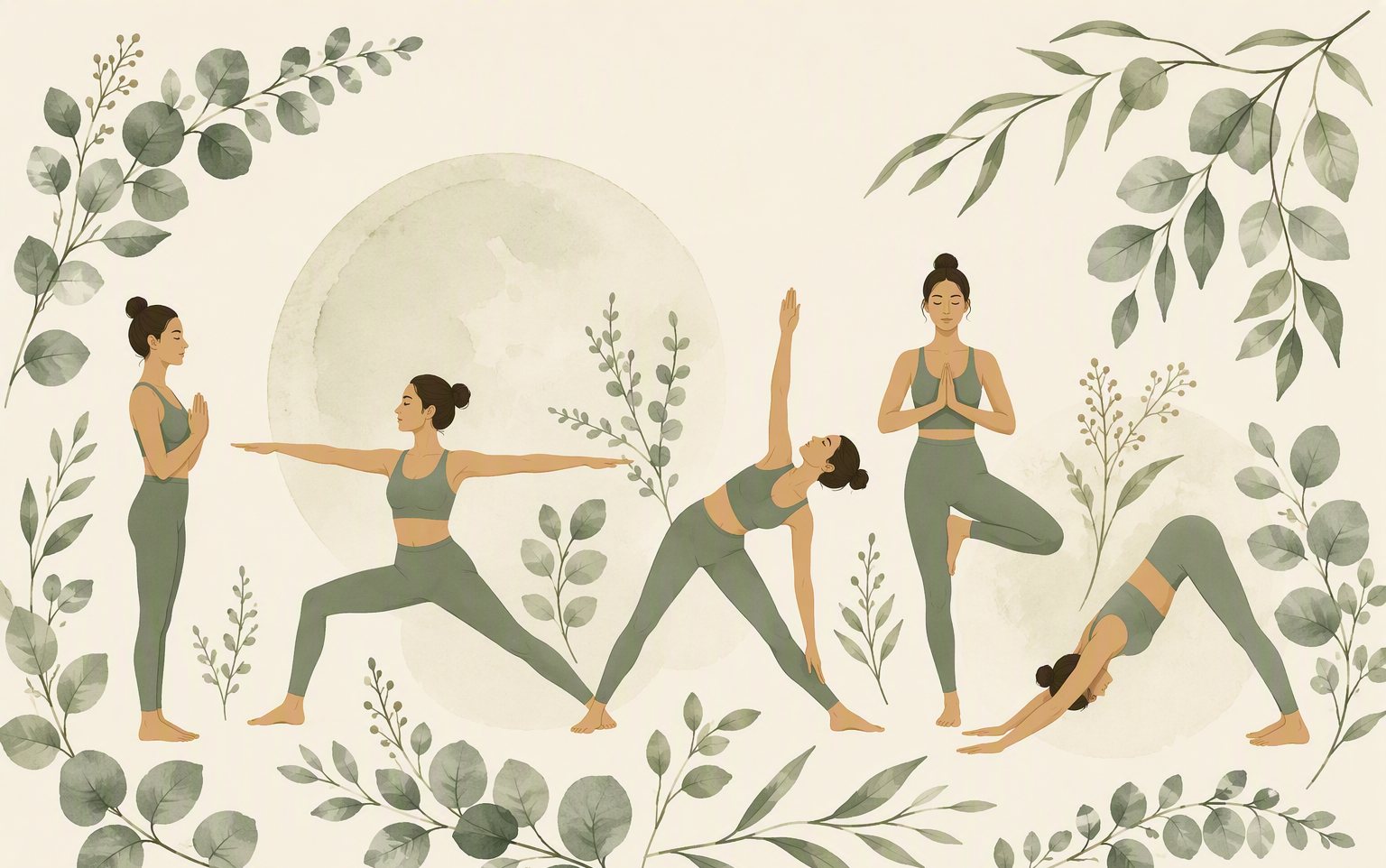
An asana is simply a body position held with attention. The Yoga Sutras define it with three words: sthira sukham asanam — a posture should be steady and comfortable. Not impressive. Steady and comfortable. Keep that sentence in your pocket; it will save your knees.
1. Mountain Pose — Tadasana
How: Stand with feet hip-width apart, weight spread evenly across heel, big-toe mound and little-toe mound. Thighs gently engaged, tailbone lengthening down, crown of the head floating up. Arms rest alongside the body, palms forward.
Why: It looks like "just standing" and is actually a full audit of your posture. Every standing pose begins and ends here.
2. Downward-Facing Dog — Adho Mukha Svanasana
How: From hands and knees, tuck the toes and lift the hips up and back, forming an inverted V. Hands shoulder-width, fingers spread wide. Bend the knees as much as you need — a long spine matters more than straight legs.
Why: Stretches the whole back line of the body, strengthens shoulders and arms, and gently inverts you — a small mood-reset button.
3. Warrior II — Virabhadrasana II
How: Step one foot back about a leg's length, front knee bent to roughly 90 degrees and stacked over the ankle. Back foot turned slightly in, both legs active. Arms reach wide at shoulder height; gaze over the front hand.
Why: Builds leg strength and hip mobility while training something subtler: staying calm inside effort.
4. Triangle Pose — Trikonasana
How: From a wide stance, reach the front arm forward as far as it goes, then tip the torso sideways and rest the hand on the shin, ankle or a block — not the knee. Top arm reaches up. Imagine your back against an invisible wall.
Why: A full side-body stretch plus a gentle twist; great for desk-stiffened spines.
5. Tree Pose — Vrksasana
How: Stand on one leg and place the sole of the other foot against the standing leg's inner thigh or calf — never the knee. Hands at the heart or overhead. Fix your gaze on one unmoving point.
Why: Balance is attention made visible. Wobbling is not failure; it is the exercise.
6. Cobra Pose — Bhujangasana
How: Lie face down, hands under shoulders. Press the tops of the feet into the floor and peel the chest up using mostly back muscles — the hands are assistants, not cranes. Elbows stay soft and close to the ribs.
Why: Counteracts the hunched-forward posture modern life trains into us. Keep it low and long rather than high and cranky.
7. Seated Forward Bend — Paschimottanasana
How: Sit with legs extended. Hinge from the hips — not the waist — and fold over the legs, holding feet, shins or a strap. Bend the knees freely; a rounded spine chasing the toes buys nothing.
Why: Deep release for hamstrings and the entire back body; naturally quieting for the mind.
8. Corpse Pose — Savasana
How: Lie on your back, legs comfortably apart, arms away from the body, palms up. Close your eyes and systematically let each body part get heavy. Stay for five to ten minutes.
Why: The hardest pose in yoga, because there is nothing to do. This is where the practice integrates — skipping it is like baking bread and not eating it.
A simple daily sequence
These eight poses already make a complete practice: start in Mountain, flow through Downward Dog, Warrior II and Triangle on both sides, balance in Tree, open the front body in Cobra, close with the Seated Forward Bend and rest in Savasana. Twenty minutes, door to door. Our four-week program builds exactly on this skeleton.