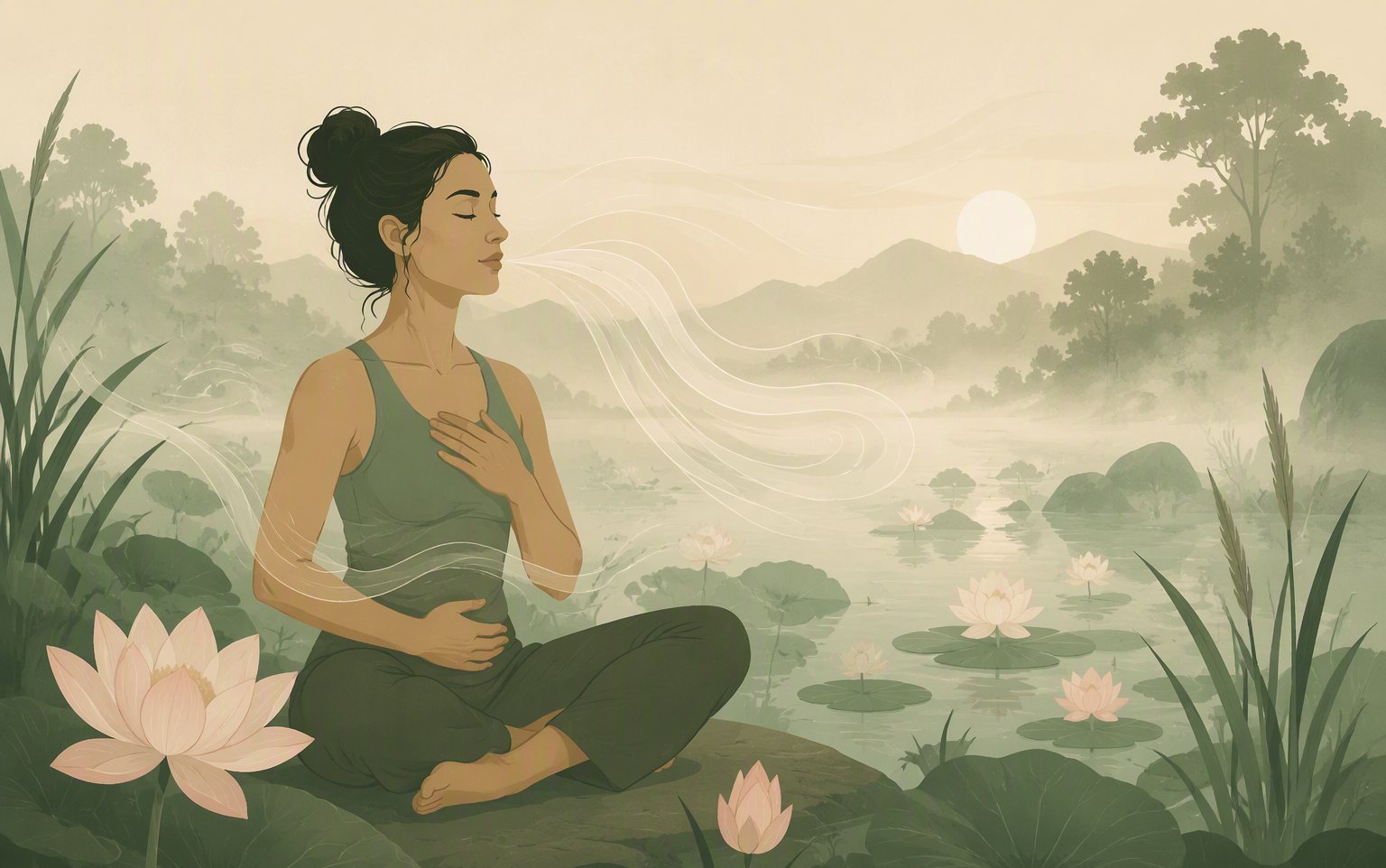
Prana is life energy; ayama is extension or control. Pranayama is the deliberate regulation of breathing — and unlike many esoteric claims, its basic mechanism is visible in any physiology textbook: slow, extended exhales stimulate the vagus nerve, which shifts the body from fight-or-flight toward rest-and-digest. Yogis discovered empirically what laboratories confirm today.
Before you begin
- Practice on an empty-ish stomach — two hours after a meal is comfortable.
- Sit tall but relaxed: a chair, a cushion, or cross-legged on the floor all work.
- Never force the breath. Mild dizziness means stop, breathe normally, and try less next time.
1. Diaphragmatic breathing — the foundation
Place one hand on your chest and one on your belly. Inhale through the nose so that only the lower hand rises; the chest stays quiet. Exhale slowly and fully. Five minutes of this before anything else — it is the base position for every other technique and the single most useful breathing skill in ordinary life.
2. Nadi Shodhana — alternate nostril breathing
The classic balancing practice. Rest the index and middle fingers of your right hand between the eyebrows; use the thumb for the right nostril and the ring finger for the left. Close the right nostril, inhale left. Close both briefly. Open the right, exhale. Inhale right, close both, exhale left. That is one round. Start with five rounds, build toward ten. Practitioners reach for it before sleep, before difficult conversations, and before exams — it is remarkably even-handed at settling mental static.
3. Ujjayi — the ocean breath
Slightly narrow the back of your throat, as if fogging a mirror with your mouth closed, so the breath makes a soft ocean sound on both inhale and exhale. This is the breathing you will hear in vinyasa classes: it paces movement, warms the body and gives the mind something textured to rest on. Five slow cycles is enough to feel it.
4. Bhramari — the humming bee
Inhale normally, then exhale with a gentle humming sound, like a bee, lips softly closed. Feel the vibration in the face and skull. Five to eight rounds. It is the fastest of the four — many people feel their shoulders drop on the very first exhale. A favorite for the end of a screen-heavy day.
A five-minute daily ritual
Two minutes of diaphragmatic breathing, five rounds of nadi shodhana, five rounds of bhramari. Done daily, this tiny ritual does more for stress resilience than an occasional hour-long class. When you are ready to sit still after breathing, continue into meditation — breath practice is its traditional warm-up.