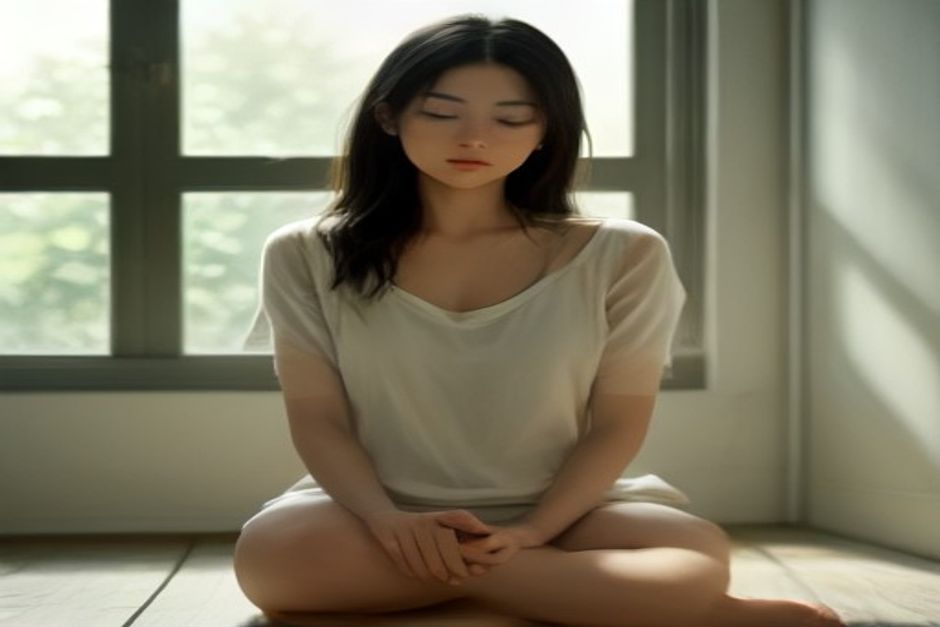
Sama means same or equal. Vritti means fluctuation — the same word Patanjali uses for the whirlpools of the mind. Sama vritti, then, is the practice of making the fluctuations of breath even: an inhale and an exhale of identical length. Nothing is held, nothing is forced, and yet this is one of the most useful breathing techniques a beginner can learn, precisely because there is so little to get wrong.
What it is (and what it is not)
You may know box breathing — inhale four, hold four, exhale four, hold four. Sama vritti is the box with two sides removed: inhale for a count, exhale for the same count, begin again. No retention at the top, no suspension at the bottom. For anyone who finds breath holds claustrophobic or anxiety-provoking, this is the balanced-breathing practice that leaves the door open.
How to practice
Finding your count — the setup
How: Sit comfortably — chair, cushion, or the floor — with the spine tall but not rigid. Breathe through the nose. Inhale at your natural pace and count it: one, two, three. Whatever number you land on comfortably is your starting count. Most people begin at three or four.
Why: The count must come from your body, not from a book. A count of six that leaves you gasping teaches your nervous system that breathwork is a threat — the opposite of the point.
The practice itself — Sama Vritti
How: Inhale for your count. Exhale for the same count. Repeat for five to ten rounds, keeping the breath smooth and silent-ish — a soft ocean sound at the throat is fine, straining is not. If the exhale keeps falling short, drop the count by one until both halves fit.
Why: Extending the exhale to match the inhale gently stimulates the vagus nerve and downshifts the stress response. You are not taking deeper breaths; you are taking even ones, which turns out to be the thing that calms people down.
Growing the count — over weeks, not minutes
How: Once a count of four feels easy for several sessions, try five. Then six. Add one count at a time, and back off the moment the breath gets ragged or the shoulders climb toward the ears.
Why: In pranayama, slow progression is not a consolation prize — it is the mechanism. Lung capacity and CO2 tolerance adapt gradually, and a count you can sustain calmly beats an impressive number every single time.
Why equal beats extreme
Beginners often assume breathwork should feel like something — big inhales, dramatic holds, lightheadedness as proof of effort. Sama vritti works from the opposite premise. Equality is the feedback: the moment the exhale shortens or the inhale grabs, you know stress or fatigue is present, because the breath just told you. It is a diagnostic tool disguised as a relaxation technique.
This is also why it pairs so well with meditation: two minutes of sama vritti settles the nervous system into exactly the state that makes sitting still possible. If counting appeals to you, coherent breathing is a close cousin — five to six breaths per minute, same logic, slightly different pacing.
When to use it
- Before meditation, as a two-minute on-ramp.
- At your desk, when the afternoon gets loud — nobody can see you counting.
- In bed, when the mind replays the day. Equal breathing at a low count is a legitimate sleep aid.
- During asana practice, whenever you notice you have been holding your breath in a hard pose.