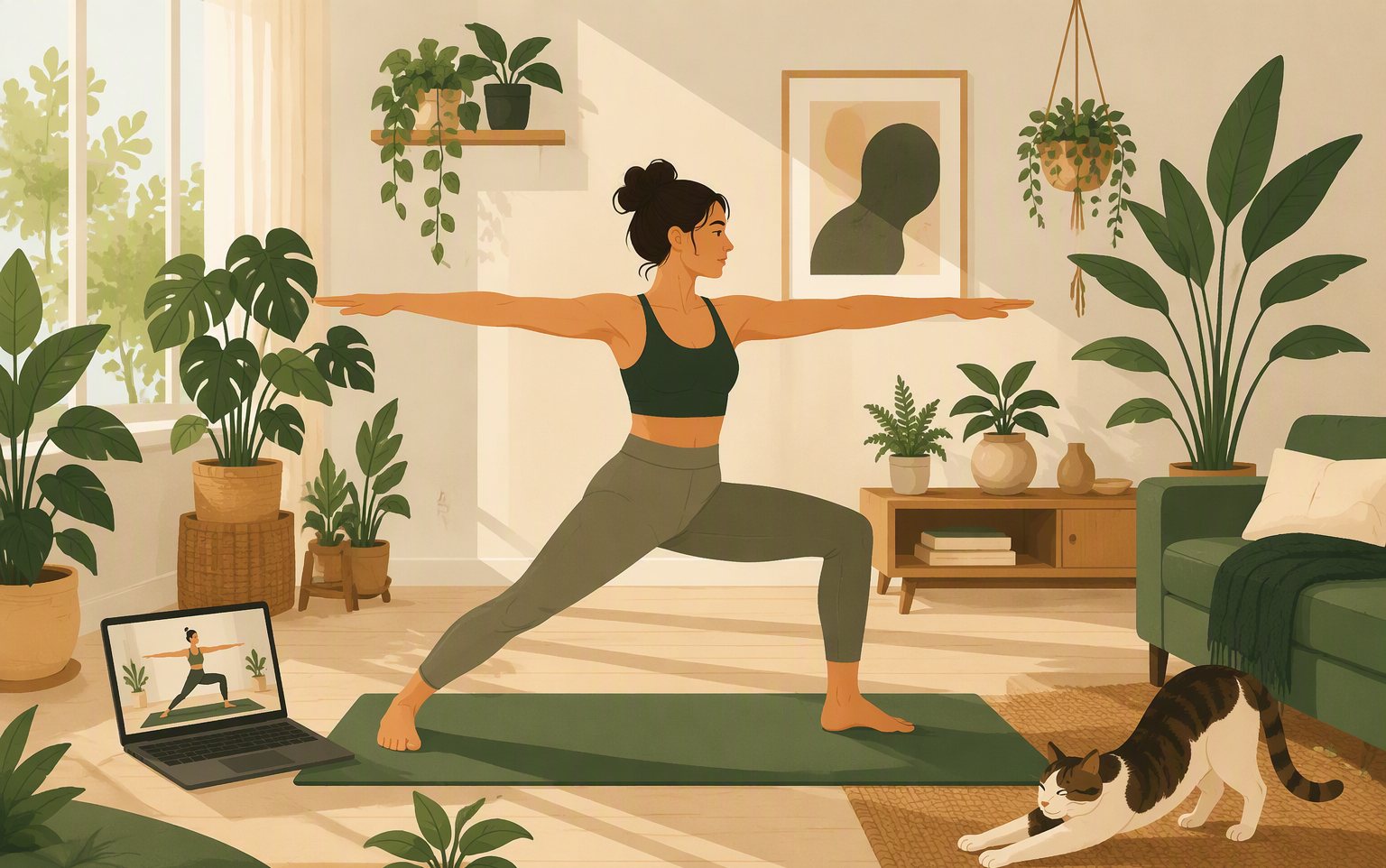
Most beginner courses fail the same way diets fail: too much, too fast, abandoned by day nine. This program is deliberately small. Twenty minutes, three times a week, for four weeks — twelve sessions total. It is built entirely on the eight foundational poses, two breathing techniques and a short sitting practice. Open each linked guide in a tab and practice along.
The universal session template
Every session follows the same skeleton, so by week two you will know it by heart:
- Arrive (2 min) — sit, close your eyes, diaphragmatic breathing.
- Warm the spine (4 min) — gentle cat-cow movements on hands and knees.
- Practice (10 min) — the week's poses, below.
- Breathe (2 min) — the week's pranayama.
- Rest (2 min) — savasana. Non-negotiable.
Week 1 — Orientation
Poses: Mountain, Downward Dog (knees generously bent), Cobra, Savasana. Breath: diaphragmatic breathing only. Goal: learn what "steady and comfortable" feels like. Nothing should hurt; if it does, do less.
Week 2 — Standing up
Poses: add Warrior II and Triangle, both sides. Breath: diaphragmatic + three rounds of nadi shodhana. Goal: connect breath to movement — inhale to open, exhale to fold.
Week 3 — Balance and fold
Poses: add Tree Pose and Seated Forward Bend. Breath: five rounds of nadi shodhana. Goal: notice that balance is attention, not talent. Wobble freely.
Week 4 — The full circuit
Poses: all eight foundational poses in sequence. Breath: nadi shodhana + five rounds of bhramari. Goal: finish each session with two minutes of silent sitting after savasana — your first formal meditation.
Rules that keep you going
- Schedule it. Put the three sessions in your calendar like meetings. Unscheduled yoga is hypothetical yoga.
- Never miss twice. One skipped session is life; two in a row is a pattern. Shrink the session to five minutes rather than skip.
- Track with a checkmark, not a judgment. "Done" beats "done well" for all twelve sessions.
After week four
You will have something more valuable than flexibility: a working habit and a body of reference experiences. From here, paths diverge pleasantly — join a local hatha or vinyasa class, extend your sits to fifteen minutes, start a japa practice, or keep this twenty-minute circuit as your permanent morning ritual. Many of us, years in, still do exactly that.