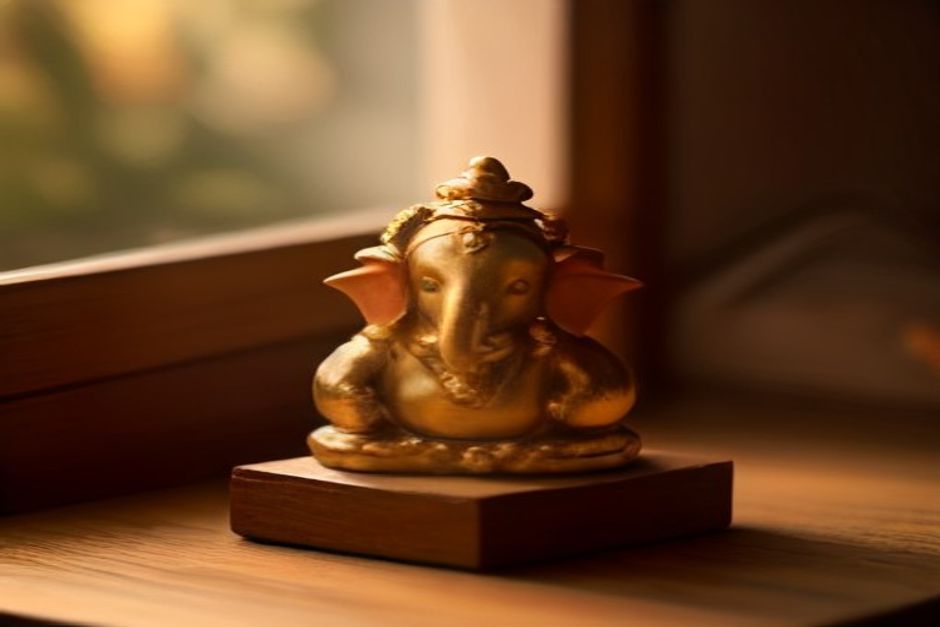
Some mantras are for meditation, some are for devotion, and some are for the moment before you begin something you're slightly nervous about. Om Gam Ganapataye Namaha is the third kind. It's the mantra of Ganesha — the elephant-headed figure you've probably seen on studio altars and Indian restaurant walls — and traditionally it's chanted at the start of things: a journey, an exam, a new job, a difficult conversation, a yoga practice. Think of it as a way of marking the threshold between not-beginning and beginning.
You don't have to worship anything to find it useful. A ritual phrase said before starting is, at minimum, a pause — a few breaths in which you collect yourself and decide to actually begin. That's worth something on its own. Here's what the words mean and how the practice works.
What the words mean
The mantra breaks down into four parts:
- Om — the opening syllable shared by most mantras, the audible deep breath that starts the whole thing. We've covered it in detail on the Om page.
- Gam (rhymes with "hum") — the bija, or "seed," mantra associated with Ganesha. Seed syllables are single sounds treated as the concentrated form of a deity's energy. Whether or not that framework speaks to you, "Gam" is simply the sound this tradition assigns to Ganesha, the way "Aim" belongs to Saraswati or "Shrim" to Lakshmi.
- Ganapataye (guh-nuh-puh-tah-yeh) — "to Ganapati." Ganapati is another name for Ganesha, from gana (the multitudes, his attendant troops) and pati (lord): "lord of the hosts." The -ye ending makes it dative — the chant is addressed to him.
- Namaha (nuh-muh-hah) — "I bow," "salutations," literally "not mine." It's the same ending as in Om Namah Shivaya: a gesture of offering, of setting the ego down for a moment.
All together: "Om — to Ganapati, I bow." Simple as that. The elaborate meanings you'll find online (each syllable unlocking a specific chakra, and so on) are later layers. The core is a salutation.
Who is Ganesha, exactly?
Ganesha is one of the most beloved figures in the Hindu pantheon: elephant head, round belly, one broken tusk, riding a mouse. He's known as the remover of obstacles and the lord of beginnings, which is why his mantra opens so many undertakings — weddings, businesses, journeys, books.
Here's the nuance most yoga-studio retellings skip: in some traditional stories, Ganesha doesn't just remove obstacles — he also places them, blocking paths that shouldn't be taken. He's less a cosmic vending machine for smooth sailing and more a figure for right relationship with difficulty itself. That's actually the more useful idea. Chanting to the remover-and-placer of obstacles before a hard thing isn't a request for an easy path; it's an acknowledgment that obstacles are part of the path, and a small act of composure before you meet them.
How to chant it
Pronunciation: Om — Gam — Guh-nuh-puh-tah-yeh — Nuh-muh-hah. Don't stress about perfection. Sanskrit is forgiving to sincere beginners, and every lineage pronounces it slightly differently anyway.
A simple practice:
- Sit comfortably and take a few ordinary breaths. Settle.
- Chant the mantra aloud three times, at whatever pace feels natural. Feel free to extend the "Om" at the start.
- If you want more, keep going — softly, or silently in the mind. Traditionally the count is 108, which is where a mala and japa practice come in: one bead per repetition, roughly ten minutes.
- Finish with a breath of silence before you get up and actually begin the thing.
When to use it: before practice, before work, before anything where you notice yourself stalling. The mantra works particularly well as a threshold ritual — the same few syllables each time, so the mind learns "oh, we're starting now." Athletes have pre-game routines; this is the yogi's version, minus the lucky socks.
What it does, practically speaking
Let's be honest about mechanisms. No controlled trial has tested whether chanting to Ganesha clears obstacles from your calendar. What a beginning-mantra does reliably do is slower and simpler: it interrupts procrastination, it gives a racing mind one rhythmic thing to hold, and it converts vague dread into a concrete first step — chanting, then acting. If you like the idea of devotional practice, it can also be that, fully. Both readings coexist fine. If mantra repetition in general clicks for you, mantra meditation is the natural next step, and the Gayatri mantra is the other great traditional choice for a steady daily chant.
Common questions
- Do I need to be Hindu, or "believe in" Ganesha? No. It helps to know what the words mean and where they come from — that's ordinary respect. Beyond that, use it at the level that works for you: devotion, ritual, or mental bookmark.
- Aloud or silent? Both are traditional. Aloud gives you vibration and breath control; silent is subtler and better for public transit.
- How many times? Three is enough to count as a beginning. 108 is the traditional full round. One, said with actual attention, beats 108 said while composing emails in your head.
An obstacle met calmly is already half removed. The rest is usually a to-do list.