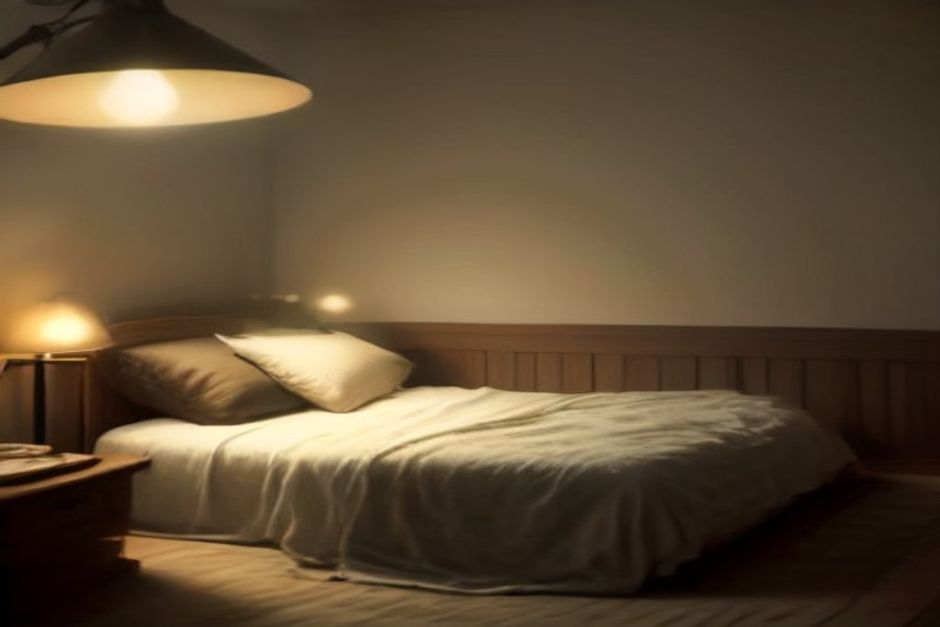
Most meditation asks you to stay awake. This one does not mind if you fail. The body scan for sleep is practiced in bed, in the dark, with the explicit permission to fall asleep in the middle — and most nights, you will. That is not the practice going wrong; that is the practice. If you have ever lain in bed with a mind running tomorrow's meetings on loop, this is the off-ramp.
The full daytime technique lives on our body scan page. This is its nocturnal cousin: same route through the body, different destination. During the day the scan trains attention; at night it gives the mind something quiet and physical to hold until sleep takes over.
Why a body scan helps you sleep
No mysticism, just mechanics. Sleeplessness usually runs on one of two fuels: rumination (replaying, rehearsing, worrying) or residual physical tension (the shoulders that never got the memo that the day ended). The scan addresses both at once. It occupies the verbal mind with a slow, structured task — naming and feeling body parts — leaving less bandwidth for the 2 a.m. committee meeting. And the act of noticing each region, without trying to change it, tends to release the guarding that keeps muscles half-braced. The nervous system reads all of this as safety, and safety is the one thing sleep absolutely requires.
The practice, about 15 minutes
The setup
How: Do everything else first — teeth, phone, alarm, lights. This practice is the last event of the day, not a step before something. Lie on your back in the position you actually sleep in (or close to it), covers arranged, room dark. Let the arms rest slightly away from the body if that is comfortable.
Why: Any task left undone becomes the thought that interrupts you at the knees. Finish the day first, then scan.
Three arrival breaths
How: Take three slow breaths, making the exhale a little longer than the inhale. Nothing fancy — no counting required, just a deliberate lengthening of the out-breath.
Why: A longer exhale is the simplest known lever for shifting the body toward rest-and-digest. Three breaths will not knock you out, but they open the door the scan walks through.
The scan, feet to face
How: Bring attention to the soles of your feet. Notice whatever is there — warmth, the pressure of the blanket, tingling, nothing at all — for a few slow breaths. Then move on, unhurried: ankles, calves, knees, thighs, hips, belly, lower back, chest, upper back, fingers, hands, arms, shoulders, neck, jaw, face, scalp. At each stop, silently name the part, feel it, and let it be heavy. A phrase that helps: "feet — resting." Then move on. If you reach the scalp still awake, rest in the feeling of the whole body breathing, and if sleep has still not come, start again at the feet, slower.
Why: The slow sequence keeps the mind employed on neutral, physical, low-stakes material — precisely the kind of material sleep likes. The naming gives wandering attention a rail to ride.
The rules that make it work
Falling asleep is success. If you drift off at the hips, the practice did exactly its job. Do not "try to finish" — the finish line is optional. Some nights you will complete the whole route; some nights you will never get past the calves. Both are fine nights.
Observe, do not fix. When you find a tense jaw or a braced shoulder, the instruction is not to relax it — trying to relax is effort, and effort is wakefulness. Just notice: "jaw, holding." Noticed tension usually softens on its own schedule. Even when it does not, you have stopped feeding it attention-turned-worry.
Blank spots and wanderings are normal. Some body regions report nothing; treat them like unvisited rooms and keep walking. And you will drift into thought — the return is quiet and unceremonious: notice you were thinking, come back to the last body part you remember. No self-criticism; that is caffeine for the mind.
Pairings that deepen the effect
The scan works alone, but two companions make it stronger. Five to ten minutes of legs up the wall before getting into bed drains the heaviness out of the legs and starts the downshift early. And a consistent sequence of small habits beforehand — the dimming, the stretching, the screens going off — builds the runway; our evening wind-down lays out a realistic fifteen-minute version, and the broader sleep habits live on the sleep page.
A note for the chronically wired: if your mind treats the scan as one more task to perform correctly, shrink it. Scan only the feet and the hands, slowly, and stop. Two stops, done well, beat twenty stops done anxiously.
Tonight, when the lights go out and the mind starts its meeting, give it the feet instead. Then the ankles. Then the calves. If you never find out how the sentence ends, you have done it perfectly.