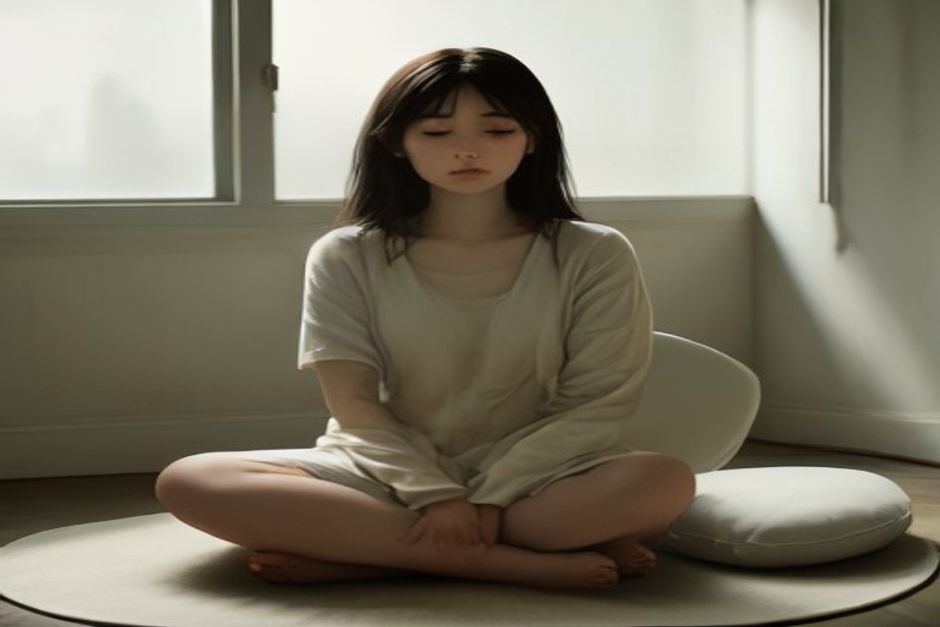
Strip meditation down to its smallest working parts and you get breath counting. No visualizations, no philosophy, no equipment, no app voice telling you that you are doing great. You breathe normally, you count your exhales from one to ten, you start again at one. That is the entire technique, and it has been the entry point of Zen practice for centuries precisely because there is nowhere to hide in it. Within two minutes you will know, with unusual clarity, exactly how scattered or steady your mind actually is today.
It is also the most forgiving technique on the meditation page. The count gives you a built-in diagnostic: if you notice yourself at seventeen, or realize you have been planning dinner since \"three,\" the information is instant and unambiguous. Other techniques make you guess whether you were present. Counting tells you.
The practice, 5 to 20 minutes
Basic count — exhales, one to ten
How: Sit in any position you can hold without squirming — a chair is genuinely fine, as our beginner's guide keeps insisting. Take two or three slightly deeper breaths to arrive, then let the breathing return to its natural rhythm. At the end of the first exhale, count silently: \"one.\" End of the next exhale: \"two.\" Continue to ten, then return to one. The count lands at the end of the out-breath, like a small period at the end of a sentence.
Why: Counting exhales (rather than inhales) pairs the number with the releasing half of the breath, which keeps the practice settling rather than stimulating. Stopping at ten — rather than counting to infinity — builds in a natural checkpoint: reaching ten without a drift is a small, verifiable success.
The restart rule
How: The moment you notice you have lost the count — at any number, for any reason — return to one. No finishing the breath you were on, no \"I think I was at six,\" no sigh of frustration. Just: noticed, and back to one, the way you would quietly re-rack a weight that slipped.
Why: Returning to one removes the temptation to bluff. Bluffing the count is the only way to do this technique wrong, and it is remarkably tempting. The restart keeps the practice honest, and the honesty is the point.
Variations, when basic gets stale
How: Count inhales instead of exhales (slightly more alerting — good for drowsy mornings). Count down from ten to one. Count both halves: \"one\" on the inhale, \"one\" on the exhale, \"two\" on the next inhale — useful when the mind is very busy and needs a tighter leash. Or drop numbers entirely and label the breath \"in ... out,\" which is counting's minimalist cousin.
Why: Small changes refresh attention without changing the skill being trained. The day you find counting boring is often the day a variation shows you how much subtlety you had stopped noticing.
Getting lost is the workout
Here is the reframe that makes or breaks a breath-counting practice: losing count is not the failure of the exercise — it is the exercise. Nobody hires a trainer and then complains that the dumbbells are heavy. Every time you catch yourself at \"fourteen\" and return to one, you have performed one clean repetition of the actual skill: noticing that attention wandered and moving it back. A sit with thirty wanderings and thirty returns is thirty repetitions. A sit where you float from one to ten in a haze of half-thought, never once noticing you were gone, is zero repetitions with good posture.
So when you catch yourself planning emails at \"five,\" the correct internal response is not a groan. It is something closer to: good catch. Then: one. Some teachers suggest mentally labeling the drift — \"thinking,\" \"planning,\" \"remembering\" — before restarting. One quiet word, no story about it, back to the breath. If the same worry pulls you away five times in a row, that is worth noticing too; it usually means the worry deserves ten honest minutes after the sit, not ten distracted minutes during it.
Counting is not breath control
A common confusion worth clearing up: breath counting is observation, not regulation. You are not slowing the breath, deepening it, or shaping it into a pattern — that is pranayama, a different (and complementary) discipline with its own techniques like box breathing and ujjayi. In counting, the breath stays exactly as it is: shallow, deep, fast, slow, whatever your body is doing. You are the scorekeeper, not the conductor. If you notice you have started unconsciously stretching your exhales to make the practice feel \"deeper,\" just let that go too.
Building the habit
Five minutes daily beats thirty minutes occasionally — this is true of every meditation technique, but counting makes it easy to test because five minutes is genuinely enough to produce wanderings, catches, and restarts. Anchor it to something that already happens: after coffee, before email, on the train. Eyes can be closed or softly open toward the floor; closed is easier at first, open trains a steadiness that transfers better to the rest of life. Set a timer so checking the clock does not become your hundredth wandering.
One cushion or chair, one timer, ten numbers, endlessly restarted. If you can count to ten, you have all the prerequisites — and if you cannot currently count to ten without your mind wandering, you have just discovered exactly why the practice exists. When counting feels steady and you are curious about wider territory, the breath makes a fine base camp for the techniques described on our meditation overview.