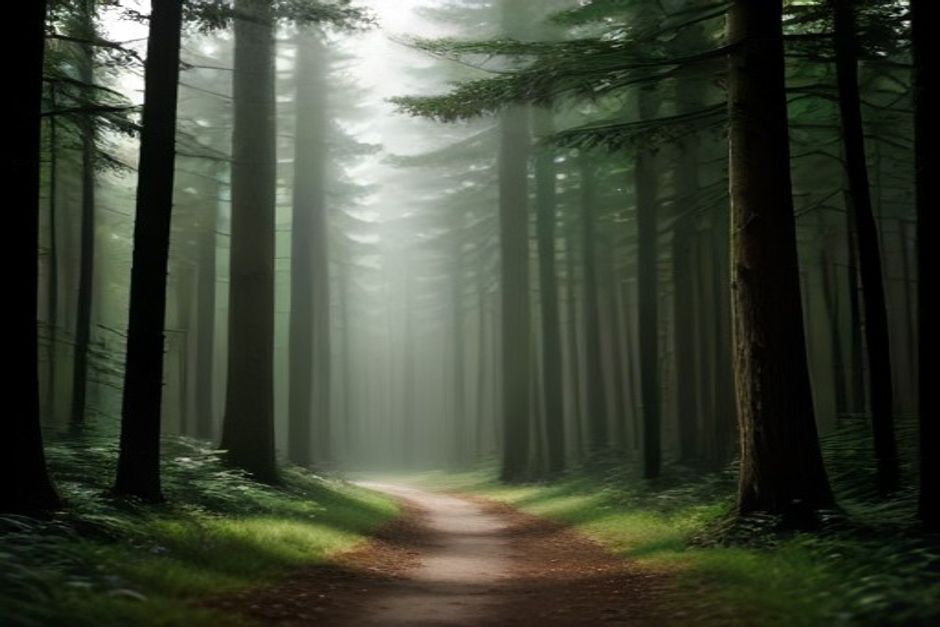
Sit-down meditation has a marketing problem: it requires sitting. For people whose backs complain, whose minds speed up in stillness, or who simply cannot face another cushion, the whole project can stall at the door. Forest bathing — shinrin-yoku, literally "taking in the forest atmosphere" — offers a different door. It is meditation that happens on your feet, outdoors, with permission to look at things. No posture to hold, no timer to obey, no transcendence on offer. Just a slow walk in which you actually notice the walk.
Where it came from
The term was coined in Japan in the early 1980s, when the forestry ministry — of all bodies — began encouraging citizens to spend unstructured time among trees. It was part public-health nudge, part cultural reminder: Shinto and Buddhist traditions had long treated forests as places that change a person. The modern version is deliberately unceremonial. You do not hike, exercise, identify species, or collect anything. You wander slowly and let your senses do the work. It pairs naturally with the kind of attention training described on our meditation page — same muscle, different setting.
Why it counts as meditation
Meditation, stripped of costume, is the practice of placing attention somewhere and returning it when it wanders. In forest bathing, the "somewhere" is the sensory field: the smell of wet soil, the temperature shift in shade, the texture of bark, the layered sound of wind moving through leaves at different heights. The mind still wanders — to emails, to dinner, to that thing you said in 2019. The practice is identical: notice, return. The forest is simply a very patient anchor, one that never gets boring because it is never quite the same twice. If you have tried sound awareness practice indoors, this is that practice with a bigger room.
A simple protocol (30 minutes, no gear)
- Arrive slowly. The moment you step off the pavement or out of the car, halve your speed. Most of us walk into nature at city pace and spend the first twenty minutes physically present and mentally elsewhere. The slowdown is the threshold.
- Spend five minutes per sense. Sight first: let your gaze go soft and wide, taking in movement and light rather than objects. Then hearing: near sounds, far sounds, the loudest, the faintest. Then smell — actually bend to a leaf or the soil. Then touch: bark, moss, a stone, the air on your forearms. Taste is the air itself; skip it if that feels silly.
- Find a spot and stand or sit for ten minutes. Watch one small patch of the world. A single tree will do. The forest does not perform, and that is the point — you are practicing staying when nothing entertains you.
- Leave slowly too. The walk back is where the whole thing either sticks or evaporates. Resist the phone until you are fully out.
What you may notice
The first ten minutes are usually boring, then faintly irritating. This is normal and is, frankly, the most useful information of the day: it shows how loudly the mind demands stimulation. Somewhere around minute fifteen, most people report a gear change — sounds get clearer, colors get louder, time gets loose. Nothing mystical is happening. Your attention, starved of novelty, has finally tuned to the channel that was always broadcasting.
"The clearest way into the Universe is through a forest wilderness." — John Muir, who never used the word shinrin-yoku but would have recognized it immediately.
No forest? Fine.
A park works. A tree-lined street works. A single reliable tree you pass daily works better than you think, because repetition is its own practice — the tree changes, you change, and noticing the difference is the whole game. A houseplant and an open window is the budget version, and on a rainy week it may be the honest one. The practice scales down gracefully; what it does not survive is speed.
Forest bathing asks nothing you don't already own: a body, a bit of time, and some trees. It is the same returning-to-the-senses work as the five senses practice, done standing up, with better scenery. For those who find seated meditation a fight, it may be the form that finally sticks — not because it is easier, but because the forest does half the holding for you.