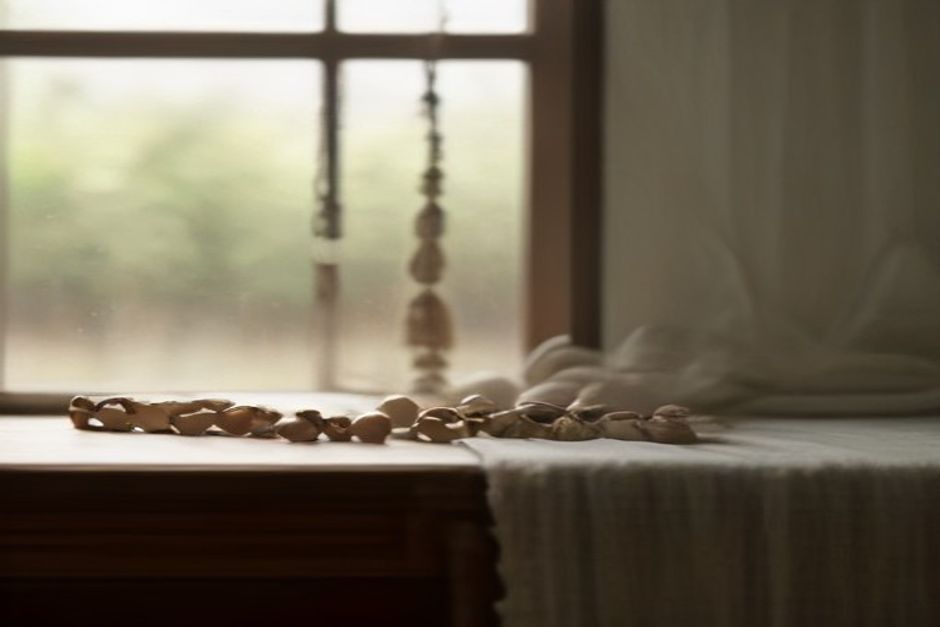
Some minds settle easily on the breath. Most do not. If your attention treats silent sitting as an invitation to reorganize your to-do list, japa — mantra repetition — gives it a job. Add a string of mala beads and your hands get a job too. That is the whole trick: occupy the parts of you that fidget, and the part that watches gets some quiet. It is one of the oldest meditation methods in the yoga tradition, and one of the most practical.
What japa actually is
Japa means repetition — of a mantra, a name, or a short phrase, said aloud, whispered, or repeated silently in the mind. A mala is a string of beads used to count the repetitions: traditionally 108 beads, plus one larger bead called the guru bead that marks the start and end. Think of it as a tactile abacus for attention. Each bead is one repetition; the strand is one complete round.
Why 108? The tradition offers many explanations — astronomical, numerical, symbolic — and none of them need to matter to you. The honest answer is that 108 is simply long enough. Ten repetitions barely gets you settled; a full round of 108 takes ten to twenty minutes depending on pace, which is a real meditation session. The number is a container, not a spell.
Choosing what to repeat
You need something to say. Options, from most traditional to most improvised:
- Om — the simplest possible choice, a single syllable. The background on it is on our Om page.
- So-ham — 'I am that,' a mantra that maps naturally onto the breath: so on the inhale, ham on the exhale. More on it at so-ham.
- A longer traditional mantra — the mantra library has full options with translations, from the gayatri to the shanti mantras.
- A plain-language phrase — 'let go,' 'be here,' 'steady.' The tradition would call this less potent; a modern practitioner can call it honest. Repetition works on the mind regardless of the language.
Pick one and stay with it for a while — weeks, not minutes. The point of japa is not variety; it is wearing a smooth groove.
How to practice, step by step
Setting up
How: Sit in any comfortable meditation posture — a chair is fine. Hold the mala in your right hand if you want to follow tradition, draped over the middle finger, with the thumb free to move the beads. Start at the bead next to the guru bead.
Why: A consistent setup becomes a ritual cue. The body learns: beads in hand, mind on duty.
One bead, one repetition
How: Say or think your mantra once, then use the thumb to pull the next bead toward you. Repeat. Keep a steady, unhurried pace — roughly one repetition per breath works well for most mantras.
Why: The bead gives each repetition a physical boundary. Instead of a blur of muttering, you get 108 discrete, countable moments of attention — and a built-in alarm every time your thumb stops moving because your mind wandered off.
Reaching the guru bead
How: When you come back around to the large bead, you have finished one round. Tradition says do not cross over the guru bead — if you want a second round, turn the mala around and go back the other way.
Why: It marks a clean ending. Finishing a round is a small, complete act, and completeness is part of what settles the mind.
No beads? No problem
The mala is a tool, not a requirement. You can count on your fingers — the segments of each finger give you twelve per hand, and nine rounds of twelve is 108. You can simply repeat the mantra for a set time using a timer. You can use any beaded necklace, a row of knots in a cord, or a jar you drop pebbles into. The mechanism that matters is repetition plus counting: one keeps the mind occupied, the other keeps it honest. If you enjoy the practice, a simple wooden or seed mala costs very little and will likely become the object you associate with sitting down — which is its real function. The broader practice of working with a mantra is covered in mantra meditation.
What to expect
The first few rounds feel mechanical. Then, usually around the middle of a round, the repetition starts running itself and something quieter shows up underneath — the same way you can drive a familiar route and suddenly notice the sky. Then you will lose it, notice your thumb has stalled on a bead while you mentally answered email, and start again from that bead. That restart is not failure; it is the exercise. Japa is meditation with training wheels that never fully come off, and that is precisely why busy minds often take to it faster than silent breath-watching.
The beads do not quiet the mind. They give the mind something harmless to hold while it quiets itself.
A realistic starting dose
Start with a quarter mala — 27 beads, about three to five minutes — once a day for two weeks. Morning works well because repetition sets a tone, but the honest answer is whenever you will actually do it. When a quarter round feels easy, go to a half, then a full round. Like every practice on this site: small, daily, and unheroic beats ambitious and abandoned.