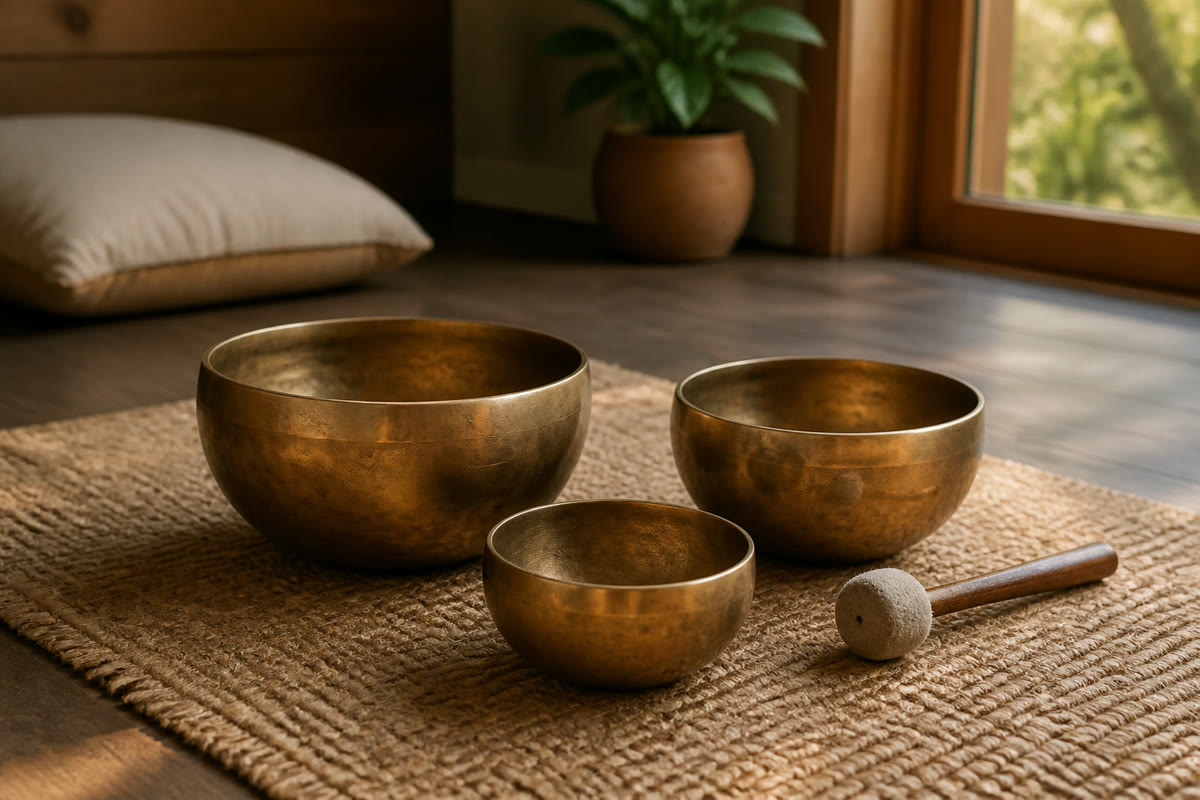
A sound bath has an unlikely name and a simple premise: you lie down, someone plays resonant instruments — singing bowls, gongs, chimes, sometimes a low drum — and for an hour your only job is to listen. No technique to master, no posture to hold, nothing to achieve. Of all the ways to meditate, it is among the most accessible, precisely because the sound does half the work for you.
It also comes wrapped in more marketing fog than most practices. So here is the honest version: what happens in a session, why it works as meditation, and what it will not do for you.
What a session actually looks like
You arrive, lie on a mat with a blanket and maybe an eye pillow, and the facilitator begins playing. The sounds are long and slow to change: a bowl is struck and allowed to ring until it disappears, then another. A gong swells for a minute. There are stretches of near-silence. Sessions usually run 45 to 75 minutes, and people commonly report three phases:
- The settling phase (first 10 minutes). The mind is chatty, the body fidgets, you are very aware of the stranger breathing next to you. Normal.
- The drift phase (middle). Attention starts following the tones on its own. Time gets elastic. Some people hover near sleep; some get unusually clear. Both are common.
- The return (last 5 to 10 minutes). The playing slows, there is real silence, and you come back to the room at whatever pace you need. Nobody rings a bell and expects you to be functional in four seconds.
Why sound works as an anchor
Meditation needs an anchor — something to return attention to when it wanders, which it will, roughly every four seconds. Breath is the classic anchor, but breath is subtle and internal; beginners often spend whole sessions losing and re-losing it. Sound has the opposite profile: it is external, vivid, and impossible to miss. A singing bowl's long decay gives you a continuous thread to follow — the mind can ride a single tone for ten seconds, which in meditation terms is a small eternity.
This is not a new idea dressed in quartz bowls. Yoga has an old name for it: nada yoga, the yoga of sound, which treats sustained listening as a doorway into concentration. Our nada yoga page covers the tradition; the short version is that practitioners have been using resonance as an attention anchor for centuries, and the mechanism — following a sound until it thins into silence — is the same one your attention learns in breath practice.
How to listen on purpose
The difference between a sound bath and an expensive nap is intent. A few pointers that keep the practice honest:
- Follow one sound to its end. Pick a single tone and stay with it as it fades, through the point where you are no longer sure you hear it. That uncertain edge — is it still there? — is exactly where attention sharpens.
- Notice the silence between sounds. The pauses are not intermissions; they are half the practice. Listening into silence is the same skill as listening into sound, one degree subtler.
- Label and return. When you notice you are planning dinner, label it — "thinking" — and come back to whatever is ringing. This is the identical move as breath meditation, transplanted. Our sound meditation and sound awareness pages teach the same technique for home practice, no bowls required.
- Let the body be included. Sound is vibration; you feel it in the chest and hands as much as you hear it. Noticing that is body-scan territory, and it counts.
What it will not do
Honesty section, because the marketing will not provide one. Sound baths are a pleasant, low-effort way to rest deeply and practice attention. They are not frequency medicine, they do not "retune" your cells, and claims about specific hertz values healing specific organs are not supported by anything resembling evidence. If a facilitator promises detox, chakra repair, or trauma release via gong, enjoy the music and discard the brochure.
What the practice can genuinely offer: an hour of enforced stillness, a clear object of attention for people who find breath frustrating, and the particular restedness that comes from being horizontal and undisturbed. That is not nothing — most adults are chronically short on exactly that.
Trying it at home
You do not need a bowl collection. A ten-minute version: sit or lie down, play a single sustained tone (a free singing-bowl recording works), and follow it the way you would follow the breath — to its end, into the silence, back to the next one. The meditation posture page covers how to sit without suffering. Ten honest minutes at home will teach you more than an hour of scenic dozing, and it costs nothing but the time.