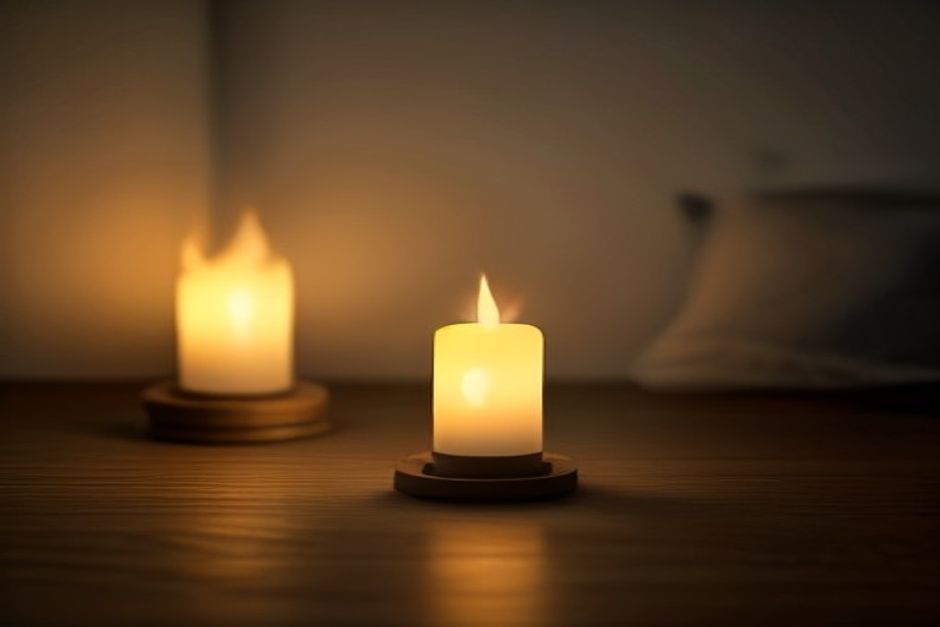
Most meditation instructions start the same way: close your eyes. For some people, that's where the practice ends. Eyes shut, mind sprints. If that sounds familiar, trataka — steady gazing — might suit you better. Instead of closing the door on the visual world, you give your eyes one simple job: look at a candle flame and nothing else.
The Sanskrit word trataka means "to gaze steadily." It appears in the Hatha Yoga Pradipika, a 15th-century manual, as one of the six cleansing practices (shatkarmas). Traditionally it was used to steady the mind before seated meditation and, in the old texts, to "purify" the eyes. We'll stick to what we can honestly say: it's a concentration drill, and a good one.
Why staring at a flame works
Attention is easier to hold when it has somewhere obvious to land. The breath is subtle; a flame is not. It flickers, dances, changes shape every second, which gives your restless mind just enough novelty to stay interested without giving it anything to chew on. You're practicing the same skill as in breath counting — notice, wander, return — but with a brighter anchor.
There's also a mechanical side. When your eyes hold still, your body tends to settle with them. Fidgety hands go quiet. Breathing slows on its own. It's the opposite of scrolling: one object, no input, no decisions.
How to practice
Setup: Place a candle at eye level, about an arm's length to a meter away, at the same height as your eyes when you sit upright. A darkish room helps — you want the flame to be the brightest thing around. Sit in any position you can hold for ten minutes without fidgeting; a chair is completely fine. No drafts, or the flame will flicker too hard to follow.
The practice:
- Sit, settle, take three unhurried breaths.
- Look at the flame. Not through it, not at the wax, not at the wick — at the flame itself, roughly its brightest, steadiest part near the base.
- Let your eyes blink normally at first. As you settle, let blinking become less frequent, but never fight a blink that insists on happening.
- When your mind wanders — to dinner, to an email, to "am I doing this right?" — notice and come back to the flame. That return is the whole exercise.
- Continue for 5–10 minutes. Then close your eyes and rest them for a minute or two, noticing the afterimage if one appears. Don't chase it; just watch it fade.
Some traditions add a second phase: after gazing, you close your eyes and visualize the flame at the point between the eyebrows. If that appeals, try it. If visualizing feels like homework, skip it — the gazing itself is the practice.
About the burning and watering
Your eyes will probably water, especially in the first sessions. This is normal: you're blinking less and the tear film is doing its job. Mild watering is fine. Sharp pain, stinging that makes you wince, or any visual disturbance is a stop sign — close your eyes, end the session, and try a shorter round next time.
Old texts promise that trataka cures eye diseases. There is no solid evidence for that, and staring harder won't fix your prescription. What it can plausibly do is train steady attention and give your screen-tired eyes a break from close-focus work. Think of it as a meditation practice, not an eye treatment.
Who should be careful
- Glaucoma or recent eye surgery: check with your eye doctor first — any practice that strains the eyes is worth a professional opinion.
- Serious eye conditions or extreme light sensitivity: choose a closed-eye practice like the body scan instead.
- Contact lenses and dry eyes: expect faster watering and discomfort; keep sessions short.
- Epilepsy triggered by flicker: a natural flame flickers at low frequencies and is generally gentler than a screen, but if flickering light is a known trigger for you, skip trataka.
And the obvious one: you're meditating next to an open flame. Stable holder, nothing flammable nearby, never leave it burning when you finish. Falling asleep mid-session is unlikely but the candle doesn't know that.
Making it a habit
Trataka slots neatly into an evening routine — it asks for darkness anyway. Five minutes before bed, candle out afterward, done. It pairs well with a few rounds of slow breathing first; alternate-nostril breathing or simple box breathing settles the body so the eyes can settle too. If you're building a broader sitting practice, treat trataka as your entry ramp: gaze for five minutes, then close your eyes and sit with the breath for five more. You'll find more structure in our meditation overview.
Steady eyes, steady mind. The flame is just an excuse to stop looking for the next thing.