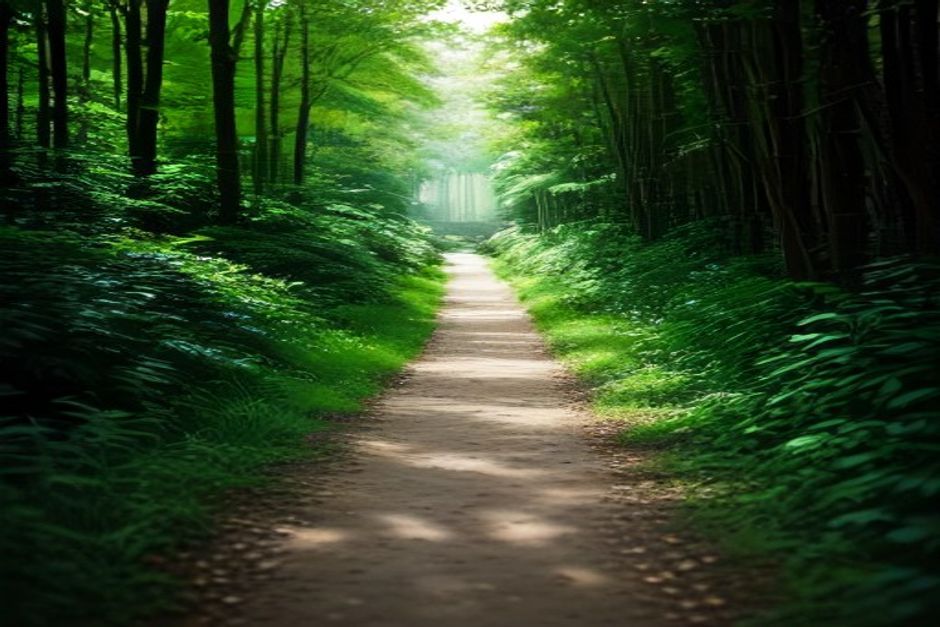
Some people take to seated meditation immediately. Others sit down, last ninety seconds, and conclude that stillness is a form of punishment invented by flexible people. For the second group — and for everyone on restlessly energetic days — walking meditation is not a compromise or a gateway drug to the \"real\" practice. It is a complete technique with centuries of tradition behind it, and it solves a specific problem: it gives the body's restlessness a job while the mind trains on sensation.
There is also a transfer argument. Almost nobody's actual life happens cross-legged. Attention trained while moving — through a hallway, a park, a parking lot — is attention trained in the conditions where you will actually need it. The meditation page lists walking practice alongside the seated techniques for exactly this reason: it is the most portable form there is.
The formal walk: absurdly slow, on purpose
Lifting — moving — placing
How: Find ten to twenty paces of clear floor — a hallway, a living room with the coffee table shifted, a garden path. Stand still for a few breaths and feel your weight through both feet. Then walk at perhaps a tenth of normal speed, breaking each step into three parts: the heel lifts, the foot moves through the air, the foot places down, rolling heel to toe. Mentally note each phase — \"lifting, moving, placing\" — and keep your eyes softly on the ground a couple of meters ahead, not staring at your feet. At the end of the path, pause, turn slowly with the same attention, and walk back. Ten minutes of this covers about fifteen meters and feels much longer.
Why: Slowing down exposes what speed conceals. At normal pace, \"walking\" is one blur; at this pace, it reveals itself as dozens of distinct sensations — pressure shifting, balance wobbling, muscles micro-correcting — which gives attention a rich, continuous feed. The wobble is a feature: you will catch yourself nearly tipping and notice, in real time, how much unconscious choreography a single step contains.
Hands and posture
How: Traditionally the hands clasp gently in front of the body or behind the back — one hand holding the other — which solves the universal beginner problem of not knowing what to do with your arms. Spine upright but not military, shoulders soft, gaze down and ahead.
Why: A consistent, slightly formal posture marks the practice as practice. Your nervous system learns: hands like this means we are paying attention now.
The natural-pace walk: practice in disguise
The formal walk is training. The natural-pace walk is deployment. Walk at an ordinary speed — to the shop, around the block, through a park — and place your attention on the physical experience of walking: the pressure of each footfall, the swing of the arms, air on the face, the rhythm of breath syncing with steps. When you notice you have been mentally elsewhere for three blocks, you do exactly what you would do on the cushion: no criticism, just return to the feet. The drill is identical to body scan logic — an anchor, a wandering, a return — but the anchor now travels with you.
A useful structure for outdoor walks: dedicate the first third to the feet (sensation), the middle third to sound (everything audible, near and far, without naming or judging it), and the final third to the whole experience — body moving through a sounding, shifting world. This keeps the attention from collapsing into one narrow channel and mirrors the progression used in wider awareness practices.
Where the attention actually goes
Beginners often ask what they are supposed to think about while walking meditatively. The honest answer is: nothing, and that is why it is hard. You are not composing thoughts about walking; you are feeling walking. The difference is the difference between reading a menu and tasting lunch. When thoughts arrive — and they will, in a continuous stream — the practice is to let them pass in the background while sensation stays in the foreground, the way traffic noise continues behind a conversation. Some people find a silent label helps at first: \"stepping, stepping,\" or \"left, right,\" said softly enough that the words follow the feet rather than replace them.
One pleasant surprise: walking meditation handles drowsiness better than any seated technique. If you are too tired to sit without nodding off, walk. The mild physical activity keeps the system alert while the attention still gets its repetitions — many retreat centers schedule walking practice right after meals for exactly this reason.
Walking in public without looking strange
The formal slow walk is best kept private or saved for a quiet park — not because it is shameful, but because moving at a tenth of normal speed through a crowded station is a hazard to everyone. The natural-pace version, however, is completely invisible. Nobody can tell that the person walking past them is practicing anything. Eyes open, normal speed, attention on the feet: from the outside you are simply someone walking, slightly less haunted by their phone than average. Commutes, dog walks, the corridor between your desk and the kettle — all of it is usable territory. This is the technique's real superpower: it converts time you already spend walking into practice time, doubling your daily training without adding a single scheduled minute.
Ten paces of floor or ten minutes of sidewalk — the technique fits both. Start with one slow formal session this week to feel what the attention is actually latching onto, then let the natural-pace version colonize your errands. If restlessness was the thing keeping you from meditation altogether, walking removes the excuse rather elegantly. Pair it with a few minutes of three-part breathing before you set off, or browse the beginner's guide to see how moving practice sits alongside poses and breathwork.