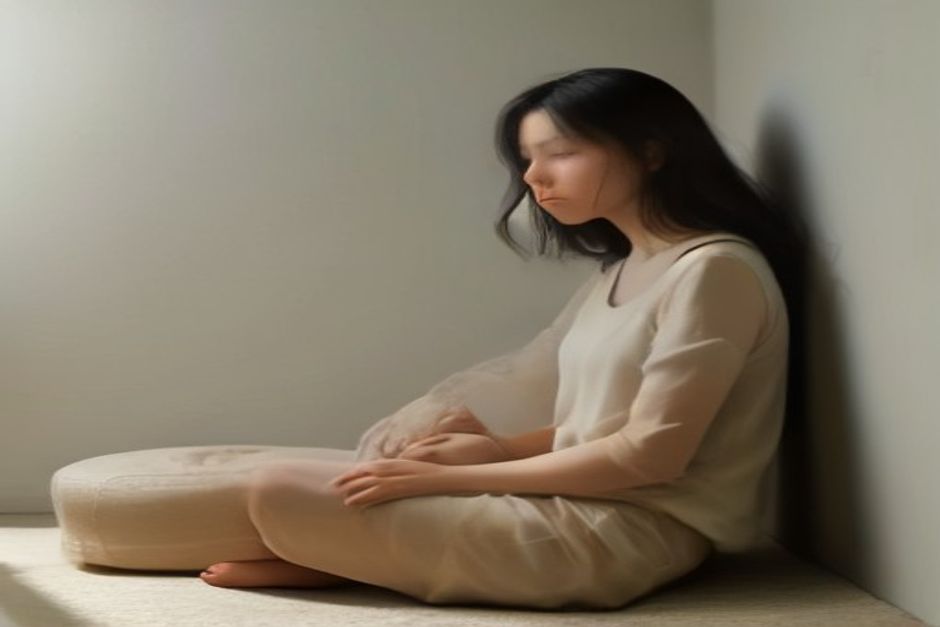
Most meditation instructions are full of techniques: focus here, visualize that, repeat this word. Zen takes the opposite road. Zazen literally means "seated meditation," and the Zen tradition's proudest claim is that there is nothing in it to achieve. The Japanese master Dogen called the practice shikantaza — "just sitting" — and meant it with unsettling literalness. You sit upright, you stay awake, you let whatever happens happen. The simplicity is the point, and also the difficulty: with nothing to do, there is nothing to hide behind.
You do not need to be a Buddhist, visit a Zen center, or believe anything in particular to try it. Zazen is a posture plus an attitude, and both fit in an ordinary chair.
Setting up the seat
Zen is fussy about posture for one un-mystical reason: the practice is long and the mind follows the spine. A collapsed, slumped sit produces a collapsed, foggy sit. The classic positions — full lotus, half lotus, Burmese with both feet flat on the floor — all share the same architecture: knees grounded below the hips, pelvis tipped slightly forward, spine stacking itself upward like a tower of coins.
If those positions are unavailable, you are in the majority. A seiza bench over folded legs works; so does kneeling over a cushion; so does a straight-backed chair, feet flat on the floor, sitting forward enough that your back does not touch the chair back. For a fuller tour of options, see meditation posture. The non-negotiables are the same everywhere: stable base, upright spine, hands settled — traditionally in the "cosmic mudra," left hand holding right at the navel, thumbs lightly touching, though hands simply resting on the thighs is fine.
Chin tucks slightly, ears line up over shoulders, the crown of the head presses gently toward the ceiling. It should feel like being well-hung laundry: nothing strained, nothing collapsed.
Eyes open, gaze down
Here Zen breaks with most popular meditation. The eyes stay open — lowered, soft-focused, resting on the floor three or four feet ahead. Traditional zazen is done facing a blank wall, which tells you something about the tradition's sense of humor and its point: you are not going anywhere, and there is nothing to look at.
The practical reason is drowsiness. Closed eyes in a quiet room invite either sleep or vivid daydreaming; the open, lowered gaze keeps you awake without giving the mind anything to chew on. If open eyes feel strange at first, that strangeness fades within a few sittings.
Counting the breath
"Just sitting" does not mean "just thinking." Beginners are given an anchor, and Zen's is the plainest one available: count your exhalations. Silently count "one" on the first exhale, "two" on the next, up to ten, then return to one. That is the entire technique.
When you lose the count — and you will, usually somewhere around three — you simply notice that the mind wandered and start again at one. No criticism, no drama. Losing the count and coming back is not a failure of the practice; it is the practice, repeated as many times as needed. More detail on this anchor lives in breath counting meditation.
After some weeks or months, many practitioners drop the counting and rest in open awareness of the sitting itself — breath, posture, sounds, thoughts passing through. That is shikantaza proper. There is no rush to get there; the counting version is a complete practice, not a training wheel you should be embarrassed about.
What to do with thoughts
Zen's instruction here is famous and famously misunderstood: thoughts are not the enemy. You do not suppress them, fight them, or follow them. The usual image is clouds crossing an open sky — the sky does not chase clouds away, and it does not grab them either. A thought arises, you notice you are thinking, and you return to the count or the posture. The thought dissolves on its own, the way a held breath releases when you stop holding it.
Dogen's phrase for this is "think not-thinking" — which sounds like a riddle until you have sat for a while and noticed the difference between deliberately thinking about something and simply being awake while thoughts pass through. The second one is the practice. It is also genuinely pleasant, once you stop expecting fireworks.
What a beginner can expect
Honesty first: the early sittings are often boring, and the knees or back may complain. Start with ten minutes — a kitchen timer is more traditional than an app with gongs. Expect restlessness in the first five minutes, a strange settling around minute seven, and the urge to check the timer throughout. All normal.
What you should not expect is a special state. Zen is emphatic that chasing bliss, visions, or "deep experiences" is just more grasping with a spiritual label. The reported benefits are quieter: a little more space between a provocation and your reaction, a little less conviction that every thought deserves an audience, a slightly better relationship with boredom — which turns out to be a superpower in a waiting room. For a broader map of styles, the meditation overview shows where zazen sits among its cousins.
You do not sit to become someone else. You sit to find out who is already there when you stop improving them.
The instructions fit on an index card: sit upright, eyes soft, count the breath to ten, begin again. Everything else — and there is a lot of else in eight centuries of Zen commentary — is just that card, explained at length.