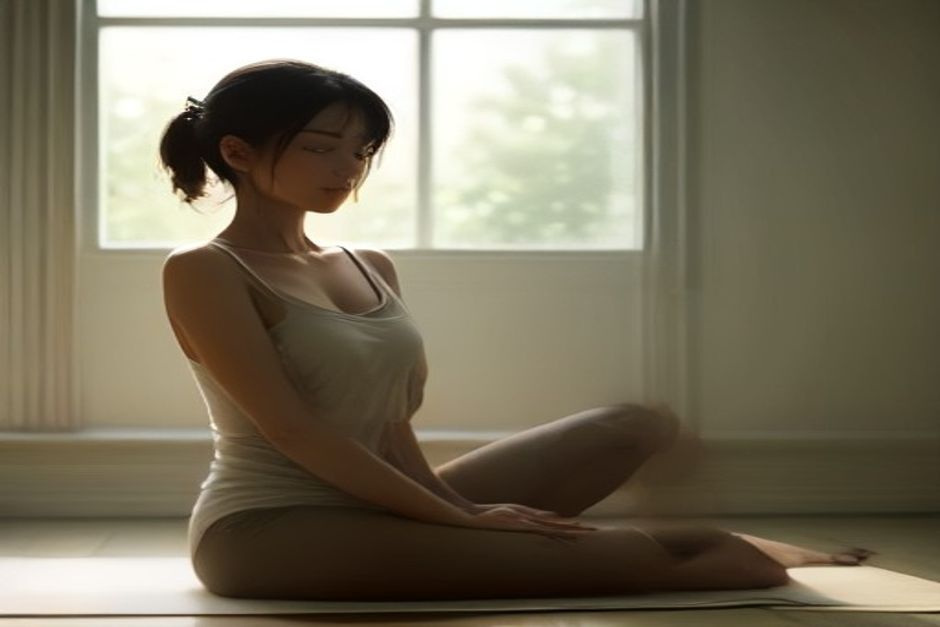
In your first few yoga classes, you will hear a sound around you like a room full of small, polite Darth Vaders. That is ujjayi — often translated as 'victorious breath', though what it conquers is mostly your own tendency to rush. It is the standard breathing of flowing yoga practice, and the good news is that it is much simpler than it sounds. You are already doing ninety percent of it. The last ten percent is a small narrowing in the throat, and this page is about finding that narrowing without straining anything.
How to make the sound
The classic instruction: open your mouth and breathe out as if you were fogging a mirror. Feel that slight constriction at the back of the throat — not in the nose, not in the chest. Now close your mouth and keep that same narrowing while breathing through the nose, on both the inhale and the exhale. That is ujjayi. The result is a soft, audible hiss, like waves heard from a distance, or air moving through a straw.
A few details that matter for beginners:
- The sound comes from the throat, not the nose. If you sound congested, the narrowing has migrated forward. Soften and let it sit lower, at the level of the collarbone.
- Inhale and exhale both make the sound. Most beginners only narrow on the exhale. The inhale matters equally — it is what keeps the breath long.
- It should be audible to you, not to your neighbor. If the person two mats over can hear you, you are performing, not breathing. Turn the volume down until it is a private metronome.
- The jaw, lips, and face stay soft. Ujjayi is a tiny valve, not a workout. If your face is involved, your throat is working too hard.
What it is actually for
Ujjayi does three practical jobs, and none of them are mystical. First, it paces the practice. In a flowing class, movements are timed to breaths, and an audible breath is much harder to shorten or skip than a silent one. When your ujjayi gets short and ragged, that is the practice telling you — in real time — that you are working too hard. It is an honest gauge; treat it as information.
Second, it anchors attention. A sound you produce yourself, that lasts exactly as long as each breath, is a near-perfect object of focus. The mind still wanders, but it wanders less when it has a soundtrack it is responsible for making.
Third, it slightly slows the breath down. The throat narrowing adds resistance, and resistance lengthens each breath cycle — which is most of what calms the nervous system during effort. Our fuller technical breakdown lives at the ujjayi pranayama page; this page is just about getting started without hurting yourself.
The three beginner mistakes
Forcing it. The most common error, by far. Beginners hear the room's ocean sound and try to match its volume, clamping the throat until the breath rasps. A strained ujjayi defeats its own purpose — it raises effort instead of lowering it. If your throat feels scratchy or tired after class, your ujjayi was too loud. Next time, aim for half the volume.
Holding it everywhere. Ujjayi belongs to active practice: sun salutations, standing poses, held effort. It does not belong to restorative poses, final relaxation, or gentle stretching, where the breath should be allowed to go quiet and natural. Using one breathing technique for everything is like wearing hiking boots to bed — correct tool, wrong context.
Never dropping it. Related, but subtler: some practitioners keep ujjayi going through poses where they are clearly struggling, as if the sound itself were the achievement. It is not. The moment ujjayi costs you more calm than it buys, drop it and breathe normally. Nobody is grading you.
When to use it, when to drop it
A simple rule of thumb for your first months: ujjayi on when the body is working, ujjayi off when the body is resting. Sun salutations and standing sequences — on. Floor stretches and savasana — off. If you are practicing a slower, quieter style, you may not need it at all; alternate nostril breathing or simple natural breathing often fits those sessions better. And if you want to compare ujjayi with the other foundational technique, our ujjayi vs dirga comparison sorts out which breath suits which practice. The broader map of techniques is on the pranayama overview.
Safety note: Ujjayi is gentle, but stop and breathe normally if you feel dizzy, light-headed, or if your throat becomes sore or dry — both are signs of forcing. If you have a respiratory condition such as asthma, or any throat or vocal cord issue, check with a medical professional before making breath restriction a daily habit. No breathing technique is worth a strained throat.
Learned kindly, ujjayi becomes something you stop noticing — a background rhythm that holds a practice together the way a drummer holds a band. Learn it softly, keep it quiet, and let it tell you the truth about how hard you are working.