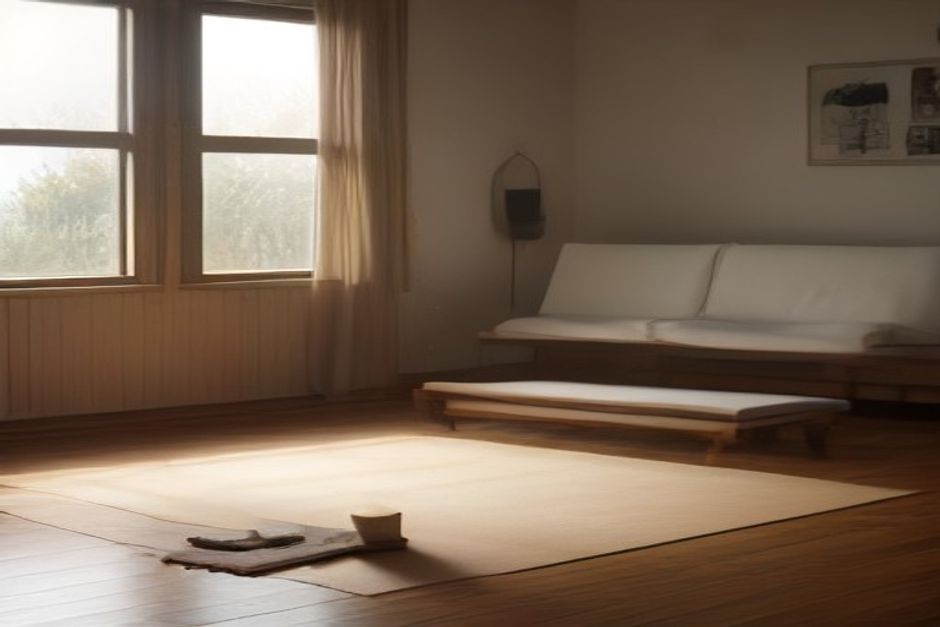
Both practices happen on the floor, in near silence, at the speed of a houseplant. Studios schedule them in the same time slots and apps file them under the same calming thumbnail, so plenty of people book one expecting the other — and spend the class either bracing through a stretch they did not want or waiting for a stretch that never comes. The short version: yin wants you to feel something; restorative wants you to feel nothing. Everything else follows from that. For the full background on each, see the glossary entries on yin yoga and restorative yoga. This page is the practical chooser.
What each one is actually doing
Yin yoga applies gentle, sustained load to connective tissue. You settle into a pose — a long forward fold, a low lunge, a straddle — find the edge where you feel a dull, spread-out stretch, and hold it for three to five minutes while keeping muscles as quiet as possible. The target is fascia and joint capsules, tissues that remodel slowly and respond to time rather than effort. The sensation should be a 4 or 5 out of 10: present, tolerable, breathe-around-able.
Restorative yoga removes load from everything. Bolsters, blankets, and blocks are arranged so that your body is completely held — no muscle working, no stretch sought. Poses are held for ten to twenty minutes. The target is not tissue but state: giving the nervous system enough safety and stillness to shift out of high alert. If yin is a negotiation with sensation, restorative is a surrender of sensation. In a good restorative setup, falling asleep is a plausible and acceptable outcome.
Pick yin when
- You feel stiff and want more range of motion. Tight hips after a week of sitting, hamstrings that object to forward folds — this is yin's home turf. Slow, patient, cumulative.
- Your mind needs a task. If pure stillness makes you anxious, yin gives attention something to hold: the sensation, the breath inside it, the small adjustments. It is meditation with a focal point built in.
- You trained hard and want to downshift without stopping. Yin sits nicely after runs, lifts, or a strong morning practice — effort-adjacent, but honest recovery.
- You are restless, not depleted. There is energy in the system and it needs somewhere to go. Three long holds will spend it better than an hour of fidgeting in a bolster nest.
Pick restorative when
- You are wired and tired. Exhausted but unable to switch off is the classic restorative indication. Sensation would be one more input; support removes inputs.
- You are recovering from illness, injury, or a brutal week. When the tank is empty, the practice should make deposits only. Restorative poses are all deposit.
- Sleep is the problem. Twenty minutes of a supported pose before bed — legs up the wall is the classic — is one of the most reliable wind-downs available without a prescription.
- Even easy stretching hurts right now. If everything is tender, that is information. Restorative meets you there without asking anything of the tissue.
The honest middle
You do not have to pick a team. Many practitioners use yin during ordinary weeks — two or three long holds in the evening — and switch to restorative during the weeks when life is on fire. They also stack well: twenty minutes of yin followed by ten minutes of a fully supported pose is a fine way to end a Sunday. The mistake is not mixing them; it is walking into the wrong one. A person who needs rest and gets yin leaves irritated. A person who needs sensation and gets restorative leaves bored. Same floor, same dim lighting, opposite medicine.
A quick session of each
Ten minutes of yin — sensation, held
How: Sit, fold forward over a cushion on your thighs, and stay for four minutes. Come out slowly, pause, then take a low lunge on each side for two minutes apiece. Breathe through the nose and let the pose deepen only on its own.
Why: Two poses, eight minutes of sustained moderate stretch — enough to feel the yin effect without a class or a timer app.
Ten minutes of restorative — support, total
How: Lie back with a bolster or firm pillows under your knees and a folded blanket under your head. Cover your eyes. Set a timer so you are not tempted to check the time, and do nothing — on purpose, badly at first.
Why: Full support lets the body stop bracing. The first five minutes are usually noisy in the head; the practice is staying anyway. Pair it with a simple breath meditation if the noise needs an anchor.