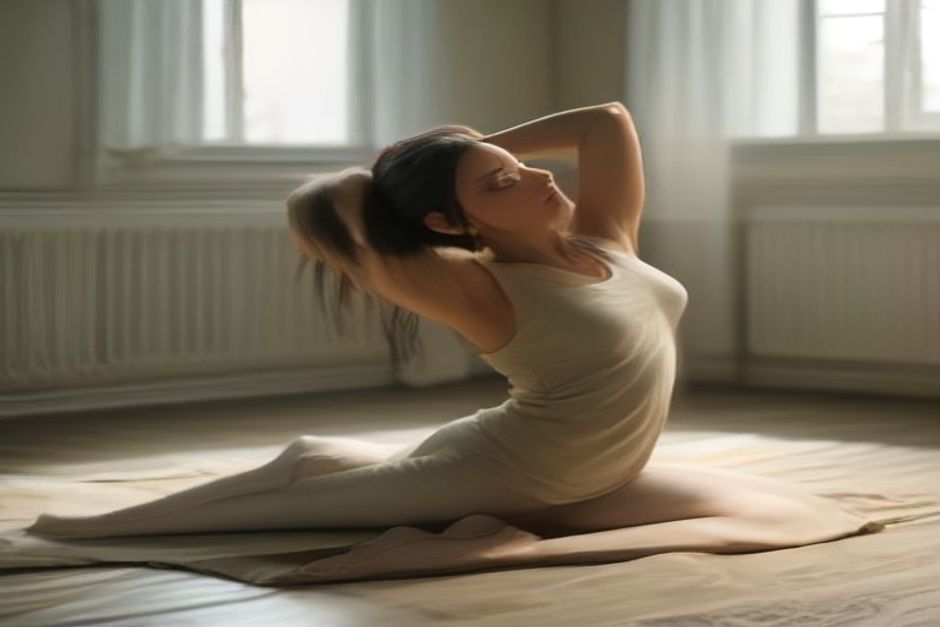
Low Lunge — Anjaneyasana, named after Anjaneya, a name for the monkey god Hanuman — is the pose desk workers need most and do least. It opens the hip flexors: the muscles at the front of the hip that shorten every hour you spend in a chair and then quietly tilt your pelvis, arch your lower back, and make standing up straight feel like effort.
The good news: it requires no flexibility to start, no balance to speak of, and works at whatever depth your body currently offers. If you are completely new, the yoga basics page covers the ground rules; this pose itself is about as beginner-friendly as they come.
Step by step
Low Lunge — Anjaneyasana
How: From hands and knees, step your right foot forward between the hands. Slide the left knee back until you feel a stretch at the front of the left hip — not pain in the knee, stretch in the hip. Stack the front knee over the ankle. Now the key move: tuck the tailbone slightly and draw the lower belly in, so the pelvis is neutral rather than tipped forward. Only then, if you like, sweep the arms overhead. Keep the ribs from flaring. Stay 6–10 slow breaths, then switch sides.
Why: The back leg's hip flexors — psoas, iliacus, rectus femoris — get a sustained stretch. The front leg works isometrically to hold position. The arms overhead add a mild backbend and shoulder opener. It is a small pose with an outsized effect on how your lower back feels afterward.
The pelvis is the whole pose
Most people do Low Lunge wrong in the same way: they sink forward into a big arch, pelvis tipped, lower back compressed, and feel a "stretch" that is mostly their lumbar spine complaining. The stretch should live at the front of the back hip, not in the low back.
The fix is one sentence: tuck the tailbone first, then go deeper. Think of the pelvis as a bowl of water you do not want to spill forward. The moment you level the bowl, the hip flexor stretch turns on — usually at a much shallower depth than you were "achieving" before. Less depth, more truth.
Pad the back knee
Kneecaps were not designed as load-bearing furniture. Fold your mat, use a blanket, or grab a cushion under the back knee — every time, not just when it hurts. If pressure on the kneecap bothers you even padded, you can tuck the back toes and hover the knee slightly, though this changes the pose's character toward a strength exercise.
Useful variations
- Hands on blocks. If the floor is far away, blocks under the hands raise it. This is the standard setup, not a beginner's crutch.
- Hands on the front knee. Upright torso, hands resting on the front thigh — the gentlest version, ideal as an office break.
- Side bend. Arms up, then lean away from the back leg. Adds the side body to the hip flexor party.
- Quad stretch add-on. Bend the back knee and reach for the foot. Only after the basic lunge is genuinely comfortable, and never if it tugs the knee.
How it fits a practice
Low Lunge is the natural doorway between floor work and standing poses. It leads well into High Lunge when you lift the back knee, and it is the ideal counter-stretch after Pigeon Pose — one opens the outer hip, the other the front. A simple evening routine: two minutes of Low Lunge per side, then Legs Up the Wall. Your lower back will notice.
Who should be careful: Knee injuries: pad generously or use the standing version at a chair. Hip replacements or acute hip conditions: get clearance from your physio before deep hip extension. If you feel pinching in the front hip rather than stretch, back off the depth and re-level the pelvis. Sharp pain is a stop sign; a strong stretch sensation is normal.
You cannot stretch away a full day of sitting in two minutes. But you can remind your hips that extension exists, and done daily, Low Lunge keeps the negotiation with your lower back a friendly one.