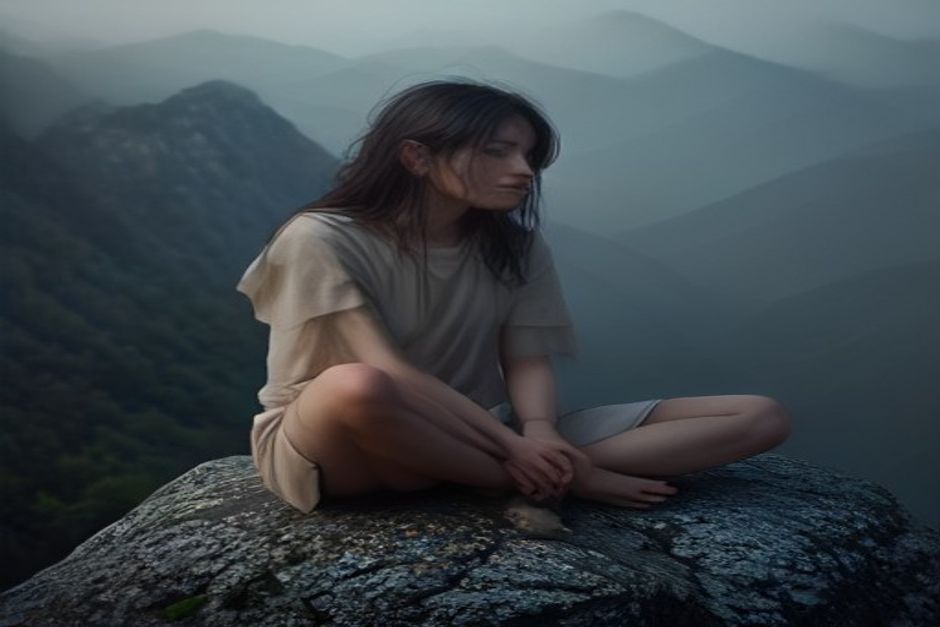
Some days, the breath is not enough. You sit down, you count, you return — and the mind treats the whole arrangement as a waiting room, checking its phone until real life resumes. The mountain meditation exists for exactly these days. Popularized by Jon Kabat-Zinn in his stress-reduction program, it replaces the subtle object of breath with an unsubtle one: a mountain. You visualize it, you borrow its qualities, and for ten minutes you let steadiness be an image rather than a demand. It is one of the friendlier doors into meditation, and one of the few practices that gets easier the more dramatic your inner weather is.
Where it comes from
Kabat-Zinn introduced the mountain meditation in the Mindfulness-Based Stress Reduction curriculum in the late 1970s, drawing on imagery older than any program — mountains have been the default metaphor for unshakable presence in meditation traditions from the Himalayas to the Zen halls of Japan. The secular version keeps the structure and drops the cosmology: a mountain sits. Weather crosses it. Seasons change it. None of this requires the mountain's participation. The suggestion — never stated as a claim — is that awareness has the same option. If visualization practices are new to you, our visualization basics page covers why images sometimes work when instructions don't.
The practice, step by step
Setting the seat
How: Sit in whatever upright posture you can hold for ten minutes — chair, cushion, bench. Spine tall but not military. Eyes closed or resting on the floor a few feet ahead.
Why: Upright matters more than elegant here; the posture itself is part of the imagery. A slump visualizes poorly. Our posture page covers the options without dogma.
Building the mountain
How: Bring to mind a mountain you know, or invent one. Give it detail: the broad base, the slopes, the tree line, the bare rock, the peak. Let it become vivid enough that you could describe it to someone. Then — the key move — bring the mountain into the body: your sitting bones as the base, your spine as the slopes, your head as the peak. Sit as the mountain sits.
Why: Detail is load-bearing. A vague blob of a mountain collapses at the first strong thought; a mountain with scree fields and a snow line holds attention the way a good story does.
Letting weather pass
How: Now let the weather come. Thoughts, moods, the argument from this morning, the email you owe — each becomes weather crossing the mountain: rain, fog, a violent thunderstorm, a long overcast week. The mountain experiences all of it and is rearranged by none of it. When you notice you've been swept into the weather — thinking instead of sitting — come back to the base, the slopes, the peak. That's the repetition: weather, return, weather, return.
Why: This is the same noticing-and-returning trained in breath counting, but with the emotional volume turned down by the metaphor. It's easier to let a thunderstorm pass over a mountain than to let a shame spiral pass through "just observe it."
Through the seasons
How: If you sit longer, let the timescale widen: night falls on the mountain, winter buries it, spring melts it, tourists photograph it, and through all of it the mountain remains — changed in surface, unchanged in nature. Stay with whatever version of steady your body can actually feel, not the one the poem promises.
Why: Stretching the timescale quietly reframes the day's urgencies. Most of what feels like emergency weather turns out to be afternoon rain.
A ten-minute version
Two minutes: settle the posture and feel the weight of the body. Three minutes: build the mountain in detail, then merge it with your sitting shape. Four minutes: weather — name what's present (planning, worry, replay) and let it move across the slopes. One minute: widen to the whole mountain at dusk, then let the image go and feel the plain fact of sitting. Open the eyes slowly. The mountain, if it worked, comes with you — a slight sense that the floor is reliable and you are heavier, in a good way, than when you sat down.
When it works, when it doesn't
This practice earns its place on restless, ruminative days — the days when the mind is too loud for subtle objects. It is also famously good before difficult conversations and on sleepless nights in the middle-of-the-night shift. It works less well when you're physically agitated — jittery caffeine energy wants walking meditation, not stillness — and for some people imagery simply doesn't generate. If the mountain won't appear, don't fight it; the same steadiness can be borrowed from mountain pose itself, standing, eyes open, feet doing what the base of a mountain does.
What it's training
Underneath the poetry, one transferable skill: the discovery that you can have strong inner weather without being the weather. That's the entire claim. The mountain doesn't suppress the storm or fix it; it just demonstrates, session after session, that something in the situation sits still while the storm does its thing. Whether you call that awareness, perspective, or a useful trick of the imagination matters less than the repetition — ten minutes of practice at being the part that doesn't have to react.
The mountain has weather. The mountain is not the weather. You have days. Sit long enough and you stop being only the day.