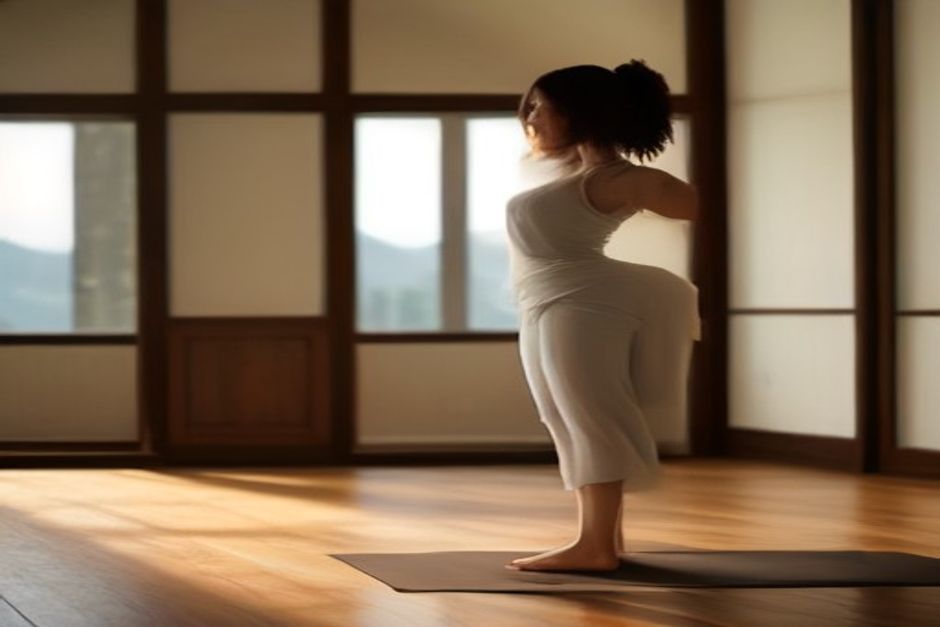
Ask a beginner to name a yoga pose and nobody says Mountain. Tadasana — tada, mountain; asana, seat or pose — is just standing there. And yet teachers keep returning to it for a reason: everything that goes wrong in Warrior, everything that collapses in Tree, every habit of locked knees and jutting ribs shows up here first, in plain sight, with nothing else to hide behind.
Mountain Pose is the diagnostic pose and the reset button. Between sides, between flows, between one demanding thing and the next, you come back to standing and check: where is my weight? What is my jaw doing? Am I actually breathing? That check is the practice.
How to stand in Tadasana
Feet first — the foundation
How: Stand with feet hip-width apart — that means hip sockets, not the outer edges of your hips, which is usually narrower than people think. Spread your toes, then settle them down. Find three points of contact on each foot: the base of the big toe, the base of the little toe, and the center of the heel. Rock forward and back a few times, then side to side, then find the middle where the weight is even.
Why: Most of us stand habitually on our heels or pitched into the forefoot. Even weight across those three points wakes up the arches and gives the whole chain above — ankles, knees, hips — a stable signal to organize around.
Knees and thighs — awake, not locked
How: Draw the kneecaps gently upward by engaging the fronts of the thighs. If your knees hyperextend (push backward past straight), keep a micro-bend — think "long legs" rather than "locked legs." Let the inner thighs spiral faintly back, as if you were holding a block between them and it wanted to slide backward.
Why: Locked knees push the pelvis out of neutral and dump strain into the low back. An engaged-but-not-rigid leg is what "strong and soft at once" actually means in practice.
Pelvis and ribs — the honest middle
How: Let the tailbone drop toward the floor without tucking it under aggressively. Then notice your ribs: most people flare them forward in an attempt to "stand up straight." Soften the front ribs down, knit the lower belly slightly in, and let the waist lengthen on all four sides.
Why: The military posture of chest out, gut in, is not a neutral spine — it is an arch with extra steps. A neutral pelvis with quiet ribs is where the low back stops working overtime.
Shoulders and skull — the top of the chain
How: Roll the shoulders up, back, and down once, then leave them alone. Let the arms hang with palms facing forward or toward the thighs — either is fine; forward palms simply open the chest a touch more. Finally, imagine the crown of the head floating up, chin level, as if the skull were a balloon resting on the spine rather than a bowling ball hanging off the front of it.
Why: A forward head adds roughly ten pounds of effective load for every inch it drifts ahead of the shoulders. Stacking the skull over the pelvis is free energy.
The posture chain: why teachers call it a blueprint
Every cue in Tadasana reappears elsewhere. The three-point foot is the front foot of Warrior I. The soft-but-awake knee is the standing leg of Half Moon. The dropped tailbone and quiet ribs are what keep Chair Pose from becoming a low-back pose. When a teacher says "come back to your Mountain," they mean: rebuild the stack from the floor up and see what changed.
A useful drill: stand in Tadasana for one full minute before a practice and one minute after. The second minute will not feel like the first. That difference — in the feet, in the breath, in the noise level of the mind — is the most honest progress report yoga offers.
Mountain as standing meditation
Because there is no stretch to chase and no balance to survive, Tadasana is an ideal container for attention practice. Stand, build the pose, and then simply track the breath for ten to twenty cycles. Notice the small sways — the body is never truly still, and watching it negotiate balance millimeter by millimeter is oddly absorbing. If seated meditation makes your back ache or your mind revolt, a five-minute standing Mountain is a legitimate alternative, not a consolation prize.
"Stand still. The trees ahead and bushes beside you are not lost." — David Wagoner
Common mistakes worth catching
- Gripping the toes. The toes should spread and lengthen, not claw the mat. If they cramp, lift them, spread them, place them back down.
- Locking the knees. If you can bounce your kneecaps freely, they are not locked. If they feel welded, soften a fraction.
- The rigid "good posture" pose. Squeezing everything at 100 percent is just tension in a vertical shape. Aim for 70 percent engagement, 30 percent ease.
- Holding the breath. Standing still often makes people quietly stop breathing. Keep the breath moving; steady breathing is half the pose.
Do not rush past this one. The mountain does not hurry, and neither should you — stand long enough to actually arrive. Browse the rest of the pose library when you are ready to put the blueprint to work.