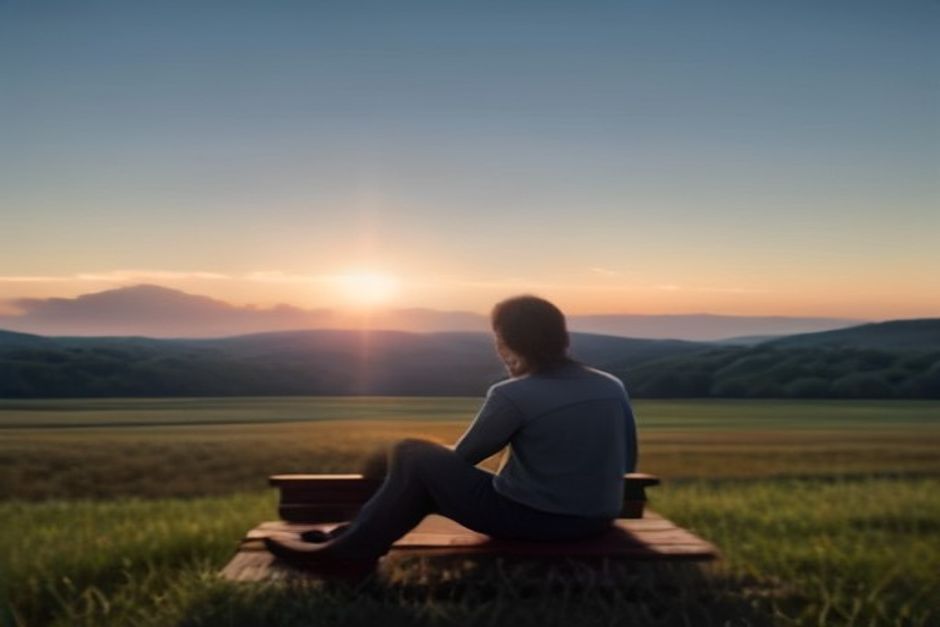
Most meditation instructions begin the same way: sit down, close your eyes, turn inward. Sky gazing runs in exactly the opposite direction. You go outside, look up, and rest your attention on the largest, most ungraspable thing available — the open sky. The practice comes from the Tibetan Dzogchen tradition, where it's considered a direct way to taste what the texts call the nature of mind: awareness that is vast, open, and not manufactured. You don't have to sign up for the metaphysics. The practice works on a simpler level, the way standing at the ocean works on people who know nothing about tides. Something in the nervous system recognizes scale, and lets go of a little of what it was gripping.
Where it comes from
In Dzogchen, sky gazing is not a relaxation technique but a pointing-out instruction: the sky is used as a mirror for awareness itself — boundless, unbroken, indifferent to the weather passing through it. Clouds come and go; the sky doesn't object. Thoughts come and go; awareness, the teaching says, doesn't object either. Whether or not that framing lands for you, it explains the method's unusual features: eyes open, posture relaxed, no object to concentrate on, nothing to exclude. The Tibetan masters apparently noticed something every picnicker knows — lying on your back watching the sky is one of the few situations where the mind stops narrating without being asked to.
How to practice
The instructions are short because there isn't much to do, which is, of course, the hard part.
Finding the spot
How: Anywhere with a wide view of sky works: a park, a backyard, a balcony, an open window in a pinch. Sit comfortably — on a bench, a blanket, the ground — or lie flat on your back. Dusk and dawn are generous times: the light is soft, the sky is doing things, and the world is quieter.
Why: Comfort matters more than correctness here. This is not meditation posture practice; a slouch you can hold for ten minutes beats a perfect seat you'll abandon in four.
Resting the gaze
How: Let your eyes rest on the open sky — not on any particular cloud, bird, or shape, but on the space itself, the way you'd look at a distant horizon. Keep the gaze soft and wide, taking in the whole field rather than focusing on a point. Glasses stay on; squinting is optional; never look anywhere near the sun.
Why: A soft, panoramic gaze does something measurable: it settles the visual system's narrow, task-oriented mode — the one you use on screens all day — into peripheral, restful seeing. It's the same open attention trained indoors as open monitoring, just with better scenery.
Working with thoughts
How: When a thought arrives — and it will — treat it like weather: noticed, not followed. The classic instruction is to let thoughts pass through awareness the way clouds pass through the sky, without chasing them and without pushing them away. When you notice you've been thinking for a while, simply return to the sky. That's the whole technique: gaze, wander, return.
Why: The vast visual field gives wandering attention somewhere honest to land. Indoors, returning to the breath can feel like returning to a small room. Here, the object of attention is so large that resting on it feels less like discipline and more like putting something down.
Ten minutes, to start
A first session: five to ten minutes, once a day or whenever you remember. Sit or lie down, take three unhurried breaths to mark the transition, then let the gaze open to the sky. No counting, no technique to maintain — just the periodic discovery that you've been elsewhere, and the unceremonious return. End without a bell: notice the body, notice the ground, stand up slowly. If ten unstructured minutes sounds alarming, pair it with something more shaped at first — a few rounds of breath awareness from our meditation page, then open the eyes and hand the rest to the sky.
Cloudy days, small skies, real life
A few practical notes for practicing outside a Tibetan mountainside. Overcast sky works fine — gray expanse is still expanse, and watching weather move is half the practice. A slice of sky between buildings works too; width matters more than perfection. Night sky is a legitimate and somewhat overwhelming variation. And if getting outside is genuinely impossible, sitting by a window with a view of sky is a real session, not a compromise to feel guilty about. The same flexible spirit runs through walking meditation and trataka — the other practices on this site that keep the eyes open and let the world in rather than shutting it out.
What it's actually training
Underneath the poetry, sky gazing trains one specific and transferable skill: attention without an object to grip. Most of the day, attention operates in target mode — the email, the exit sign, the face, the phone. Sky gazing rehearses the opposite: awareness resting, wide and unselective, on a field too large to manage. People who practice it regularly report a subtle shift that's hard to argue with: the small irritations of the day start looking more like weather — present, passing, not worth building a shelter around. That may be the nature of mind revealing itself, or it may just be what happens when a person spends ten minutes a day remembering how big the sky is. Either way, the minutes are not wasted.
The sky has been demonstrating non-attachment for several billion years. It is a patient teacher, and it never cancels class.