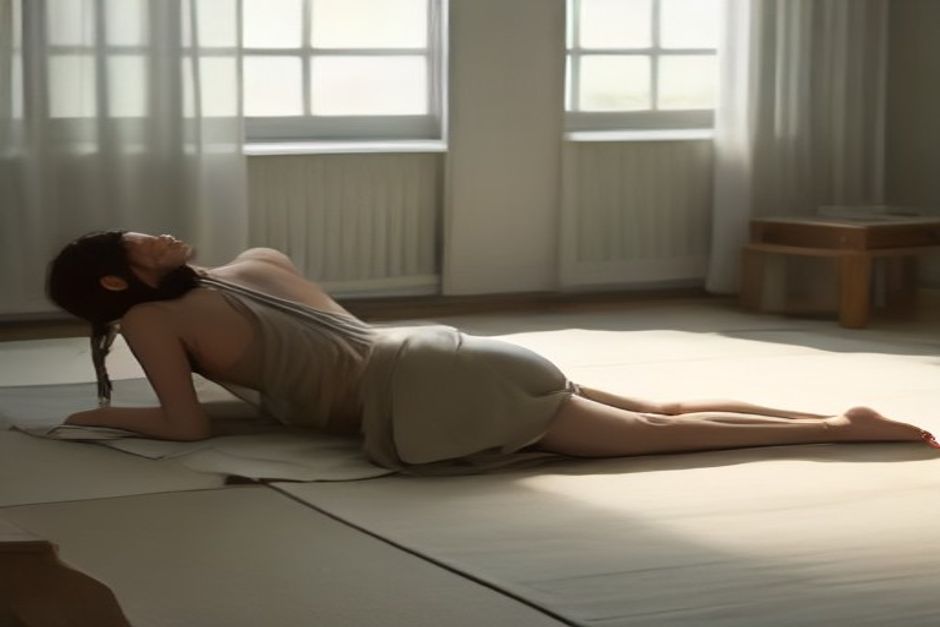
Yoga nidra — "yogic sleep" — is the most honest deal in the entire catalog of practices: you lie down, you listen to a guided sequence for twenty to forty minutes, and that is the whole job. No poses, no breath control, no concentration feats. If you can lie on the floor and follow a voice, you have all the qualifications. It was systematized in the 1960s by Swami Satyananda Saraswati, who adapted much older tantric visualization practices (nyasa) into a structured, secular-friendly protocol — which makes it both genuinely traditional and thoroughly modern at once.
What it produces is a specific state: deeply relaxed, yet (ideally) still aware — hovering in the borderland between waking and sleep rather than falling fully into either. Practitioners sometimes call it the best rest they get all week. Here is what it actually involves, minus the hype.
The setup
Comfort is not a luxury here; it is the technique. Use the full Savasana setup: mat or carpet, a bolster or folded blanket under the knees if your low back complains, a thin cushion under the head, socks on, a blanket over the body — your temperature will drop, and being cold at minute ten is the most common way sessions fail. An eye pillow or a folded shirt over the eyes helps. Then set an intention to stay listening: the traditional instruction is "remain awake and aware," which mostly means do not fight sleep, but do keep one ear on the voice.
The 20-minute structure
1. Settling and sankalpa — 2-3 minutes
How: Feel the points where your body meets the floor. Let the weight go. Then state a sankalpa — a short, present-tense resolve, like "I am at ease" or "I meet the day steadily" — silently, three times, with quiet conviction.
Why: The sankalpa is yoga nidra's distinctive feature: a seed planted in a relaxed mind. Keep it the same for weeks or months; it is a direction, not a wish list.
2. Body scan — 5-7 minutes
How: Move awareness through the body in sequence — right thumb, second finger, third finger ... palm, wrist, elbow — the classic nidra scan is detailed and brisk, hopping from point to point faster than a slow body scan. Right side, left side, back of the body, front.
Why: Rapid rotation keeps the mind too busy to ruminate while systematically discharging tension. You are not relaxing muscles on command; you are visiting them, and the visiting does the work.
3. Breath awareness — 3-4 minutes
How: Without changing the breath at all, watch it move — belly rising and falling, or air at the nostrils. Many scripts add a gentle mental count: breathing in, "27"; breathing out, "27"; counting down toward one.
Why: Breath observation deepens the settling. If the count dissolves, fine — that usually means you have gone deeper than counting reaches.
4. Opposites and imagery — 4-5 minutes
How: The guide invites pairs of opposite feelings — heaviness and lightness, warmth and coolness, remembering each vividly — then a series of images: a beach at dusk, a childhood room, a candle flame.
Why: Alternating opposites loosens the grip of whatever state you arrived in. Imagery engages the visual mind so the verbal mind finally goes quiet — the same trick humming-bee breath plays through sound.
5. Sankalpa and return — 2-3 minutes
How: Repeat your sankalpa three more times. Then come back slowly: feel the floor, hear the room, wiggle fingers and toes, roll to one side, sit up when ready. Do not hurry this part.
Why: The resolve is repeated at the deepest point of relaxation, when it is most likely to stick. The slow return protects the state you just built — jackknifing upright is the practice equivalent of slamming a door.
What the research actually says
Honesty section, because yoga nidra attracts inflated claims. Small studies and pilot trials suggest benefits for stress, sleep quality, and anxiety symptoms, and there is interesting early work on its use with insomnia and trauma — including a version adapted for veterans (iRest). The evidence base is genuinely promising and genuinely thin: small samples, short follow-ups, few large controlled trials. What can be said plainly: twenty minutes of guided deep rest reliably produces twenty minutes of deep rest, and that alone is not nothing in a week where most people get none. Treat bigger claims as hypotheses, not results.
"What if I fall asleep?"
Everyone asks, and the traditional answer is: try to stay aware, but if you sleep, you probably needed sleep. Practically: if you drift off every single session, practice earlier in the day, bend your knees with feet flat on the floor, or keep one forearm vertical — the classic trick where the arm drops and wakes you. If you never remember anything past the body scan, either you are sleeping (in which case, see our sleep page — the deficit may be real) or you are simply deep; both are workable. Practiced in bed at night with no pressure to finish, yoga nidra doubles as one of the most reliable on-ramps to actual sleep we know.
A blanket, a bolster, a voice, twenty minutes. No performance is possible — there is nothing to be good at, which is exactly why exhausted people finally rest here. Start with one guided recording (there are many free ones), same sankalpa each time, and give it a week of evenings before you judge it. For the wider map of stillness practices, the meditation page shows where nidra sits among its more demanding cousins.