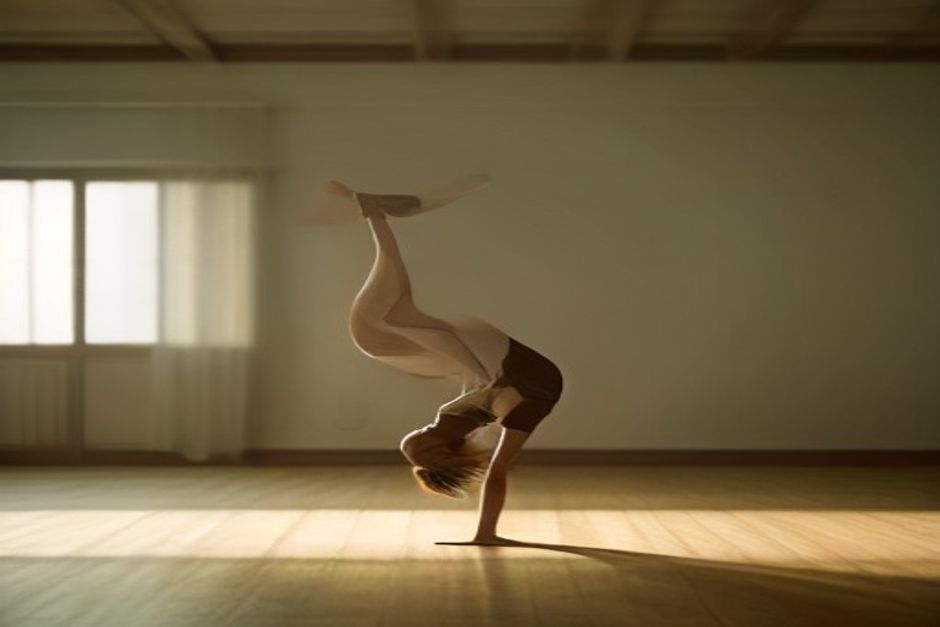
Bird of Paradise — Svarga Dvijasana, roughly "twice-born of heaven pose," a name with more poetry than clarity — is the one where you bind your arms under a bent leg, stand up on the other leg, and then unfold the bound leg toward the ceiling like a flower deciding to be a tree. It looks impossible for longer than most poses do, and then one day the standing-up part simply works. The unfolding part takes longer. Both parts are learnable, and both have honest halfway versions that are worth doing on their own.
What you are actually asking of your body
Three capacities have to show up at the same time:
- Hamstring length on the lifted leg — the full pose is, at heart, a standing split with a bind. If your hamstrings are short, the leg simply will not straighten, and no amount of balance fixes that.
- Shoulder range for the bind — the same wrap you practice in bound side angle variations, now loaded with the weight of a leg.
- Single-leg balance under an asymmetric load — harder than Warrior III in some ways, because the lifted leg pulls you sideways rather than simply back.
Step by step
Step one: bound side angle — Baddha Parsvakonasana
How: From Extended Side Angle with the right leg forward, reach your right arm under the right thigh and your left arm behind your back, and clasp hands or wrists. If the clasp is not there, hold a strap between the hands — this is not cheating; it is how shoulders learn. Stay here for five breaths. This alone is a complete pose.
Why: The bind is the foundation. If you cannot hold the wrap comfortably in the lunge, you definitely cannot hold it while standing on one leg.
Step two: the stand-up — the hard part nobody photographs
How: Keeping the bind, inch the back foot forward until both feet are roughly under you, knees deeply bent, torso folded over the bound thigh. Then — this is the whole trick — press down through the standing foot and stand up the way you would rise from a low chair: slowly, with the weight back in the heel. Look at one point on the floor. Wobbling is normal; hopping is information.
Why: Most attempts fail here, not in the unfold. Practicing just the stand-up, with no intention of straightening the leg, builds the exact balance this pose needs.
Step three: the unfold — Svarga Dvijasana
How: Once you are steadily upright with the leg still bent against your chest, begin to extend the bound leg upward and slightly out to the side. Straighten only as far as the hamstring allows without rounding the spine or yanking the shoulder. The standing leg stays strong and micro-bent. Breathe. Come down by re-bending the knee first, then folding forward, then releasing the bind — in that order.
Why: Extending gradually keeps the load in the muscles instead of the hamstring attachment, which is the part that tears when people get ambitious.
Honest modifications
A bent-knee Bird of Paradise is still Bird of Paradise. Standing tall in the bind with the knee tucked is stable, strong, and quietly impressive in a way a strained straight leg is not. You can also keep a strap in the bind indefinitely — many long-term practitioners do. And on days when balance is simply not available, Half Moon against a wall trains the same standing-leg intelligence without the bind.
How to practice it
Two or three attempts per side, two or three times a week, is plenty. Attempt the pose after you are fully warm — sun salutations and a few rounds of side angle first. Treat the stand-up as the main event for your first months with the pose; the unfold is the garnish. Film yourself once in a while if you like data: what feels like a crooked disaster often looks surprisingly close, and what feels vertical rarely is.