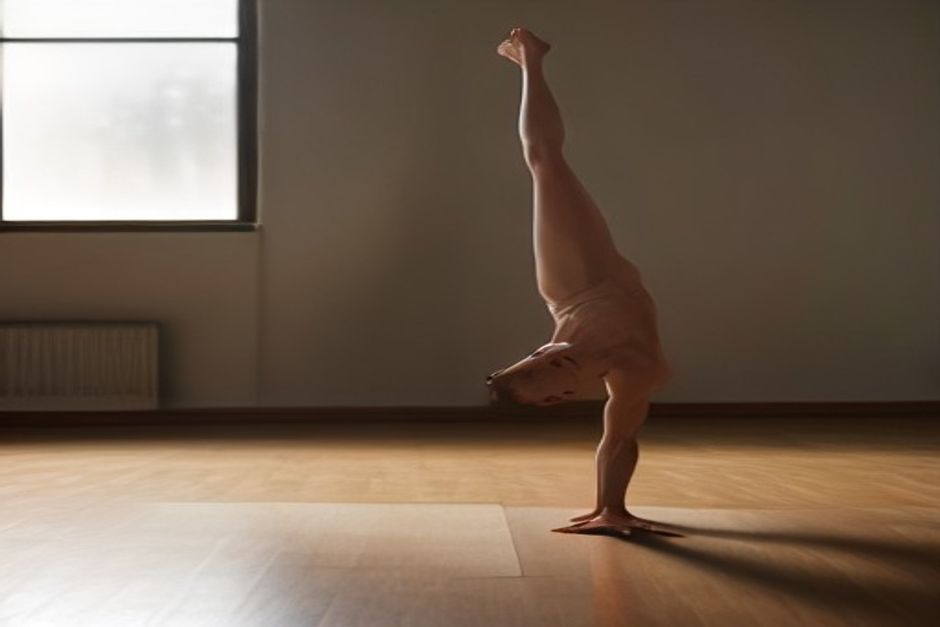
Warrior III — Virabhadrasana III — is the third of the warrior family and the one that humbles people fastest. Standing on one leg while your torso and other leg form a horizontal line sounds like geometry. In the body it feels like negotiation: the ankle wobbles, the standing hamstring burns, and your attention, if it wanders for a second, tips you over. Which is exactly why it is worth practicing. Balance is a skill, and this pose is a very honest teacher.
If Warrior I teaches grounded strength, Warrior III teaches you to keep that strength while the ground shrinks to one foot.
Step by step
Warrior III — Virabhadrasana III
How: Stand at the top of your mat. Shift your weight into your right foot and hinge forward from the hips, lifting the left leg behind you. Keep the standing knee soft — a micro-bend, not locked. Aim for torso and lifted leg roughly parallel to the floor, hips level, back toes pointing down. Arms can reach forward, sweep back alongside the body, or stay at the heart. Fix your gaze on one unmoving spot on the floor. Hold 3–5 breaths, come up slowly, and switch sides.
Why: The standing leg builds serious strength in the glutes, hamstrings, and the small stabilizers of the foot and ankle. The lifted side strengthens the entire back line. And the balance demand trains focus in a way that no amount of cueing can fake — your mind is either here or you are on the floor.
The lifted hip: the mistake everyone makes
As the back leg rises, the same-side hip almost always opens toward the ceiling. It feels higher and more impressive, but it cheats the standing hip of its work and twists the low back. The fix is unglamorous: lift the leg less. Point the back toes toward the floor, roll the lifted hip down, and accept a lower leg. A Warrior III with the foot at hip height and level hips beats a high leg with a twisted spine, every single time.
Wall drills that actually work
Hands-to-wall Warrior III — learning the shape
How: Face a wall, arms' length away. Hinge forward and place both palms flat on the wall at shoulder height. Walk one leg back and lift it until your body forms a capital T. Press into the wall, lengthen through the crown and the back heel, and hold 5 breaths per side.
Why: The wall removes the balance panic so you can feel the real work: level hips, long spine, strong standing leg. This is where the shape is built. Spend weeks here, not days.
Heel-to-wall Warrior III — learning the push
How: Stand with your back to the wall, about a leg's length away. Hinge into the pose and press the lifted foot firmly into the wall behind you, hands at the heart or on blocks. Hold 5 breaths, then switch.
Why: Pressing the wall teaches the back leg to be active rather than decorative. The resistance also gives your nervous system a reference point, which steadies the wobble considerably.
Airplane arms — the sustainable version
How: In the full pose, sweep the arms straight back alongside the body, palms facing in, like wings. Keep the neck long, gaze down.
Why: Arms-forward looks heroic but multiplies the load on the low back. Airplane arms keep the chest open with far less strain — the better choice for longer holds and for anyone whose low back grumbles.
Wobbling is not failing
Here is the part nobody tells beginners: the wobble is the training. Every correction your ankle makes is strength and body awareness being installed in real time. A perfectly still Warrior III held for three breaths teaches you less than a wobbly one you rescue five times. So step out, reset, and come back in. That cycle — lose it, find it — is the practice in miniature, the same skill that sitting meditation trains with the mind instead of the foot.
Work balance poses in early in a session, while your legs and attention are fresh. If you are building a regular rhythm, our honest guide on how often to practice yoga can help you place sessions sensibly in a real week.
Balance is not the absence of movement. It is a hundred small recoveries per breath.