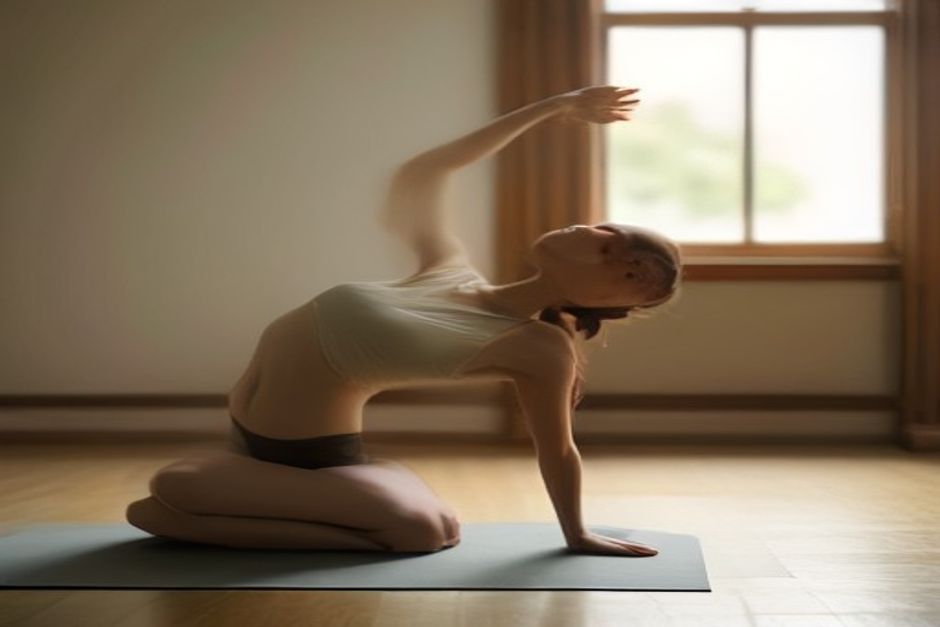
Camel Pose — Ustrasana, from ustra, camel — is the backbend people either love or quietly dread. Done well, it opens the whole front of the body: hip flexors, abdomen, chest, throat. Done carelessly, it is a masterclass in pinching the low back and wondering why your lumbar spine complains for two days. The difference is almost entirely about where the bend happens.
Why bother with Camel
Most of us live in a gentle forward fold we never chose: shoulders rounded over a keyboard, hip flexors shortened by the chair, chest caved. Camel is the deliberate opposite. It stretches the psoas and rectus femoris (the hip flexors that tug on the pelvis all day), opens the chest and the fronts of the shoulders, and gives the spine a taste of extension — the direction it rarely visits. If Bridge Pose is the gentle introduction, Camel is the intermediate chapter: more opening, more exposure, more need for technique.
It is also a strange pose emotionally. Opening the chest and throat while tipping the head back can feel vulnerable in a way that forward bends do not. That is normal. Keep the head neutral if you prefer — the backbend works without the drama.
Camel Pose, hands to hips — Ustrasana, supported
How: Kneel with knees hip-width apart, thighs vertical, shins and tops of the feet pressing into the mat (tuck the toes under if your ankles object). Place your hands on your low back, fingers pointing down, elbows drawing toward each other behind you. Inhale and lift the chest up — think up first, not back first. Then, keeping the hips stacked directly over the knees, begin to arch the upper spine, pressing the hips gently forward. Let the head follow last, or keep the chin slightly tucked. Hold for three to five breaths. To come out, press the hips forward, lift the chest up first, and sit back on your heels. Never lead the exit with the head.
Why: Keeping the hips over the knees and lifting the sternum before arching moves the curve into the thoracic spine — the part built to bend — instead of dumping it all into the five lumbar vertebrae.
Camel Pose, hands to heels — Ustrasana, full
How: From the supported version, if the chest is genuinely lifting and the low back is quiet, reach one hand back to the same-side heel, then the other. Tucking the toes under brings the heels closer; flat feet is the harder, deeper version. Once the hands land, keep pressing the hips forward so the thighs stay near vertical, and keep lifting through the sternum. Breathe — it is tempting to hold your breath here, and that is a sign you have gone too far. Three to five breaths, then hands to the low back and rise up slowly.
Why: The heel version deepens the shoulder and chest opening and anchors the pose, but it only works if the foundation — hips over knees, long low back — stays intact. Reaching for the heels by collapsing the lumbar spine buys you nothing.
Camel against a wall
How: Kneel facing away from a wall, thighs pressed lightly against it. As you arch back, the wall keeps your hips from drifting behind your knees — the single most common alignment leak in this pose. Hands can rest on the low back or reach for the heels.
Why: The wall gives honest feedback. If your thighs lose contact, your hips have swung back and the bend has migrated to your low back.
Common mistakes
- Hips drifting back. The thighs should stay roughly vertical throughout. If the hips sink behind the knees, the pose becomes a low-back hinge.
- Squeezing the glutes hard. Light engagement is fine; a hard clench tilts the pelvis and compresses the sacrum. Think of lengthening the tailbone down instead.
- Dropping the head first. The neck is the last thing to move back and the last thing to come forward. Lead with the chest in both directions.
- Grabbing the heels at any cost. If reaching the heels shortens your breath or tweaks your back, the hands-to-hips version is not a consolation prize — it is the pose.
Where it fits
Camel lands naturally in the middle-to-late part of a practice, after the spine is warm — a few rounds of Cat-Cow, some lunges for the hip flexors, maybe a Bridge or two. Follow it with a neutral shape: Child's Pose with the knees wide, or a simple seated forward fold, so the spine gets to come home. And remember the honest measure of the pose: not how far back you go, but whether you can still breathe freely while you are there. That rule, incidentally, applies to every pose in the library.