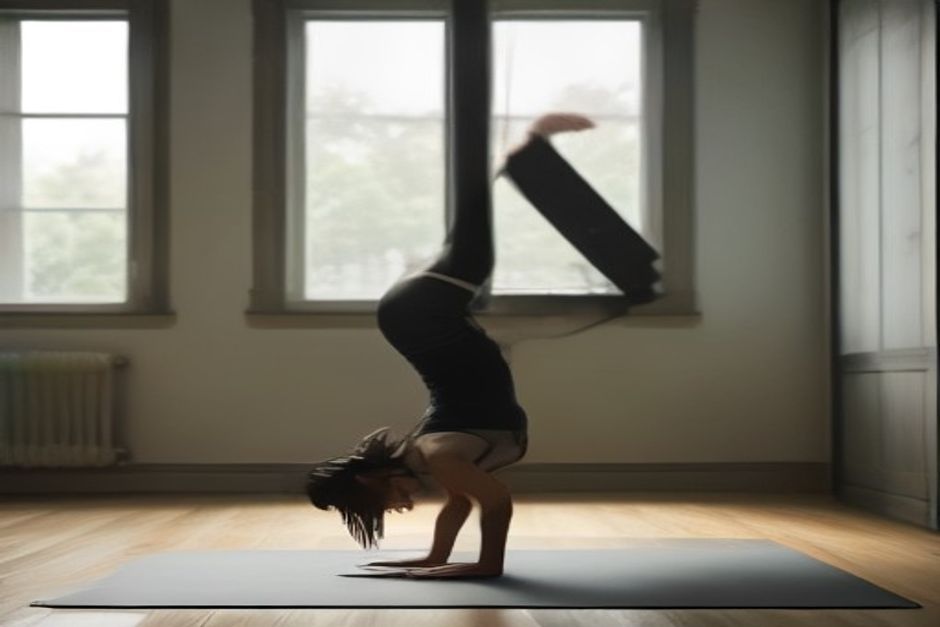
Crow Pose — Bakasana (often translated as crane, though the naming debate has entertained yoga nerds for decades) — is usually the first arm balance anyone attempts. It looks like sorcery and feels, at first, like an elaborate way to fall on your face. Here is the secret nobody tells beginners: the pose is mostly not about strength. It is about understanding where your weight needs to go and being willing to put it there. The falling-on-your-face part is the tuition, and there are ways to pay less of it.
The physics, briefly
In Crow, your hands are a base, your upper arms are a shelf, and your knees rest on that shelf. The pose balances when your center of mass hovers over your hands — which means your head must travel forward of the wrists. Most failed attempts share one cause: the practitioner tries to lift up instead of tip forward. You cannot hop into Crow any more than you can hop into standing; you lean, the feet get light, and then they leave the floor almost by accident. If you have solid Plank and Chaturanga strength, you very likely already have the raw power this pose needs. What you're missing is the tipping.
The setup drill — no flying required
How: Squat with feet together, knees wide. Plant your palms shoulder-width, fingers spread, middle finger pointing forward. Bend the elbows slightly — a shelf, not a deep Chaturanga — and wedge your knees high onto the backs of your upper arms, as close to the armpits as honesty allows. Now simply rock forward and back, feeling the weight move into the hands and the feet get heavy and light. Ten slow rocks.
Why: This teaches the single hardest thing in the pose — trusting that your arms will hold you — with zero risk. If the shelf pinches, move the knees a little lower or wider; some experimentation is normal.
One foot up — the honest intermediate
How: From the setup, lean forward until your head passes your wrists and one foot floats up. Hold two breaths, switch sides. Then try lifting one foot, setting it down, and lifting the other — a slow, wobbly march.
Why: Most people can hold one-foot Crow long before both. This is where balance actually gets built: in the wobble, not in the success photo.
Crow Pose — Bakasana
How: Setup as above. Gaze at the floor about a foot in front of your hands — looking back at your feet tips you over; looking too far forward does the same. Lean forward until the head counterbalances the hips, press the floor away firmly (this lifts the shoulder blades and stabilizes everything), and let one foot, then the other, draw up toward the sitting bones. Round the upper back slightly, pull the belly in, breathe. Three breaths is a triumph. Exit by setting the feet down — or by tipping forward onto a cushion, which is also a classic.
Why: Pressing the floor away is what turns a pile of limbs into a structure. It is the same action that protects the shoulders in Plank, and it is the difference between holding Crow for a breath and holding it for ten.
Managing the fear (the real obstacle)
- Practice over a folded blanket or cushion placed where your face would land. You will probably never need it, but your nervous system doesn't know that, and a calm nervous system balances better.
- Try Crow with your feet on a block. Starting higher means less tipping is required to get light — many people fly for the first time this way.
- Do it at a wall, facing the wall, shins eventually resting against it. The wall catches the over-lean so you can explore the forward edge safely.
- Accept the tipping. Everyone who holds Crow has fallen out of Crow, usually forward, usually softly, usually laughing. The floor is ten inches away. This is one of the least dangerous things that feels dangerous.
Wrist care
Arm balances load the wrists in deep extension, and Crow often arrives in a practice before the wrists are ready for daily reps. Warm them up with gentle circles and palm-down stretches, limit yourself to a handful of attempts per session, and treat lingering wrist ache as a reason to pause, not push. Building tolerance gradually — the same principle behind how often to practice anything — beats heroics.
Crow has a peculiar side effect: once you can do it, every other arm balance stops looking impossible. The pose is a threshold — proof that your body can trust your hands. Expect a few weeks of wobbling, a few soft landings, and one ordinary day when both feet simply float up and stay there.