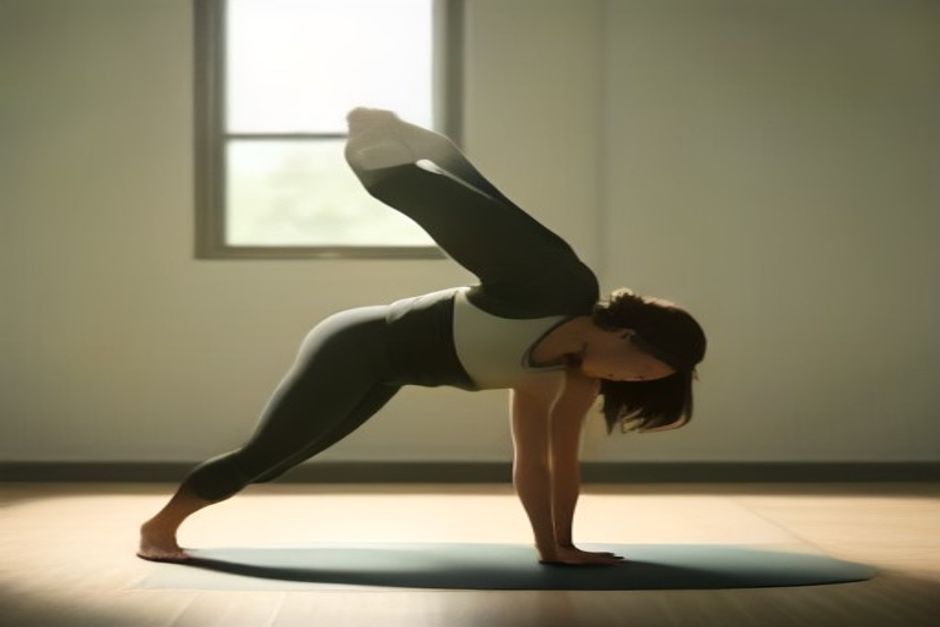
Yoga gives the front of the body a lot of attention — planks, chaturangas, boats — while the back side quietly atrophies under a desk chair. Reverse plank, Purvottanasana ("intense stretch of the east," meaning the front of the body, which faces the rising sun in the traditional orientation), is the corrective. It is a full posterior-chain strengthener disguised as a chest stretch, and it is the single most underused pose for people who sit all day.
What it actually trains
Flip a plank upside down and everything reverses. Instead of loading the abs and shoulders in front, reverse plank loads:
- The glutes and hamstrings, which lift and hold the hips — the exact muscles sitting switches off.
- The upper back, which keeps the chest open against gravity — the exact muscles the screen hunch stretches into uselessness.
- The shoulders in extension, the opposite of the forward-rolled desk position, opening the chest and front of the shoulders.
If plank is armor for your front, reverse plank is scaffolding for your back. Most people need the scaffolding more. Our neck tension anatomy page explains the posture this pose pushes back against.
Reverse plank — Purvottanasana
How: Sit with legs extended in front of you. Place your hands on the floor behind your hips, about a hand's width back, fingers pointing toward your feet (or slightly out to the sides if your shoulders prefer it). Press into your hands and feet, and lift your hips until your body forms one long line from shoulders to ankles. Keep the legs active — inner thighs reaching toward each other — and let your head rest back only if the neck is comfortable; otherwise keep the chin slightly tucked and the gaze up. Hold for three to five slow breaths, then lower with control.
Why: The lift comes from the glutes and back, not from shoving the ribs forward. If you feel the pose mostly in your low back, you are arching instead of extending — think of reaching your tailbone toward your knees and lifting through the breastbone.
Common mistakes (all fixable)
- Hips sagging halfway. The pose quietly becomes a weird sitting position. Either commit to the full line — hips high — or choose a prep version below. The halfway sag loads the shoulders without training anything.
- Ribs flaring. Puffing the chest up by arching the low back. The opening should feel broad across the collarbones, not pinched in the spine.
- Feet splaying out. Keep the feet parallel, pressing through the inner edges as well as the heels. Turned-out feet leak the leg work that makes the pose worth doing.
- Holding the breath. The chest is stretched wide, so breathing feels harder — that is normal, and also the point. Slow nasal breaths under load are free training for the diaphragm.
Wrist-friendly options
Hands-behind-back puts the wrist in deep extension, which some wrists vote against immediately. The pose is worth keeping, so change the interface:
Reverse tabletop (bent knees)
How: From sitting, bend your knees and plant your feet hip-width apart, close to your sitting bones. Hands behind you as above. Lift the hips until the thighs are roughly parallel to the floor — a table shape. This is easier on the wrists, the shoulders, and the hamstrings while training the same muscles.
Why: Most people should start here, and many should stay here for months. It is not the junior version; it is the same exercise with a sensible lever length.
Forearm reverse plank
How: Place forearms on the floor behind you instead of hands, elbows under shoulders, palms flat or fingers interlaced. Lift the same way.
Why: Zero wrist extension, all the posterior-chain work. If wrist pain has been pushing you away from arm-support poses generally, our wrist guide for weight-bearing poses has more workarounds, and side plank on the forearm uses the same principle from a different angle.
Safety note: Skip or modify reverse plank with acute wrist or shoulder injuries, and be cautious with any history of shoulder dislocation — shoulder extension under load is the position to respect most. Neck discomfort usually means the head has dropped too far back; keep the chin slightly tucked instead. As always, sharp pain in a joint is a stop sign, and a burning effort in the muscles is just effort. Learn to tell them apart and this pose will serve you for decades.
Do reverse plank two or three times a week and something unglamorous happens: you start sitting up straighter without thinking about it, because the muscles that hold you upright got stronger. No mantra required — just the back side of your body, finally invited to practice.