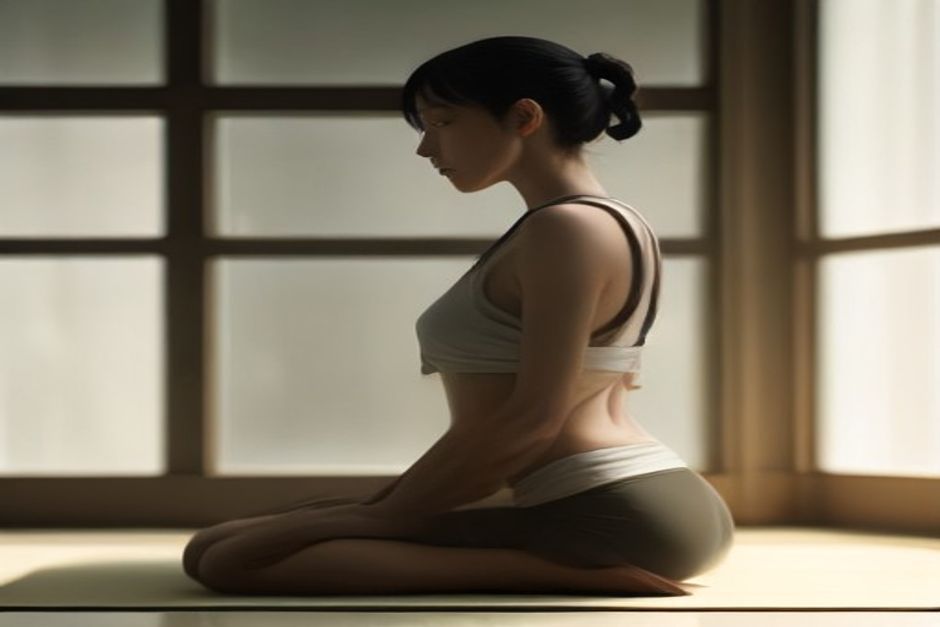
Few poses expose the gap between ambition and anatomy as honestly as Paschimottanasana, the seated forward bend. The name is a mouthful: paschima means "west," which in yoga's body-map is the back side of the body — the whole rear line from heels to head — and uttana means "intense stretch." So: intense stretch of the entire back body. Not "grab your feet and pull." Yet pulling is what most people do, and the low back is what pays for it. Done with a long spine and a little humility, this is one of the most useful asanas in the library — a hamstring stretch, a calming forward fold, and a lesson in the difference between effort and strain.
Where the fold actually happens
A forward bend is, mechanically, a rotation of the pelvis over the femurs — the hip joints are the hinge. When the hamstrings are tight (and after years of sitting, whose aren't?), the pelvis refuses to tip, and the bend gets borrowed from the lumbar spine instead. That's the rounded, nose-to-knees shape everyone recognizes. It looks deep. It is mostly your low back doing work it was not designed to do under load. The paradox of the pose: the person with bent knees and a flat back, forehead nowhere near their shins, is doing it correctly; the person flattened over straight legs with a spine like a question mark is not.
Seated Forward Bend — Paschimottanasana
How: Sit with legs extended in front of you. If your lower back rounds just sitting like this — and for most people it does — sit on the edge of a folded blanket until you can find an upright pelvis and a neutral spine. Bend the knees as much as you need. Inhale, reach the arms up and lengthen the waist; exhale, tip the pelvis forward and hinge over the legs, holding the feet, shins, or a strap looped around the balls of the feet. Keep the spine long rather than the head low. Each inhale, lengthen a fraction; each exhale, soften a fraction deeper. Stay for five to ten breaths, then come up slowly on an inhale.
Why: Hinging from the hips keeps the stretch in the hamstrings, where it belongs, and out of the lumbar discs. The blanket and bent knees are not beginner compromises — they are the setup that makes the pose honest. As the hamstrings release over weeks, the legs can straighten on their own schedule, not yours.
Halfway version, forehead to bolster
How: Set up as above, then place a bolster or a stack of firm cushions across your thighs and rest your forehead on it once you've hinged forward.
Why: Support turns the pose restorative. With the head held, the neck and spinal muscles can actually let go, and forward folds held this way have a noticeably settling effect on the nervous system — a good reason to end an evening here rather than chasing depth.
The strap, used properly
A strap is not a tow rope. Loop it around the balls of the feet — not the arches, which encourages sickling the ankles — hold one end in each hand, and use it to keep the arms long and the spine extended. The strap's job is to lengthen your arms, nothing more. If you find yourself rowing yourself toward your toes with bent elbows and a cranked neck, you've turned a stretch into a tug-of-war, and the hamstrings will win by tightening. Straight arms, long waist, quiet breath: that's the whole technique.
Details that change the pose
- Thighs stay awake. Gentle engagement through the quadriceps — pressing the backs of the knees toward the floor — signals the hamstrings that it's safe to lengthen. Muscles protect what they don't trust.
- Feet: flexed, not forced. Draw the toes back toward the shins to include the calves, but don't claw. Ankles stay neutral, feet not flopping outward.
- Stop at the honest edge. The right depth is where you feel a broad, warm stretch in the backs of the thighs and can still breathe freely. Sharpness behind the knee is a stop sign — that's tendon territory, not muscle. Our hamstring anatomy page explains why the sit-bone attachment, not the belly of the muscle, is what actually tears.
- Duration beats depth. Ninety seconds at a sustainable edge changes tissue and habits; ten seconds at your maximum changes nothing except your relationship with the pose.
Where it fits in a practice
Seated forward bend is a closer, not an opener. It belongs late in a session, after the body is warm — following standing work like standing forward bend, lunges, or warriors. Pair it with its natural complements: a gentle backbend beforehand, and a reclined twist or happy baby afterward to release the low back. Forward folds are traditionally calming, and this one earns the reputation — the slowed breathing they demand is the same long-exhale pattern used in relaxing pranayama.
The real curriculum of Paschimottanasana is patience. Hamstrings lengthen on a timeline measured in months of consistent, moderate work — not minutes of heroic pulling. Sit tall, hinge honestly, breathe. The toes will be there when you arrive.