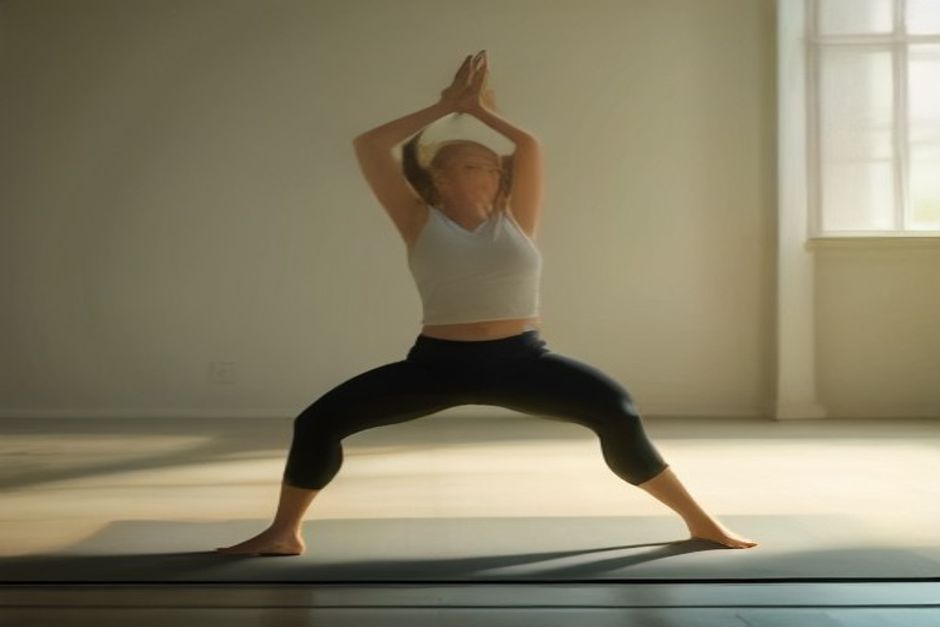
Warrior I — Virabhadrasana I — is named after Virabhadra, a fierce warrior said to have been created from a lock of the god Shiva's hair. Dramatic origin story for a pose that mostly asks you to stand in a lunge and reach up. But that is the point of the warriors: they practice steadiness, not combat. You are training the ability to stay grounded while something in you wants to quit.
It is also one of the best hip flexor openers in the standing repertoire, which matters if your daily life involves a chair. If you are new here, read our yoga basics guide first and come back — this page assumes you can stand on your own two feet.
Step by step
Warrior I — Virabhadrasana I
How: From standing, step your left foot back about a leg's length. Turn the back foot out roughly 30–45 degrees — not the full 90 you may have seen. Bend your front knee toward 90 degrees, tracking it over the second and third toes. Press through the outer edge of the back foot, firm the back leg, and reach both arms up. Let the shoulders slide down away from the ears. Gaze forward or softly up. Stay for 5–8 breaths, then switch sides.
Why: The front leg builds strength in the quadriceps and glutes; the back leg gets a deep stretch through the hip flexor and calf; the lifted arms open the chest and train upright posture. It is a full-body argument against the desk slouch, compressed into one shape.
The hip-squaring myth
Classic instruction says to square your hips to the front of the mat. For most human pelvises, with the back foot turned out, that is anatomically optimistic. Forcing it usually torques the back knee or cranks the sacroiliac joint. A kinder and more honest cue: point your hips toward the front, and stop where your back leg still feels stable. Two practical fixes:
- Widen your stance. Place your feet hip-width apart left-to-right, as if on two train tracks rather than a tightrope. Instantly more room for the pelvis.
- Let the back heel angle out more. 45 degrees is a suggestion, not a law. Some hips want 60.
Common mistakes
Front knee collapsing inward. Watch it in a mirror or glance down: the knee should stack over the ankle and point the same way as the toes. If it drifts in, press the knee gently outward and root through the big-toe mound.
Back foot floating. If the outer edge or heel of the back foot lifts, you lose the foundation and the hip flexor stretch. Shorten the stance until the whole back foot can press down.
Ribs flaring with the arms. Reaching up often comes with a big low-back arch. Knit the front ribs slightly down and lengthen the tailbone; the arms can still rise without the spine turning into a banana.
Warrior I with hands on hips — beginner variation
How: Set up the legs exactly as above, but place your hands on your hip bones. Use your hands as a level: notice which hip is hiking up or rolling back, and nudge toward even. Stay 8–10 breaths.
Why: Without the arms overhead, you can actually feel what the pelvis is doing instead of guessing. This is the version to live in for your first few weeks — and the one to return to whenever the low back complains.
High lunge arms-up — heel-lifted alternative
How: Same lunge, but keep the back heel lifted on the ball of the foot, back leg strong and straight. Reach the arms up only if the low back stays quiet.
Why: Removing the turned-out back foot removes the hip-squaring problem entirely. You keep the hip flexor stretch and leg strength with far less joint negotiation — a good option on days the back knee or ankle objects.
How long, and how often
Five to eight slow breaths per side is plenty. Warrior I appears in most flowing sequences, and holding it a little longer at the start of practice warms the legs for everything after. Pair it with Child's Pose as a rest between sides, and finish your session with a few minutes of quiet sitting — standing poses build the steadiness that seated practice uses.
The pose is not a battle to win. It is a place to practice being strong and unhurried at the same time.