Before alternate nostrils, before counts and holds, before anything with a warning label, there is a simpler question: can you actually feel yourself breathe? For most adults the honest answer is "sort of." Years of sitting, stress and sucking in the stomach have shrunk the average breath into a shallow sip that lives in the upper chest. Dirga Pranayama — the three-part breath, dirga meaning long or deep — is yoga's remedial class for that. It is not advanced. It is not flashy. It is the foundation under everything else in the breathwork section, and skipping it is like learning to drive a stick shift before learning where the pedals are.
The idea is one sentence long: fill the lungs in three zones — belly, then ribcage, then upper chest — in one continuous wave, and empty them in reverse. Your hands do the teaching.
How to practice
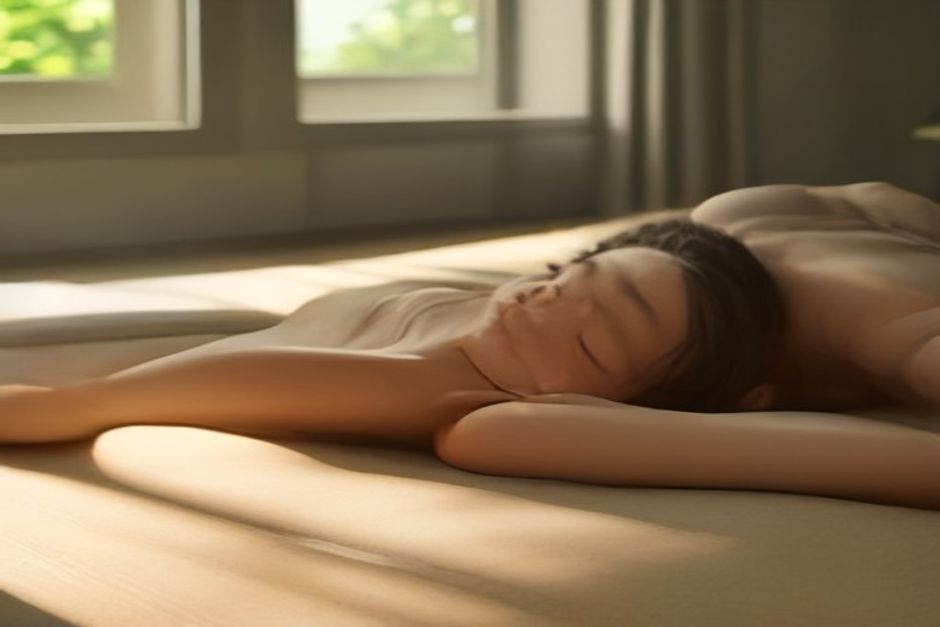
Lying down, with hands — the learning version
How: Lie on your back, knees bent or supported by a bolster, in the setup we use for Savasana. Place one palm flat on your belly, below the navel, and the other on the center of your chest. Inhale slowly through the nose and deliberately send the breath to the lower hand first — the belly rises, the chest stays still. Keep inhaling: feel the ribcage widen sideways under your hands. Keep inhaling: the upper chest and collarbones lift last, and the upper hand finally rises. Then exhale slowly through the nose, letting the wave reverse — chest settles, ribs soften, belly falls. That is one breath. Practice for two to five minutes.
Why: The hands give you feedback your attention alone cannot. Most beginners discover, to their surprise, that their "deep breath" moves only the upper hand. The lower hand is the lie detector. Lying down removes gravity and postural effort from the equation, so all of your attention can go to the breath itself.
Seated, hands-free — the daily version
How: Once the wave is familiar, sit tall — on a chair, a cushion, anywhere — and run the same three-part fill without your hands. Belly expands, ribs widen, collarbones lift; exhale in reverse, slow and complete. Five to ten breaths, or a minute or two whenever you think of it.
Why: This is the version you will actually use: before a hard conversation, in a waiting room, at the start of an asana practice, or lying awake at 3 a.m. Seated and hands-free, it is invisible to everyone around you.
Why this comes first
Every other breathing technique assumes you can do this one. Ujjayi needs a full, steady breath to make its ocean sound. Nadi Shodhana asks you to breathe smoothly through one nostril at a time — impossible if your baseline breath is a panicked sip. Even the counted patterns like 4-7-8 work poorly when only the top third of the lungs is participating. Dirga is the diagnostic and the fix in one: it shows you where your breath does not go, then trains it to go there.
There is also a quieter benefit that sneaks up on people. Following a breath through three zones, in order, over and over, is concentration training in disguise. You cannot narrate your to-do list and accurately track a breath wave at the same time. That is why Dirga doubles as a gateway into meditation: the technique is breathing, but the skill you build is attention.
Common mistakes, honestly listed
- Reverse breathing. Belly pulls in on the inhale, out on the exhale — backwards. Extremely common, totally fixable. Go back to the lying-down version and let the lower hand retrain the pattern over a few days.
- Three disconnected gulps. Belly, pause, ribs, pause, chest. The goal is one smooth wave, not a staircase. Slow everything down until the zones blend.
- Shoulder lifting. If your shoulders climb toward your ears on the inhale, you are recruiting neck muscles instead of letting the chest expand on its own. Keep the shoulders heavy; the collarbones float, they do not hike.
- Overfilling. A full breath is not a maximum breath. Straining at the top creates the tension you are trying to release. Fill to about eighty percent and let it feel easy.
Where it fits in a day
Morning: two minutes lying in bed before your feet touch the floor — it sets the breathing pattern for the hours ahead and pairs naturally with a morning routine. Midday: three seated breaths before eating, before a meeting, or whenever the shoulders have quietly risen to ear level. Evening: the lying-down version as the opening act of a wind-down, easing you toward stillness.
Belly, ribs, chest. Exhale, and let it all go. Learn this one wave and every other technique you will ever meet gets easier — because they are all, underneath the counts and nostrils and sounds, just variations on a full breath taken on purpose. Start with the beginner's guide if you are assembling a practice from scratch.