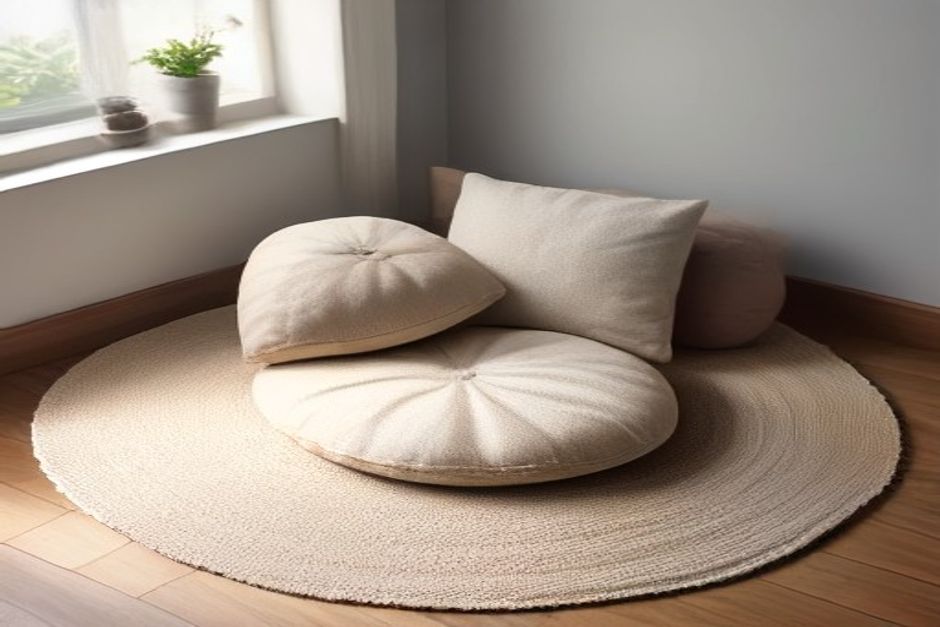
Say a pose name out loud — Trikonasana, Savasana, Virabhadrasana — and you hear the same syllable at the end of every one: -asana. It is the most repeated word in modern yoga, printed on every schedule and shouted (gently) in every class. And for most of yoga's history, it meant something so much simpler than a pose that the modern usage would have baffled the old texts: asana meant your seat. The thing you sat on, and the way you sat in it, to meditate.
The plain meaning
The Sanskrit root is ās, "to sit." Āsana is literally "the act of sitting" or "a seat." In the oldest yoga texts, that's the whole job description. When the Yoga Sutras — compiled roughly 1,700 years ago — give their famous definition, sthira sukham āsanam, they mean: a posture that is steady and comfortable. Full stop. The sutras spend exactly three verses on asana out of nearly two hundred, and none of them describe a triangle, a warrior, or anything requiring a mat with grip. The posture they care about is the one you can hold, still and at ease, for meditation.
That definition is worth sitting with (sorry): steady and comfortable. Not impressive, not deep, not Instagram-shaped. The ancient test of a good asana was whether you could forget you had a body long enough to watch your mind.
How a seat became six hundred poses
So how did "sit down" turn into the physical practice on every studio schedule? Slowly, then suddenly. Medieval Hatha yoga texts, starting around a thousand years ago, began describing non-seated postures — the Gheranda Samhita famously lists eighty-four but teaches only thirty-two, and even those are mostly seated or simple. The explosion of standing poses, arm balances, and athletic sequences is largely a twentieth-century development, shaped by Indian teachers like Krishnamacharya and influenced, awkwardly but honestly, by European gymnastics and physical-culture movements of the same era.
None of this makes modern asana illegitimate. Languages drift, practices evolve, and the modern pose library — which you can browse on our asanas page — does real good for real bodies. But knowing the history changes the emphasis: the poses were always supposed to be a means. The seat was the point. You move through warrior and triangle so that, at the end, you can sit comfortably and be still. The physical practice is a very elaborate way of earning a comfortable seat.
How to read pose names
The -asana suffix turns out to be a free Sanskrit lesson, because the front half of every pose name is just a description. A quick decode:
- Trikonasana — trikona (triangle) + asana. Triangle pose.
- Savasana — sava (corpse) + asana. Corpse pose: lie still, practice being nothing.
- Padmasana — padma (lotus) + asana. The seat shaped like a lotus.
- Balasana — bala (child) + asana. Child's pose.
- Virabhadrasana — named for Virabhadra, a warrior from myth. Warrior pose.
Once you see the pattern, every pose name is a tiny translation exercise rather than an incantation. Our glossary decodes the common prefixes and the wider vocabulary — pranayama, drishti, vinyasa — in the same spirit: Sanskrit as a set of labels, not a spell book. (The tradition also treated names with reverence; if the tension between utility and respect interests you, the story of "namaste" is a good companion read.)
Why any of this matters for your practice
Two practical takeaways. First, the sthira sukham test still works. Whatever pose you're in — from child's pose to a wobbling half moon — you can ask the ancient question: is this steady, and could it be more comfortable? If the answer to both is no, back off ten percent. That's not a modern modification; it's the original instruction, older than any alignment cue.
Second, the history quietly reframes what a "good practice" is. A session that ends in five genuinely still, comfortable minutes of sitting is, by the oldest standard we have, a complete success — arguably more complete than ninety minutes of advanced poses that leave you too wired or sore to sit at all. The poses are the staircase. The seat is the room at the top. The philosophy page traces how asana fits into the larger eight-limb framework, where it's the third limb out of eight — important, and explicitly not the destination.
"The pose was never the point. The point was a body quiet enough to sit in."
So the next time a teacher calls out a long Sanskrit name, hear it for what it is: a description, plus an invitation to sit with whatever shows up. Same instruction as it was 1,700 years ago. The seat got fancier. The sitting didn't.