Every yoga tradition tells you to listen to your body. Kripalu is the one that built an entire school out of the sentence. The name comes from Swami Kripalvananda, a Gujarati master of kundalini yoga whose disciple Amrit Desai brought the teaching to the United States in the 1960s and founded what became the Kripalu Center in Stockbridge, Massachusetts — today the largest residential yoga center in North America. After a painful scandal and separation from its founding teacher in the 1990s, the school rebuilt itself around the methodology rather than the man, and that methodology turned out to be the valuable part all along.
The three stages
Kripalu describes its practice as a progression through three stages, and understanding them explains everything about how the classes feel:
- Stage one: willful practice. You learn the poses, the alignment, the breath. The body is an object you're working on. This is where every beginner starts, in every tradition.
- Stage two: will and surrender. You hold poses longer and start watching what happens inside them — sensation, resistance, the urge to quit, the urge to show off. The pose becomes a question rather than a task: what am I actually feeling, and what am I doing about it?
- Stage three: meditation in motion. The practice stops following external form altogether. You close your eyes and let the body move as it wants to move — spontaneous, unchoreographed, sometimes barely recognizable as "yoga poses" from the outside. The tradition calls this surrendering to the body's own intelligence.
Most styles treat stage one as the whole curriculum. Kripalu treats it as the on-ramp.
What a class is like
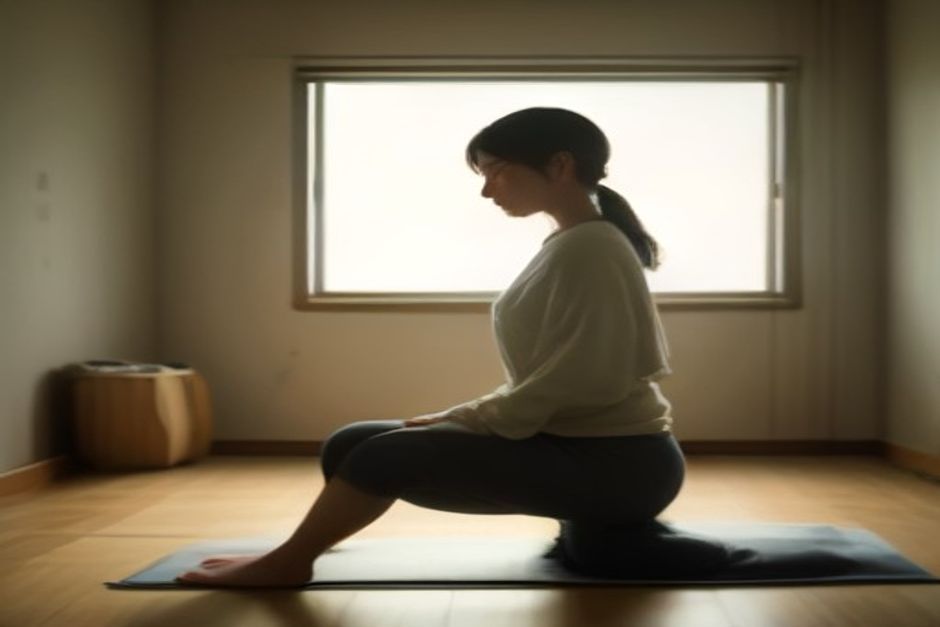
Kripalu classes are deliberately gentle to moderate, with the intensity scaled to the student rather than the schedule. The teacher demonstrates little, talks a lot about sensation and choice, and keeps offering the same radical option: do less. A typical class moves slowly through warm-ups and a modest set of postures — think child's pose, cat-cow, simple standing shapes, supported backbends — with long pauses and frequent invitations to notice breathing, emotion, and the commentary in your head. There are no adjustments to push you deeper; there are questions to bring you closer. It shares DNA with hatha and, in its slower offerings, with restorative yoga, but the aim is different: not flexibility, not even relaxation exactly, but self-observation without judgment — the skill our meditation pages work on from the sitting side.
"BRFWA" and the inward toolkit
Kripalu teachers use an acronym as a mantra of attention: BRFWA — breath, relax, feel, watch, allow. Breathe. Relax what can soften. Feel what's actually there. Watch your response to it. Allow it to be as it is. It sounds almost too simple, and in practice it is the entire contemplative technology of the school, applicable to a tight hamstring, a difficult conversation, or the last ten minutes of a long meeting.
The history worth knowing
Amrit Desai, the charismatic founder, was forced out in 1994 after admitting to sexual relationships with students, breaking his own celibacy teaching and the community's trust. The center's response — separating the school from the guru, restructuring governance, keeping the method — is now studied as one of the few successful recoveries in modern yoga's long catalog of leader scandals. The pattern, and the healthy-boundaries alternative, is worth reading about in our entry on the guru relationship.
Who it suits
Kripalu suits you if you're recovering from something — an injury, a burnout, a decade of being shouted at by fitness culture — or if you suspect the interesting part of yoga was never the poses. It is one of the most beginner- and body-diversity-friendly traditions on offer. It suits you less if you want to sweat, be corrected into better alignment, or keep your feelings out of your forward bends.
Kripalu's quiet claim: the pose was never the point. The point is who's doing the pose, and how they treat themselves while doing it.