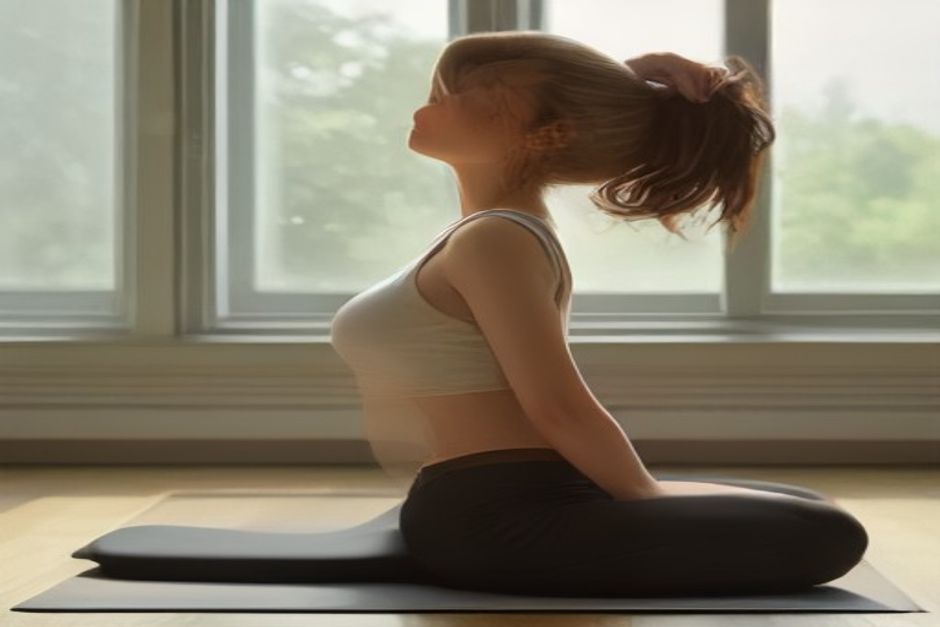
Your spine is usually discussed in two acts — the neck that hurts and the low back that hurts — while the twelve vertebrae between them get no lines. That's a shame, because the thoracic spine is often the reason the other two are complaining. It's the middle manager of the torso: when it does its job, nobody notices; when it stiffens, everyone above and below has to work overtime. This page covers what the thoracic spine is built to do, why modern life freezes it, and a few drills that give movement back. For the full map, see our overview of the spine.
What it is
The thoracic spine is the twelve vertebrae labeled T1 through T12, running from the base of your neck to the bottom of your ribcage. Each one has a pair of ribs attached, which makes this region fundamentally different from the neck and low back: it's a spine with a cage bolted to it.
That cage changes everything about how the region moves:
- Rotation is its specialty. The thoracic facet joints are angled for twisting. Roughly half of all the rotation in your spine is supposed to happen here.
- Flexion comes easily. Rounding forward — think slumping over a laptop — is the movement the thoracic spine does most and needs least help with.
- Extension is limited. The ribs and the downward-sloping spinous processes restrict arching backward. Some extension is available and valuable; forcing it is not.
Compare that with the lumbar spine below it, which is built for stability and rotates very little, and the cervical spine above, which is built for mobility in every direction. The thoracic spine is the rotational engine in the middle — and the whole system is designed on the assumption that it will turn.
Why it stiffens
The thoracic spine doesn't wear out from use; it stiffens from disuse. The modern posture — hours rounded forward over a screen, chest collapsed, ribs compressed — asks the region to hold one position and never rotate. Tissue adapts to what you ask of it. Ask nothing, and the answer arrives in a few years: a mid-back that moves like a single board instead of twelve joints.
Two quieter contributors matter too. Shallow chest breathing keeps the ribcage still for most of the day, and the ribs are the thoracic spine's moving parts — a ribcage that doesn't breathe well is a thoracic spine that doesn't move well. (The loop runs both ways; see how breath and posture shape each other.) And habitual one-sidedness — always carrying the bag on one shoulder, always turning to one screen — builds asymmetry into the stiffness.
Who pays the bill
Bodies are economical. When a joint that should move doesn't, the movement still has to come from somewhere:
- The neck pays upward. If the mid-back can't extend or rotate, you crane the neck to see the world. Chronic neck tension often starts twelve vertebrae lower than it hurts.
- The low back pays downward. Rotation that can't happen in the thoracic spine gets borrowed from the lumbar spine, which is specifically not built for it. Many cranky low backs are just over-rotating to cover for a stiff middle.
- The shoulders pay sideways. Overhead arm movement requires thoracic extension; without it, the shoulder joint impinges on itself trying to finish the arc.
This is why so many yoga sequences keep circling back to twists and side bends — they're maintenance payments on the middle of the spine so the ends don't go into debt.
Drills that give it back
None of these require heat, equipment beyond a mat, or heroics. Two minutes each, most days, beats an ambitious session once a month.
Open Book — side-lying rotation
How: Lie on your side, knees bent and stacked, arms straight out in front with palms together. Open the top arm up and over like a book cover, letting your chest follow until your shoulders rest toward the floor behind you. Breathe five slow breaths; come back. Repeat both sides, 5–8 openings each.
Why: The stacked knees lock the lumbar spine out of the movement, so the rotation has to come from the thoracic region — exactly the isolation you're training.
Thread the Needle — from tabletop
How: From hands and knees, reach one arm up toward the ceiling, opening the chest, then thread that arm under your body and rest on the shoulder. Alternate slowly, 6–10 per side. Full details in our pose entry.
Why: Rotation under a small, safe load — the thoracic spine learns to move while it's doing something, which is how it will actually be used.
Cat-Cow with Rotation — the upgrade
How: Do ordinary cat-cow a few times, then add a spiral: as you inhale, let the chest rotate slightly toward one side; as you exhale, toward the other. Keep the pelvis still.
Why: Combines the region's two available movements — flexion/extension and rotation — in the gentlest possible dosage.
Seated Twist, Breathing — the desk version
How: Sit tall in a chair, both feet down. Turn your chest to one side, hands on the chair back if that helps, and take five full breaths into the ribcage. Switch sides.
Why: The breath does half the work — each inhale expands the ribs and mobilizes the thoracic joints from the inside. You can do this one in a meeting. Nobody will notice.
A note on pain: mid-back stiffness that eases as you move is normal and trainable. Mid-back pain that is sharp, constant, wakes you at night, or comes with numbness or fever is a different category — see a clinician before stretching it. Twists should feel like wringing out a sponge, never like pinching a nerve. If a rotation reproduces your pain exactly, back out of it and get assessed.
The thoracic spine's story is the same as most of the body's: it doesn't need to be fixed, it needs to be used. Rotate it, breathe into it, and stop asking your neck and low back to do its job — they'll thank you by going quiet.