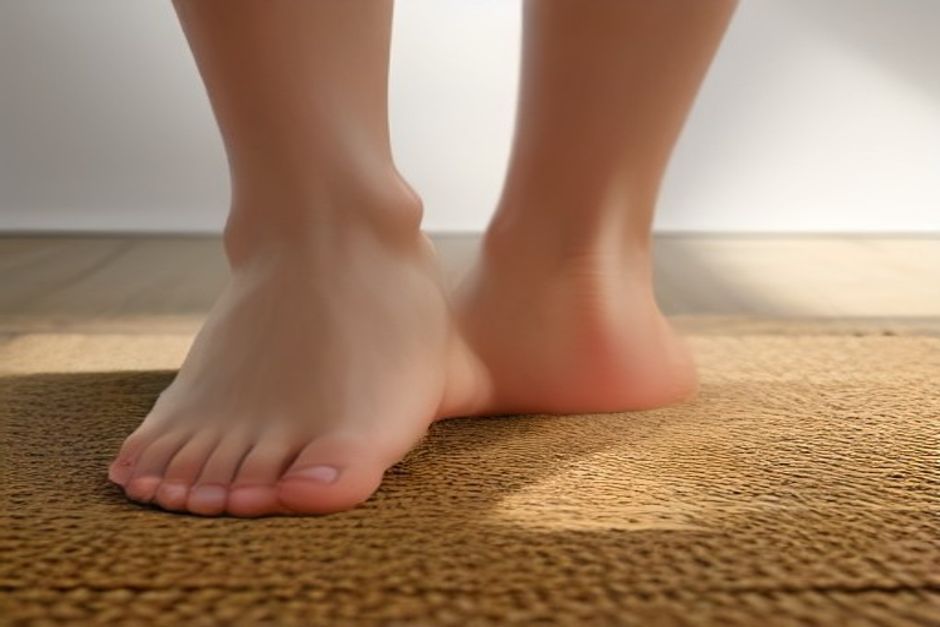
Every standing pose you have ever done started at your arches. Teachers say "root through your feet" and move on, but the structure doing the rooting is a genuine piece of engineering: a flexible vault of twenty-six bones that stores energy, absorbs shock, and adapts to ground in a way no shoe has ever matched. It deserves more than a cue.
This page zooms in on the arch itself. For the wider tour — toes, tripods, barefoot drills — see your feet in yoga.
What the arch actually is
You have three arches per foot, but the star is the medial longitudinal arch — the visible curve along the inner foot. It is not a rigid bridge. It is a spring held up by two systems:
- Passive support: ligaments and the plantar fascia, a thick band running from heel to toes that tightens like a bowstring when you load the foot.
- Active support: muscles — the small intrinsic muscles inside the foot, plus the tibialis posterior and others arriving from the calf. These are the part you can train.
When you step, the arch compresses slightly and recoils, absorbing force and returning a little of it. When it works well, it is shock absorber and launch pad in one. When the active support is weak or sleepy, the passive structures take load they were not designed to carry alone — which is one plausible chapter in many stories of plantar heel pain.
The tripod: what the arch means in a pose
In standing poses, weight is meant to spread across three contact points: the base of the big toe, the base of the little toe, and the heel. That triangle is the tripod, and the arch is the space it encloses. The cue "lift your arches" does not mean clench your feet into fists; it means the tripod stays grounded while the muscles of the foot stay awake — engaged but not cramping. Watch a beginner in tree pose: the standing foot often rolls outward, the inner arch collapses, and the ankle wobbles. Wake the tripod, and the wobble halves before any "balance" has improved. Balance starts at the sole, as the anatomy of balance explains.
Flat feet: what changes and what doesn't
A low or flat arch means the foot rolls inward more under load — overpronation, in the jargon. In yoga terms, that shows up as ankles collapsing inward in mountain pose, knees drifting in at chair pose, and arches aching after long standing sequences. The honest summary:
- Plenty of flat feet are strong, pain-free, and need nothing. Arch height alone is a poor predictor of problems.
- If your flat feet are flexible (an arch appears when you sit or rise on tiptoe), strengthening can genuinely help.
- If pain, not shape, is the issue — especially heel or inner-ankle pain — see a physiotherapist or podiatrist before turning yoga into a rehab experiment.
We have a full page on flat feet and yoga, including when orthotics are a tool rather than a defeat.
High arches: the other side
A high, rigid arch gets less attention but has its own trade: less shock absorption, more pressure concentrated at heel and ball, and often tight calves underneath. High-arched feet tend to like cushioning, calf stretching, and — same as everyone — stronger foot muscles. Different shape, same homework.
Strengthening without gadgets
You do not need balance boards, toe separators, or vibrating platforms. Three boring drills cover most of it:
Short foot — the arch lift
How: Standing or sitting, keep your toes relaxed and long on the floor, then gently draw the ball of the foot toward the heel — the arch rises, toes do not curl. Hold five seconds, release. Ten per foot.
Why: This is the direct switch for the intrinsic foot muscles, the active half of the arch's support. It is harder than it sounds, and cramping at first is common — back off and build up.
Toe yoga
How: Keep all toes down, lift just the big toes; reverse — press the big toes, lift the other four. Alternate for a minute.
Why: Independent toe control is a sign the foot's fine motor wiring is alive, and it restores the big toe's job as the inside anchor of the tripod — the anchor that matters in every standing balance.
Slow calf raises
How: Rise onto the balls of your feet over three seconds, pause, lower over three seconds. Ten to fifteen reps, ideally barefoot, weight even across the tripod rather than rolling to the outer edge.
Why: The calf complex — especially tibialis posterior — is the arch's crane from above. Strong calves are arch support you build once and wear everywhere.
In the practice itself
Barefoot practice on a firm surface is already arch training — the foot has to do the work a shoe normally outsources. That is one quiet argument for yoga's no-shoes policy. In standing poses, check the tripod before anything else: big-toe mound down, outer foot grounded, arch awake rather than lifted to the ceiling. Thirty seconds of attention there improves everything stacked above it.
When to get professional eyes: new arch pain, heel pain that is worst on your first morning steps, one arch that has visibly dropped compared to the other, or any foot pain that changes how you walk — these are reasons to see a physiotherapist or podiatrist. Exercises help healthy feet get stronger; they are not a treatment plan for an injury.