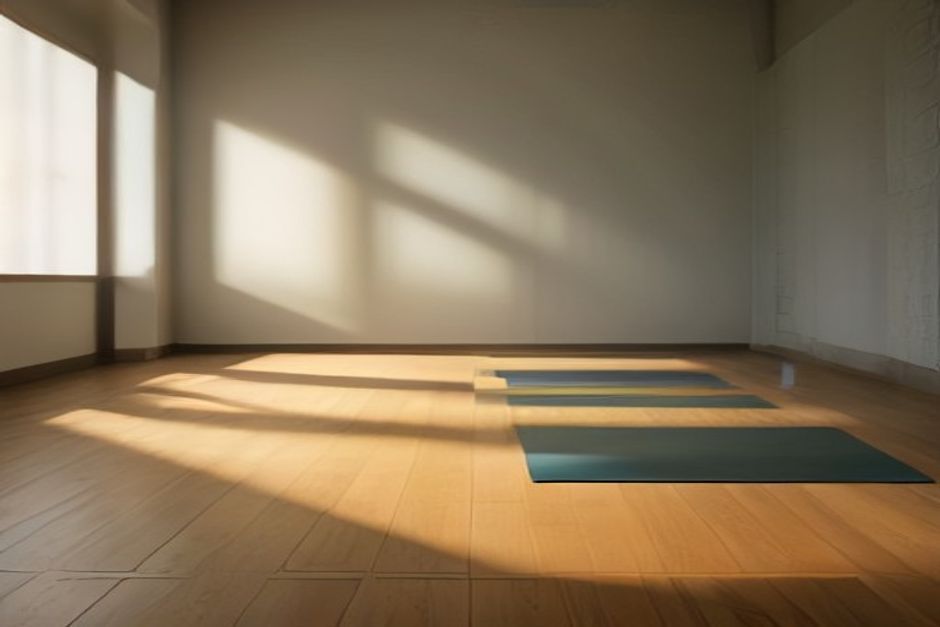
You have decided to go to a yoga class, and now your brain is helpfully generating scenarios: you'll wear the wrong thing, set up in someone's sacred spot, fall over during a balance pose, and be quietly judged by a room of serene experts. Here is what actually happens, step by ordinary step.
Before you leave the house
You need less than you think. Comfortable clothes you can move and bend in — nothing you have to keep adjusting, nothing so loose it falls in your face during a forward fold. Our what to wear guide says it in one line: you already own it. Bring water. If you have a mat, bring it; if you don't, nearly every studio rents or lends them, usually for a couple of dollars or free. Arrive ten to fifteen minutes early — that's not etiquette theater, it's genuinely useful time to sign in, mention any injuries, and claim a spot without rushing.
One practical note: eat lightly in the hour or two before class. A full meal and downward dog are not friends. A banana or toast an hour out is fine; a three-course lunch is a negotiation you will lose.
Walking in
Shoes come off at or near the door — there will be an obvious pile or shelf, so you can't really get this wrong. Check in at the desk, say it's your first class, and let the teacher know. This is the single most useful thing you can do. Teachers want to know; it changes how they cue the room, and it means they'll offer you options instead of assuming you know the vocabulary. If you have an injury, a condition, or you're pregnant, say so now, privately, in one sentence. "First class, and my left knee is touchy" is a complete and perfect briefing.
Where to put your mat
The etiquette here is simple: not in the front row on your first day, and not blocking anyone's view of the teacher. The middle of the room is the sweet spot — close enough to see and hear, far enough from the mirror to avoid self-consciousness, and surrounded by people you can copy when a cue doesn't parse. Unroll the mat so it aligns roughly with your neighbors'. If the room is crowded, people will shift mats to make space; that's normal and not an imposition.
Then you sit on your mat and wait. Some people stretch, some lie down, some just sit. Nobody finds any of this remarkable. Our yoga etiquette page covers the rest — silence your phone, stay for savasana, wipe a borrowed mat — but the core rule is just: be unremarkable, and you already are.
During class: what the teacher actually expects
Exactly one thing: that you stay on your mat and take care of yourself. That's the entire job description.
You will not know the pose names. Nobody does at first — half the room is following along a half-second late, and that's fine. When a pose is too much, come to child's pose and rest; taking child's pose mid-class is not quitting, it's the most experienced-looking move available to a beginner. When the teacher offers "option one, option two," take option one. When they say "if this is available to you," and it isn't, that's the end of the sentence — you don't owe the pose anything.
Teachers sometimes offer hands-on adjustments. Most studios now use consent cards or ask verbally; if you'd rather not be touched, say so at check-in or decline in the moment. A simple "I'm good, thanks" is all it takes, and no teacher worth their mat will take it personally.
The wobble problem
You will wobble in balance poses. Here is the secret the room already knows: everyone wobbles. The person in the front row with the expensive mat wobbles. The teacher wobbles when demonstrating the left side. Balance poses are designed to be unstable; the wobble isn't failure, it's the exercise. And the liberating truth is that nobody is watching — everyone is too busy monitoring their own ankles to have opinions about yours. The self-consciousness you feel walking in evaporates about four minutes into class, replaced by the much more absorbing question of whether your arms can stay up for one more breath.
The ending everyone underestimates
Class ends with savasana — lying on your back, doing nothing, for five to ten minutes. Beginners are often tempted to skip it and slip out. Don't. It's the part your nervous system came for, and leaving early is both bad manners and a genuinely missed experience. Lie still, let your breathing be unremarkable, and let the practice settle. Then there will be a quiet "namaste," you'll roll up your mat, and you'll walk out feeling oddly taller.
"Nobody remembers your first class except you. Everyone else was too busy surviving their own."
Afterward
Expect some soreness the next day in places you didn't know had muscles — that's normal, and our first-month guide maps what comes next. If you liked the class, go back within the week while the momentum is warm. If you didn't love the teacher or the style, try a different one before concluding anything about yoga itself; teaching styles vary enormously, and our courses page and the yoga basics overview can help you figure out what to try second.
The nervous feeling at the studio door is universal — every person in that room had a first class, and most of them were at least as nervous as you. The only difference between them and you is that they went in. Go in.