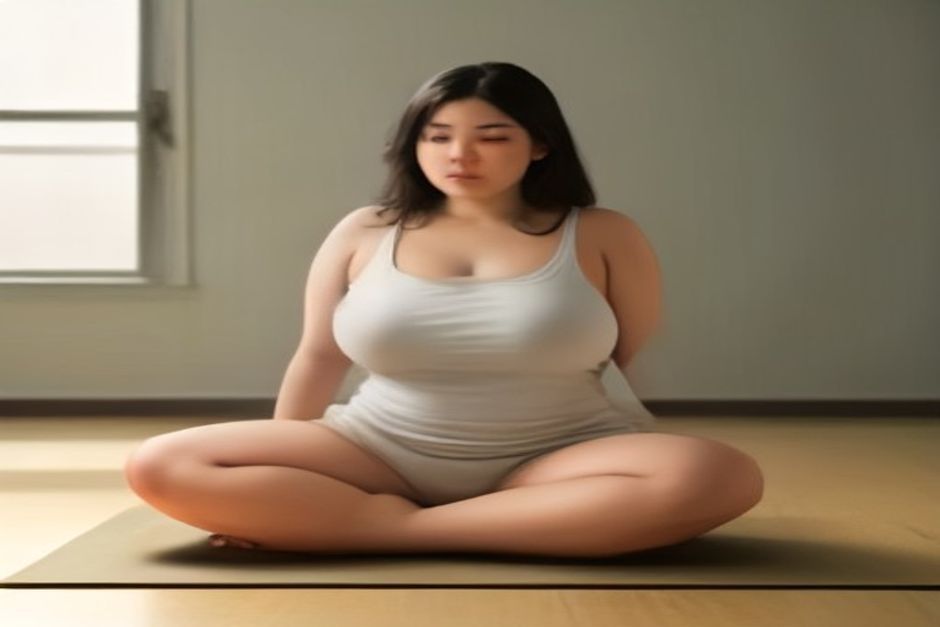
Short answer: no. Longer answer: no, and the belief that you should lose weight first has kept more people off the mat than tight hamstrings, busy schedules, and confusing class names combined. Yoga doesn't have a body-size prerequisite. It has poses, and poses have versions, and one of those versions fits the body you have today.
That said, honesty is the house policy here, so let's be honest about both halves: you can start now, and some standard instructions won't fit your body as written. That's not you failing yoga. That's generic cueing failing you. Here's the fix.
What a bigger body actually changes
Mostly geometry. A belly, chest, or thighs take up space, and some classical alignment cues pretend they don't. "Feet together" in a forward fold, "hands to the floor," "chin to shin" — these cues assume a body with nothing in the way. If your body has something in the way, the pose isn't unavailable; it just needs a wider doorway. This is adaptation, not dilution. A lunge with a wide stance is a lunge.
What doesn't change: the breathing, the balance training, the strength work, the nervous-system downshift, the noticing-your-body part — which is to say, the yoga.
The adaptations that make practice work
Widen your stances
How: In any standing pose or forward fold, take your feet hip-width or wider — genuinely wider, not the polite extra centimeter. In folds, let the belly have a lane to travel through.
Why: Width creates room, and room creates depth. A wide-stance forward fold often goes further than a narrow one because the body isn't blocking itself. Wide-legged forward fold may become your favorite version.
Bring the floor up
How: Blocks under hands in folds and lunges; a chair for standing balance work; a bolster under the torso in child's pose so you're resting on support instead of compressing against your thighs. Our home props guide covers substitutes you already own.
Why: Props aren't the beginner's crutch — they're how you get the pose's actual benefit (stretch, breath, rest) without the pose's irrelevant struggle (reaching a floor that was never the point).
Swap the poses that fight you
How: Skip what's built wrong for your body and take the equivalent: seated twists instead of deep belly-compressing twists; legs-up-the-wall instead of shoulderstand; child's pose with knees wide and torso propped instead of flat to the mat.
Why: Nearly every pose has a sibling that delivers the same effect through different geometry. Choosing the sibling isn't quitting; it's practicing.
Wrists, knees, and load — the honest part
Weight-bearing on the hands is the one place where body weight genuinely matters, and it matters for everyone over a certain size, not just you. Planks and down dogs load the wrists heavily. If that's uncomfortable, the fix is simple: forearm versions, fists instead of flat palms, or standing and seated alternatives. The wrist anatomy page walks through the mechanics and the workarounds. Same with kneeling — a folded blanket under the knees turns "never again" into "oh, fine."
And pace yourself on transitions. Getting up and down from the floor repeatedly is legitimately hard work. Choose practices that stay mostly standing, or mostly seated, and transition slowly. That alone makes many classes far more doable.
Finding the right room
Teaching varies enormously. Look for classes labeled gentle, chair, accessible, or all-bodies; look for teachers who offer options without being asked. Online, "yoga for bigger bodies" is a real search term with real, good teachers behind it. If a class or video makes you feel like an obstacle, that's a bad class, not a bad body. Leave it. There are better ones, and the courses page is a decent place to start looking for structured, self-paced options.
"You don't shrink yourself to fit the practice. The practice bends — that's literally what it's for."
What happens when you start now
The unglamorous truth: yoga won't necessarily change your weight, and it doesn't need to. What it reliably changes is your relationship with the body you're in — you feel it more, fight it less, and move it in ways that make daily life easier. Stairs, floors, sleep, stress. Those benefits are available at every size, from the very first session. Waiting until you're smaller to claim them just means not having them for longer.
So: mat, or chair, or just the floor. Wide stance, props up, skip what fights you. Start with the body that showed up today — it's the only one that can practice, and it can.