Props have a reputation problem. Somewhere along the way, the block and the bolster got filed under "equipment for people who can't do the pose," which is exactly backwards. Props are how you make a pose fit your body instead of forcing your body to fit a pose. Every good studio knows this; it's why the prop wall exists. The good news for home practitioners: almost everything on that wall has a household equivalent, and you probably own it already. Our full props guide explains what each prop does — this page is about getting the same effects for free.
Why props matter in the first place
A prop does one of three jobs: it brings the floor closer, it fills the gap between you and the floor, or it supports your weight so your muscles can stop working. That third job is the one people underestimate. In restorative yoga, support is the entire point — a pose held with effort is exercise, while a pose held with support is rest, and your nervous system can tell the difference even when your ego can't.
So before we start raiding the house: anything you substitute must be stable, must not collapse under your weight, and must not have sharp edges or corners where your body will rest. A wobbly stack of paperbacks under your hand in a balance pose is not a prop; it is a prank.
The translation table
Yoga block → a stack of hardcover books. Two or three sturdy hardcovers, spines aligned, tied together with a belt or wrapped in a rubber band, make a serviceable block. Use them under your hands in standing folds and lunges, or under your sit bones in seated poses. The book stack doesn't have the three height settings of a real block, and it won't forgive a sweaty sliding hand the way cork does — so keep your weight mostly vertical over it, and skip it for anything where you'd push sideways.
Yoga strap → a belt, a bathrobe tie, or a long scarf. Anything non-stretchy, at least a meter and a half long, works. A cotton dressing-gown belt is nearly perfect: soft, strong, and washable. Use it to hold a foot in a reclined hamstring stretch when your hands can't reach, or looped around both arms in a shoulder stretch. The one thing a household belt lacks is a buckle that holds a fixed loop, so tie a loose knot you can adjust, or just hold the ends. Do not use resistance bands or anything elastic — the spring is the opposite of what you want.
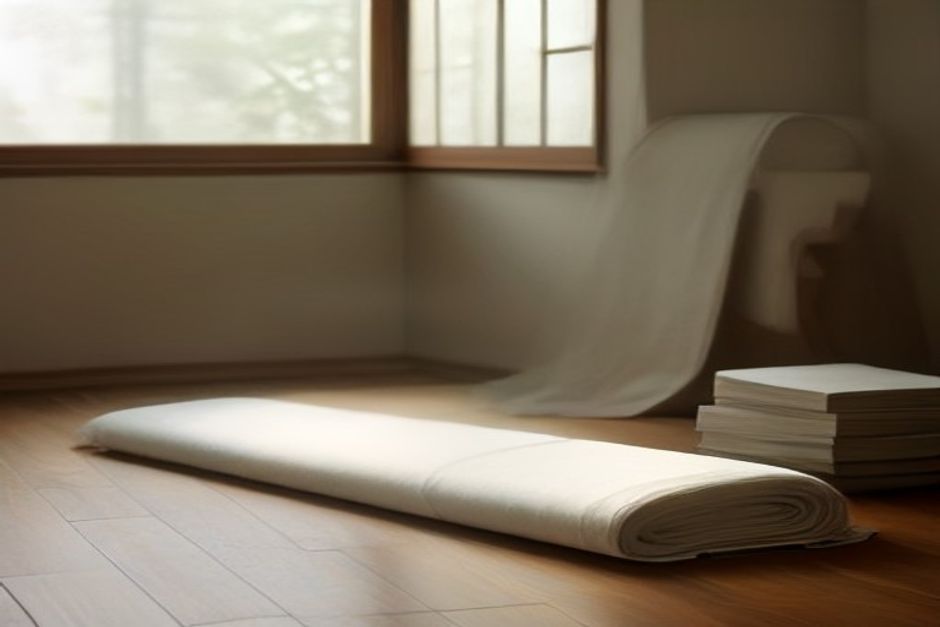
Bolster → couch cushions, firm bed pillows, or a rolled sleeping bag. A bolster is just a firm, body-length pillow. Two couch cushions stacked, or a tightly rolled sleeping bag cinched with a belt at both ends, do the job. This is the substitute that unlocks the most: a bolster under your knees in savasana, along your spine for a supported chest opener, or under your torso in a restorative child's pose. The key word is firm — a squishy down pillow compresses to nothing and supports no one.
Yoga blanket → any thick blanket or large towel. Wool or fleece blankets are ideal because they hold a fold. A folded blanket under the sit bones tilts the pelvis forward in seated meditation; rolled into a sausage, it supports the neck in savasana or the ankles in legs up the wall; folded into a pad, it saves your knees in lunges. Beach towels work too, rolled tight. This is the easiest substitution on the list — a blanket is a blanket.
Eye pillow → a clean sock filled with rice. Fill a sock with dry rice or lentils, tie it off, and drape it over your eyes in savasana. The gentle weight signals the face to relax in a way that's hard to explain until you try it. Five minutes of assembly, and it works exactly like the store-bought version.
Furniture is a prop too
The wall is the best prop you own. Legs up the wall, standing poses with a hand on the wall for balance, calf stretches with your hands pressed into it — a wall is more stable than any block ever made. A sturdy chair is the second best: seated twists, supported backbends over the seat, and a whole style of practice exists built around one. The edge of the couch works for supported bridge. Stair steps make an excellent calf stretch and a passable incline for hands in push-up-style poses. Once you start seeing furniture as yoga equipment, your home gets noticeably bigger.
What not to improvise
Two things deserve real money eventually. The first is the mat itself: grip is the one quality you cannot fake with a towel or a carpet, and slipping is how wrists and shoulders get hurt. The second is anything load-bearing under your full body weight in an unstable position — a book stack is fine under one hand in a lunge, but don't press your whole weight into it in a balance pose. If you practice regularly and want to upgrade one thing at a time, the foam versus cork blocks comparison is a sensible place to start.
Safety note: a household prop must be boring. If it slides, collapses, rolls away, or has a corner that digs in, it fails the test — no matter how clever the substitution felt. Test every improvised prop gently before loading it, and keep pets and small children out of the landing zone.
The point of all this
Props were never about gear. They're a physical way of saying: the pose adapts to you, not the other way around. That idea is at the heart of how we teach the asanas here, and it costs exactly nothing to practice it. Grab the books, unroll the belt, claim the couch cushions before someone sits on them, and set up your studio. It was already there.