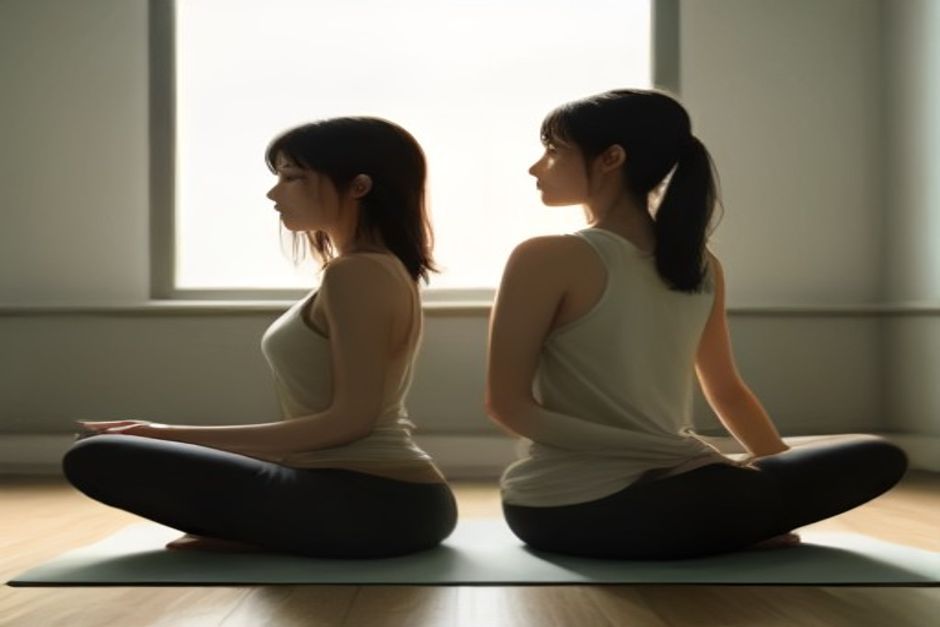
Search "partner yoga" online and you'll find two people in swimwear forming a human arch over a sunset cliff. Ignore all of that. Real partner yoga for normal humans is quieter: two people on adjacent mats using each other as props, mirrors and occasional counterweights. It's less circus, more conversation — and it teaches things solo practice structurally cannot, mostly about how you communicate under mild physical awkwardness. Which, it turns out, is a lot like how you communicate everywhere else.
Three ground rules before anyone touches anyone
- Ask, then listen. Before every pose: "Want to try this? Tell me when it's enough." The word "enough" ends the pose, instantly, no negotiation. This single rule is 90% of partner yoga safety.
- No surprise depth. Never push, pull or press a partner deeper into a stretch without asking. A body you can't feel should never be moved past the point it chose itself.
- Laugh when it's wobbly. It will be wobbly. Partner poses collapse, timing fails, someone's foot ends up somewhere undignified. Couples and friends who treat this as comedy get the full benefit; those who treat it as a test get an argument with stretching.
Five poses that actually work in a living room
1. Back-to-back breathing
How: Sit back to back, legs crossed or extended — whatever's comfortable. Close your eyes and simply breathe. Notice when your breathing syncs with theirs, and when it doesn't. Three to five minutes.
Why: The whole practice in miniature: shared presence without performance. It's also the calibration round — you learn your partner's rhythm before anyone's hamstrings get involved. If you both meditate, it pairs naturally with breath counting.
2. Back-to-back seated twist
How: Still back to back, both of you twist to the right — your right hand reaches across to your partner's left knee, your left hand to your own right knee. Five breaths, then the other side. You'll be twisting in "opposite" directions and meeting in the middle; that meeting is the stretch.
Why: Your partner's back gives you a stable wall to rotate against — a deeper twist than most people find alone, with built-in feedback: if your partner suddenly tenses, you're pushing, so stop.
3. Partner forward fold with a press — carefully
How: Partner A sits in a wide-legged fold, folding forward to their own comfortable edge (see wide-legged forward fold). Partner B sits facing away, sacrum against Partner A's upper back, and gently leans back — adding weight by relaxing, not by pushing. Partner A says "enough" when it's enough. Switch roles after ten breaths.
Why: Gentle sustained pressure helps the back body release in a way that's hard to create solo. The heavier partner never goes second on this one — match the pressure to the folder, not to enthusiasm.
4. Double downward-facing dog — the gateway acro pose
How: Partner A holds downward dog. Partner B stands facing A's back, places hands on the floor in front of A's hands, and walks their feet up onto A's lower back or hips, forming a second dog on top. Hold three breaths; come down carefully; switch.
Why: This is as acrobatic as beginner partner yoga needs to get. The bottom partner gets a shoulder stretch with feedback; the top partner gets balance and trust practice in one. Spot each other, and skip it entirely if wrists or shoulders are grumpy.
5. Supported child's pose for two
How: Partner A rests in child's pose. Partner B sits beside them and places one warm, still hand between A's shoulder blades. No pressing — just contact. Two minutes, switch.
Why: Deliberately unimpressive, and often the pose people remember. Still, warm contact in a resting pose settles the nervous system faster than most techniques. Finish every partner session here rather than with something fancy.
What the partner actually adds
The poses are fine, but they're not the point. Three things only happen with another person on the mat:
- Feedback you can't edit. Solo practice is full of self-deception — you feel aligned when you're not. A partner sees your actual shape. Used kindly ("your hips are drifting left" rather than "you're doing it wrong"), this is worth several classes.
- Trust as a trainable skill. Letting someone hold some of your weight — physical and otherwise — is a practice. The tradition calls the community around practice sangha; partner yoga is sangha at a scale of two.
- Communication under load. How you say "enough," how you hear it, whether you joke or go quiet when the pose collapses — it's all data about the relationship, delivered gently and at ankle height. Couples therapists charge more for less.
Who to practice with (and who not to)
A patient friend, a partner, a teenage kid who can be bribed — all good. The requirements aren't strength or flexibility; they're willingness to communicate and tolerance for wobble. A mismatched pair — one experienced, one brand new — often works better than two intermediates, because the roles stay clear. What doesn't work: practicing with someone competitive, or someone who can't hear the word "enough" without taking it as a challenge. That's not a partner, that's an obstacle with good intentions.
Solo yoga teaches you to listen to your own body. Partner yoga teaches you to listen to someone else's — and to say what yours needs, out loud, before it hurts.