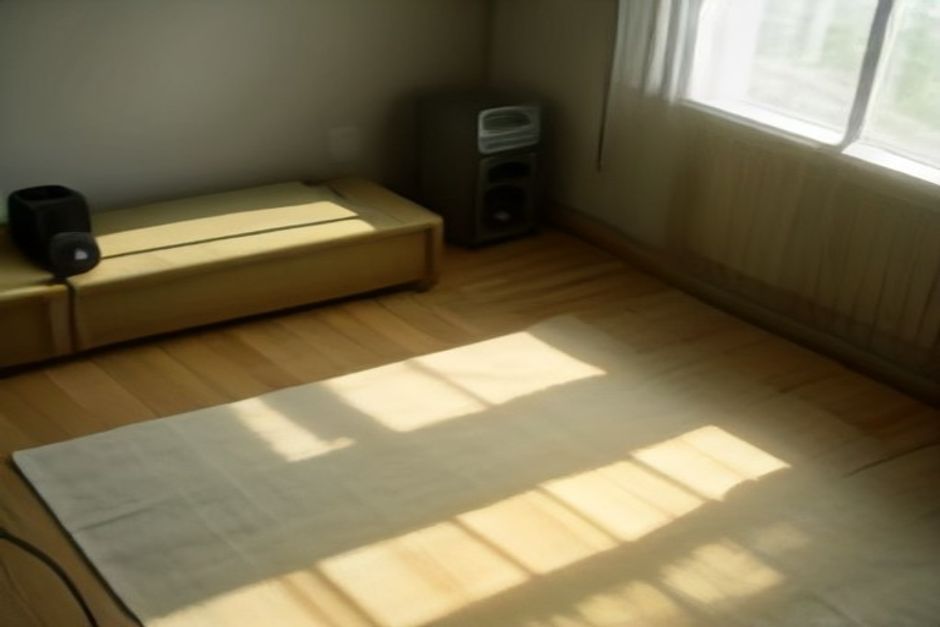
Open a yoga video and there's music. Walk into a studio and there's music. Practice at home in silence and it can feel, strangely, like something is missing — as if the playlist were part of the pose. It's worth asking what the music is actually doing, because the answer cuts both ways. Music can carry a practice through a low-motivation evening, and it can also paper over the very thing practice is for: noticing what's happening. Neither answer is universal. The skill is knowing which one today needs.
What music genuinely adds
Let's give the playlist its due, because it earns it in three honest ways.
It gets you to the mat. On the days when practice feels like one more task, pressing play on a familiar album is a ritual that starts the session before willpower has finished objecting. This is not trivial. A practice that happens with musical assistance beats the silent practice that didn't happen, every time.
It paces the breath. Slow ambient music, something around sixty beats per minute, quietly entrains breathing slower than the day's default tempo. Teachers have used this forever; it's part of why studio classes feel calmer than the same poses done in a hurry at home.
It marks the session as different. Music tells the household — and your own nervous system — that the next forty minutes are not ordinary time. In a small apartment with thin walls and shared space, that boundary matters. If that's your situation, our notes on building a home practice cover the other half of the problem.
What it quietly costs
Now the other side, stated with the same honesty.
Music is a place to hide. The whole mechanism of practice is attention: feeling the stretch, hearing the breath, watching the mind generate its commentary. A good playlist is engineered to absorb attention — that's what it's for. Every time the practice gets boring or uncomfortable, the music is there to carry you over the moment instead of through it. The moment you skip is usually the one that was doing the work.
It outsources the mood. Part of what practice trains is the capacity to arrive in whatever state you're in — flat, irritated, wired — and work from there. Music with a strong emotional character pre-selects the mood for you. That's pleasant. It's also a shortcut past the raw material, and the raw material was the curriculum.
Silence has information in it. In a quiet room you hear your own breath — its speed, its raggedness, the moment it smooths out. You hear the floor, the joints, the street outside. This is close to what the tradition calls nada yoga, the yoga of sound: attention resting on what's actually audible. The same skill is trained directly in sound awareness meditation, and it's much harder to develop when a playlist is filling the channel.
The tradition's view, briefly
It's worth noting that classical practice had plenty of sound — just not background sound. Mantra chanting, breath sound in ujjayi, the spoken count of a led class: sound in these cases is the object of attention, not the wallpaper behind it. The distinction isn't music versus no music. It's sound you attend to versus sound that attends to you — one gathers the mind, the other entertains it so the mind can wander unnoticed. A practiced playlist can be either; honesty about which is happening on any given day is most of the skill.
A working compromise
If you don't want to choose a camp, here's the split many experienced home practitioners arrive at without ever deciding to:
- Music for the physical, silence for the still. Playlist on for the warm-up and standing poses; off before the floor sequence and final rest. Savasana to music is common; Savasana in silence is a different, deeper animal.
- Music scales with resistance. The lower your motivation, the more legitimate the playlist. Some days the music is scaffolding, and scaffolding is fine — you just don't mistake it for the building.
- One silent practice a week, minimum. Not as austerity but as calibration. The silent session is where you find out what the music was covering — breath quality, impatience, the actual state of the body — and that information should shape the rest of the week.
- If you use music, let it be featureless. Lyrics and familiar hooks are attention magnets. Ambient, drone, or instrumental music at low volume supports practice; your favorite album auditions for it.
The honest test
Here's the diagnostic that settles any individual session: after practice, ask what you remember. If you remember the album, the music ran the session. If you remember your breath, your hip, the three minutes where the mind finally went quiet — the practice ran the session, whatever was or wasn't playing. Neither is a failure. But only one of them is training the thing yoga trains. Some days you need the playlist to show up at all; take it. On the days you'd have shown up anyway, try the sound of the room. It's a stranger, more interesting recording than anything you'll stream.