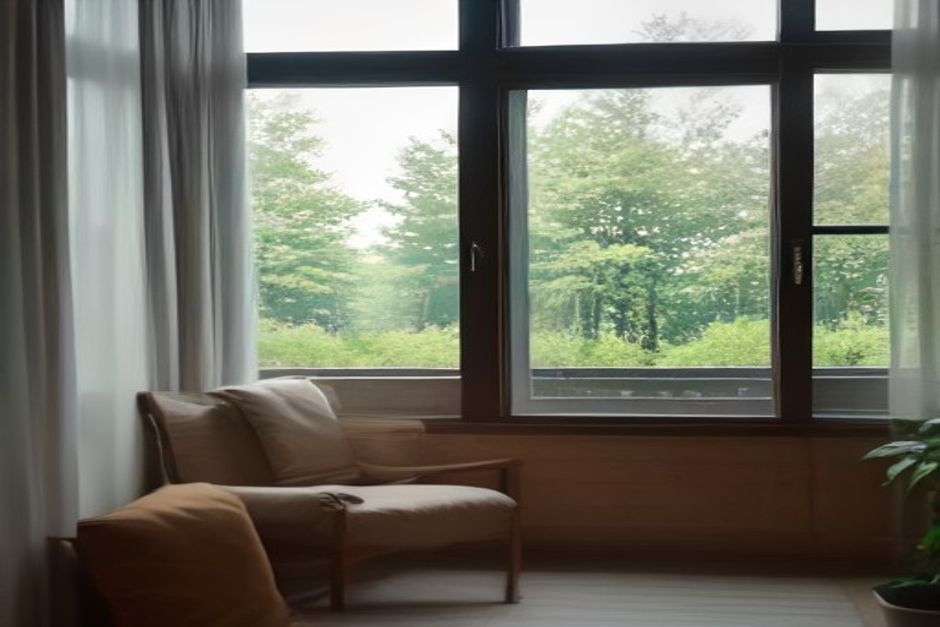
Some people close their eyes and immediately feel at home. Others close their eyes and their mind turns into a pinball machine. If you are the second kind — and most people are, at least sometimes — here is a practice that does not ask you to close your eyes at all. Window meditation is exactly what it sounds like: you sit comfortably, look out a window, and use whatever is moving out there — weather, light, buses, birds, a neighbor who is always watering something — as the anchor for your attention.
Why a window works
Attention anchors come in two flavors: still ones (the breath, a candle flame) and moving ones (sounds, walking). A window offers a third kind — moving but impersonal. Things happen out there, but none of it is yours to fix, answer, or finish. The street goes about its business whether you watch or not, which makes it strangely easy to watch without grabbing. There is also the light: open-eyed practice keeps drowsiness honest, which is why this works well for people who drift off the moment they close their eyes. It sits in the same family as trataka, the traditional candle-gazing practice, and sky gazing — but it needs no candle and no sky. Just a pane of glass and ten minutes.
The setup
Sit in a chair or on a cushion facing the window, far enough back that you take in the whole frame rather than inspecting details. Spine tall, hands resting, shoulders uninvolved. Let your gaze go soft — the way you look at a fireplace, not the way you look at a phone. You are not watching for anything. You are just watching.
The practice, step by step
1. Arrive (one minute)
Feel the seat under you and the weight of your hands. Take three unhurried breaths. Then let the breathing do whatever it does — this practice does not manage it.
2. Watch what moves (eight minutes)
Let whatever enters the frame be the object: a cloud reorganizing itself, rain deciding on a direction, a pedestrian in a hurry. When you notice you have drifted into commentary — where is that bus even going, I should check the forecast, did I answer that email — that noticing is the practice. Name it "thinking," and come back to the glass and what is beyond it. You will do this forty times. That is not failure; that is forty repetitions of the only skill meditation teaches.
3. Include the frame (one minute)
For the last minute, widen the view to include the window frame itself, the glass, maybe your faint reflection — the boundary between in here and out there. This is quietly the most interesting part, and the one that tends to produce the small click of perspective people come to meditation for. In the language of open monitoring, you have shifted from watching objects to watching awareness itself. No need to make it mystical; it is just a wider lens.
4. Close (a few breaths)
Look away from the window, feel the room again, take three breaths, and get up before the phone gets its say. Done.
What you will probably notice
First: how much narration your mind adds to a completely ordinary street. Second: that the "boring" stretches — the minutes when nothing moves — are where the real work happens. Boredom is the weight this exercise lifts. Third, eventually: weather becomes genuinely interesting again, which is a small, real upgrade to an ordinary life.
Variations
- Rain days are the advanced class — mesmerizing, and harder to stay honest in.
- Night windows: watch lit windows and passing headlights; keep the session shorter.
- High floors: watch only sky and rooftops — a close cousin to sky gazing.
- Winter: bare branches move more than you remember. So does snow.
If window watching turns out to be your door in, the meditation section has the next steps — breath anchors, body scans, and the closed-eye practices that may, eventually, stop feeling like a pinball machine.
If watching the outside world reliably ramps up anxiety rather than settling it, pick a still indoor object instead — a plant, a cup, a patch of wall — and run the same steps. And if low mood or racing worry is a daily companion, a meditation habit pairs well with professional support, not instead of it.