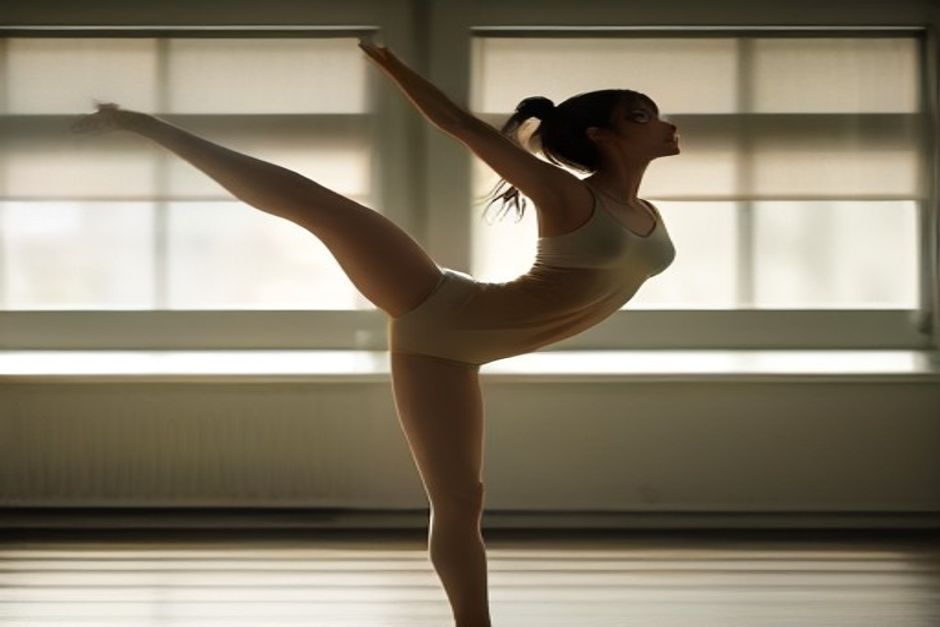
Dancer's Pose — Natarajasana, the pose of Nataraja, Shiva as the lord of the dance — is the one that ends up on yoga studio posters. One leg rooted, one leg kicked up behind, chest open, free arm reaching forward. It looks like pure flair, but underneath the theatre it is a tidy engineering problem: a standing balance and a backbend negotiated at the same time. Get the structure right and the elegance arrives on its own.
What the pose is actually training
Three things at once. The lifted leg gets a serious quad and hip-flexor stretch — deeper than most kneeling lunges manage. The spine and chest get a standing backbend, the same front-body opening as Camel but with half the support. And the standing leg, ankle and foot get the full balance workload, the kind that wakes up muscles a squat never meets. It is also a lesson in mechanics: the pose deepens not by pulling the foot up with the arm, but by kicking the foot into the hand. The kick is the engine; the arm is just along for the ride.
Dancer's Pose — Natarajasana
How: Stand tall with feet together. Shift your weight into the left foot and bend the right knee, bringing the right heel toward the sitting bone. Reach the right hand back and take the inside of the right foot or ankle — inside grip keeps the knee tracking straight back; outside grip tends to wrench it sideways. Start with the knees close together and the torso upright. Now the key move: press the right foot back into your hand so the thigh lifts behind you, and let that kick tip your torso forward in a single piece, chest lifted. Extend the left arm forward alongside the ear or slightly upward, eyes on one unmoving point. Hold five breaths, release slowly, and switch sides.
Why: Kicking the foot into the hand creates the backbend through opposition — the leg drives back, the chest reaches forward, and the spine opens between them. Pulling with the arm instead just strains the shoulder and stalls the pose.
Dancer with a strap
How: Loop a strap (a belt works) around the right ankle or foot. Hold both ends in the right hand — or, for the deeper version, take the strap overhead with both hands as you would in a shoulder stretch. Set up as above and kick the foot into the strap.
Why: If your hand cannot reach your foot without yanking the shoulder or twisting the spine, the strap is not cheating — it is the difference between a stretch and a strain. Tight quads and shoulders are exactly who this pose is for; the strap just lets them in the door.
Dancer at the wall or chair
How: Stand a forearm's distance from a wall, fingertips of the front hand resting on it, or hold the back of a chair. Practice the kick and the thigh lift without the balance demand.
Why: Balance and backbend are hard to learn simultaneously. Separating them — quad stretch first, balance later — builds both faster.
Common mistakes
- Knee winging out to the side. Keep the lifted knee pointing back, roughly in line with the standing hip. If it splays outward, the hip is cheating and the knee is paying.
- The outside-foot grip. Grabbing the outer edge of the foot twists the knee joint. Take the inside edge, or use a strap.
- Collapsing into the standing hip. The standing-side hip tends to jut out. Keep the pelvis level-ish and the standing leg strong but not locked.
- Rushing the tip. The torso should tip forward only as much as the kick drives it. Leaning first and kicking second is how people meet the floor.
Where it fits
Dancer belongs in the standing-peak portion of a practice, once the quads and shoulders are warm — a few lunges, a Warrior or two, some gentle backbends like Bridge or Cobra. It pairs naturally with Warrior III, its flatter, fiercer cousin in the standing-balance family. Afterward, give the spine symmetry: a standing forward fold, then the other side. The goal is not the poster version. The goal is five steady breaths where the kick and the reach balance each other — which, not coincidentally, is also the entire trick of yoga practice in general.