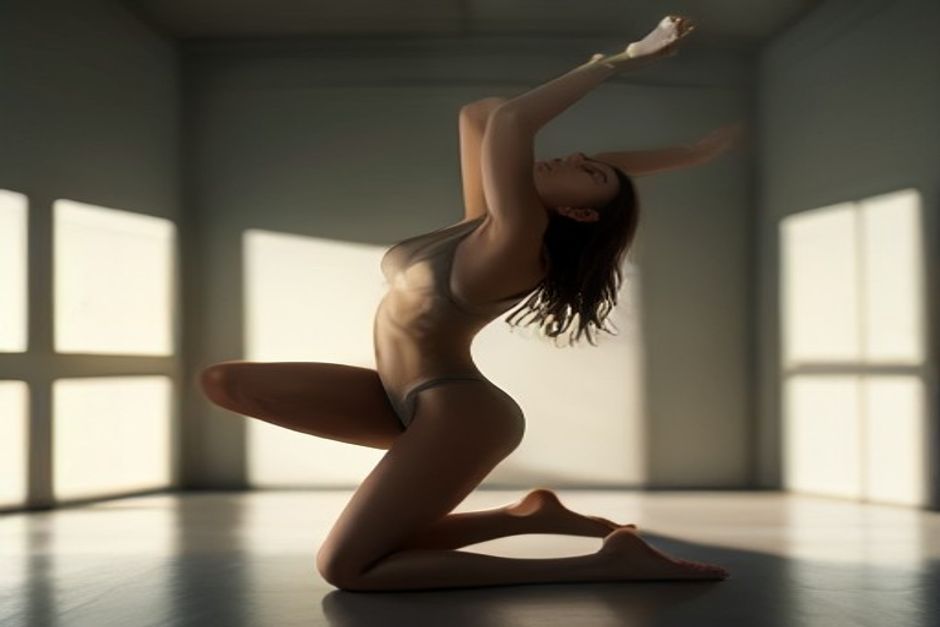
Most of yoga moves the spine forward and backward. Side bending — genuine lateral length, hip to armpit — shows up less often, which is strange given how much of modern life compresses the side body: slumping into one hip at a desk, leaning on one armrest, carrying a bag on the same shoulder for a decade. Gate pose, Parighasana, is the dedicated side bend of the kneeling family, and it's one of the friendlier poses in the whole library: no balance required, no deep flexion, just a long slow arc.
The name comes from the parigha, the crossbar on a gate — the extended leg is the bar, the torso swings over it. Poetic enough for a pose whose main risk is dozing off in it.
The basic pose
Gate pose — Parighasana
How: Kneel with hips stacked over knees, on a folded blanket if your knees have opinions. Extend the right leg straight out to the side, foot flat on the floor, toes pointing up or slightly forward, knee facing the ceiling. Inhale the arms out; on an exhale, slide the right hand down the right leg — shin, ankle, or a block — and reach the left arm up and over the ear. Keep the chest open to the ceiling rather than rolling forward. Stay for five breaths, inhale back up, switch sides.
Why: The stretch runs from the left hip through the obliques and the intercostal muscles between the ribs — tissue that rarely gets lengthened and that breathing depends on. People who do it regularly often notice their breathwork feels roomier; that's not a coincidence, it's anatomy. See the breath and posture page for the longer version.
Length first, depth second
The classic mistake in gate pose is collapsing: the bottom side crunches, the chest rotates toward the floor, and the pose becomes a forward fold wearing a side bend's costume. The fix is to think of the pose in two stages. First, reach the top arm straight up and get genuinely tall — both sides of the waist long. Only then tip sideways, and only as far as you can go while keeping that length. A gate pose that goes two inches with a long spine does more than one that reaches the floor with a crumpled ribcage.
A useful cue: imagine your back is against a wall. The back of the head, the shoulder blades, and the hips all want to stay on that imaginary wall as you bend. When the top shoulder rolls forward of it, you've traded side length for the illusion of depth.
Variations
Gate with a block
How: Set a block at its tallest height just inside the extended leg and rest the bottom hand on it instead of the shin. This raises the floor and makes the length-first principle much easier to honor.
Why: Sliding the hand down the leg invites grabbing and pulling. A block just supports. It is the same argument made everywhere in the props guide: props aren't remedial, they're precise.
Gate with the top hand behind the head
How: Instead of reaching the top arm overhead, place that hand lightly behind your head, elbow pointing up, and gently spiral the chest a few degrees toward the ceiling.
Why: Adds a whisper of rotation to the side bend and makes the "open chest" instruction physical rather than aspirational. Keep the head heavy in the hand — no pulling on the neck.
The kneeling knee
Half your body weight lands on one kneecap here, so pad it without being asked twice — a folded blanket or a doubled mat under the kneeling knee. If kneeling is off the table entirely, the same side bend can be taken sitting cross-legged (one hand on the floor, the other arm over) or standing with the feet wide, in the spirit of extended side angle minus the lunge.
Gate pose sits well in the middle or end of a practice — after standing work, before the floor sequence. It pairs naturally with a gentle twist like the reclined twist and a forward fold, giving the spine all three directions before rest. It also fits neatly into a short sequence from the pose library on days when ten minutes is what you have.