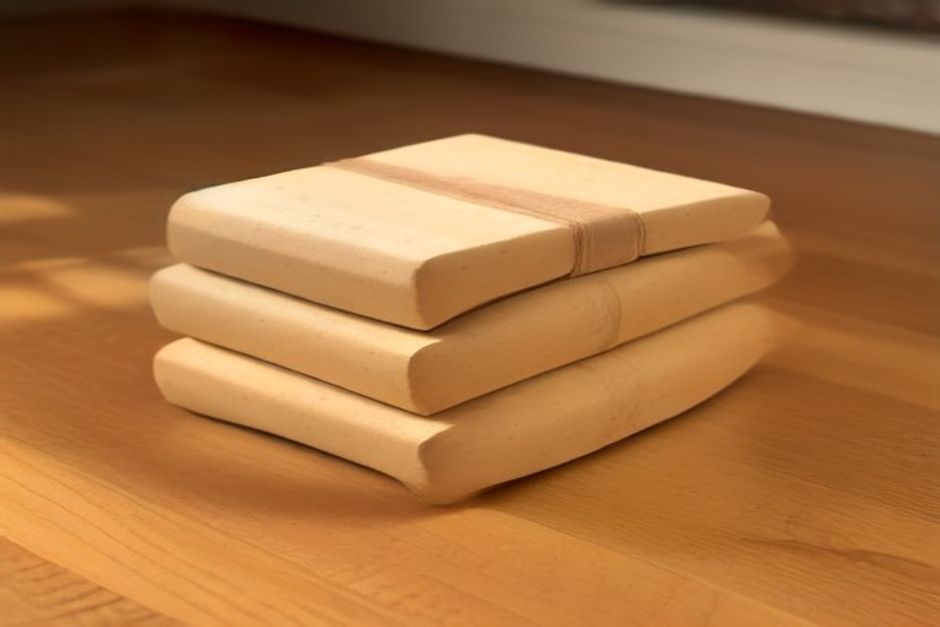
Props have a branding problem. Somewhere along the way, "using a block" got coded as "not good enough yet" — as if the floor were the finish line and props were training wheels. B.K.S. Iyengar, who basically invented modern prop use, saw it the other way around: props are how a pose is made to fit a body, instead of the body being forced to fit the pose. A block isn't a lesser version of the pose; it's often the version where your spine is actually long, your breath actually moves, and your joints actually survive. With that settled, here's what to buy, in the order that earns its keep.
1. Two blocks — buy these first
If you buy nothing else, buy two blocks. They bring the floor up to you, which sounds trivial and changes everything: half moon becomes balance practice instead of a hamstring hostage situation; revolved triangle becomes a twist instead of a face-plant; forward folds stop being a negotiation with your lower back. Sitting on a block in cross-legged positions tips the pelvis forward and lets the spine stack — most people's "I can't sit comfortably" is really "my hips are below my knees."
What to get: Foam is light, cheap, and fine for most uses — a good first buy. Cork is heavier, firmer, more stable under load, and nicer for standing balances; it costs more and lasts longer. Wood is beautiful, heavy, and unforgiving — skip it unless you know you love it. Standard 4-inch thickness is the most versatile; buy two of the same.
Household substitute: a stack of hardcover books wrapped in a towel. Wobbly but functional while you decide.
2. A strap — the cheapest flexibility tool there is
An 8-foot cotton strap with a D-ring buckle costs about the same as two fancy coffees and does one essential job: it extends your arms. Loop it around a foot in a reclined hamstring stretch and your back stays long instead of rounding to grab the toes. Use it in dancer's pose when the hand can't reach the foot. Bind with it in shoulder stretches. Wherever a pose says "grasp," and your body says "no," the strap says "approximately."
What to get: 8 feet suits almost everyone; 10 if you're tall. Plain cotton webbing, metal D-ring. This is a commodity item — the expensive versions are not better.
Household substitute: a belt, a bathrobe tie, a long scarf, a dog leash (washed).
3. A bolster — buy when rest becomes the point
A bolster is a firm cushion about the size of a small person, and it's the heart of restorative yoga: lie over it lengthwise and the chest opens with zero effort; put it under the knees in savasana and the lower back lets go; drape over it in child's pose and the pose becomes something you could nap in — which is rather the idea. If your practice includes any wind-down, pre-sleep work, or stress recovery, a bolster earns its floor space. If your practice is all active flow, it can wait.
What to get: Firm is the key word — a soft, squishy bolster is just a pillow with ambitions. Rectangular is more versatile than round for most bodies. Removable washable cover, non-negotiable.
Household substitute: two firm bed pillows rolled tight in a blanket and secured with the strap you bought above.
4. Blankets — you already own these
Two or three firm wool or cotton blankets are the quiet workhorses: folded under the knees in lunges, stacked under the hips in seated poses, rolled under the neck in shoulderstand setup, and draped over everything for the warmest savasana of your life. Don't buy "yoga blankets" at a markup until you've used what you have. The only requirement: they should fold into firm, dense shapes. A fluffy duvet fails at this; a cheap woven camping blanket excels.
5. A mat you don't think about
The mat market is a hall of mirrors, so here's the short version: a mat needs to not slip and not fall apart, and both of those correlate weakly with price above a modest floor. Very cheap mats peel and slide; mid-range mats from any established maker are genuinely fine for years. Thickness: 4–5 mm suits most people; thicker mats cushion knees but wobble in balances. If your hands slip in downward dog no matter what, that's the one upgrade that matters — grip is the whole job.
What to skip (at least at first)
- Yoga wheels. Fun for a week, then a large object you store. Everything they do, blocks and a bolster do with more control.
- Aerial swings. Genuinely enjoyable, genuinely a different hobby with real installation and safety requirements. Not a starter prop.
- Meditation benches and special cushions. Try a folded blanket or a block first — many "I need a zafu" situations are solved by sitting two inches higher. If sitting practice sticks for a few months, then upgrade; see our posture guide for setup.
- Straps with gimmicks, alignment mats with printed lines, inversion stools. The lines don't align you — a teacher or a mirror does. Inversion stools solve a problem that legs up the wall solves for free.
- Anything marketed as "hot yoga specific" before you've attended a single hot class.
The real rule
Buy in response to a need you've actually met in practice, not in anticipation of a practice you imagine. The block you buy after the third time your hand dangled six inches above the floor will be used forever; the prop you buy because a video looked cool will gather dust. Start with two blocks and a strap — under forty dollars, ninety percent of the value — and let the rest of the collection assemble itself, one honest need at a time.
A prop is not an admission of limitation. It's a tool for practicing the pose you actually have, in the body you actually brought.