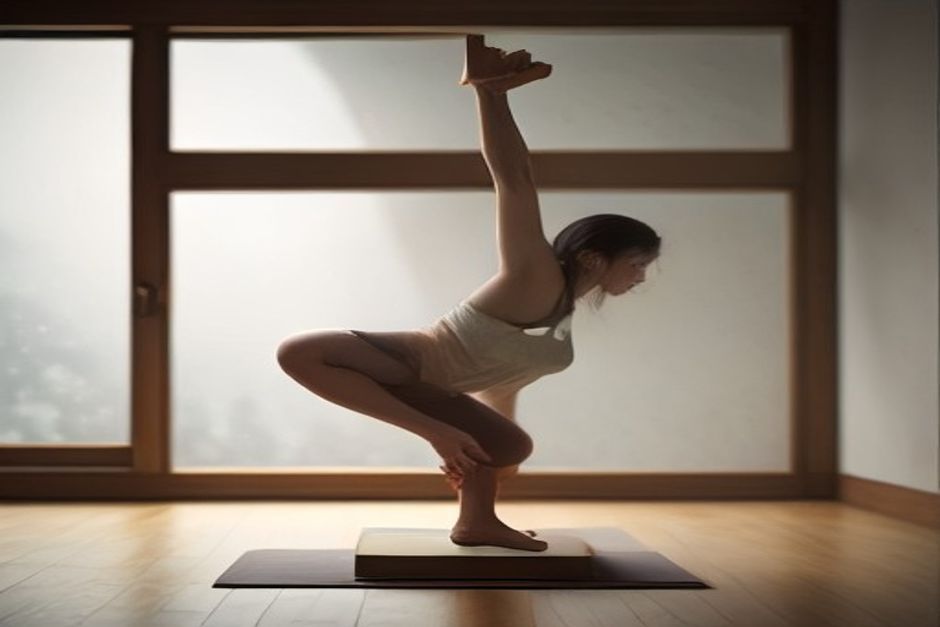
Half Moon — Ardha Chandrasana, from ardha (half) and chandra (moon) — is the pose that separates two kinds of yoga students: those who reach for a block, and those who spend the pose wobbling with their fingertips grazing the floor and their form in shambles. Be the first kind. Half Moon done with a block is a superb hip opener and balance trainer. Half Moon done without one, before you are ready, is mostly an exercise in falling gracefully.
What Half Moon builds
The standing leg gets strong — glutes, outer hip, ankle stabilizers all working overtime. The hips get opened in an unusual way: the top hip stacks and rotates open while the standing hip holds you up, which is a coordination most daily life never asks for. The chest and arms open wide, and the whole side body from standing foot to top fingertips gets long. It is one of the few poses where you are simultaneously balancing, strengthening and stretching — a three-for-one deal, which is why it earns its place in almost every standing sequence.
Half Moon with a block — Ardha Chandrasana
How: From a Triangle or standing position with the right foot forward, place a block on its tallest setting about a foot in front of and slightly outside your right foot. Bend the right knee and plant your right hand on the block. Now shift your weight forward onto the right leg and hand, and lift the left leg until it is parallel to the floor, toes flexed toward your face. Straighten the standing leg without locking the knee. Open the left hip toward the ceiling — imagine your pelvis is a book opening against a wall behind you. Extend the left arm straight up, in line with the right. Gaze at the floor for stability, or up at the top hand if the neck is happy. Hold five breaths, lower with control, switch sides.
Why: The block puts the floor where your hand actually is, so the spine can stay long and the hips can open instead of you crumpling sideways to reach the ground. Height first, depth later.
Half Moon at the wall
How: Set up with your back near a wall — as you lift the back leg and open, your back foot, sitting bones and shoulders can all find the wall. Some days you rest lightly against it; some days you just know it is there.
Why: The wall teaches what "open to the side" actually feels like, because most people, left alone, rotate the chest down toward the floor instead of up toward the ceiling. It is the fastest alignment teacher this pose has.
Half Moon, both hands down
How: The full entry from standing splits, both hands on blocks or the floor, the lifted leg high, hips stacked. Think of it as the pose with a safety net — useful for learning the leg position without balance pressure, or for a deeper hamstring day.
Why: With two points of support you can explore how high the leg goes and how open the hips get, then carry that map into the one-handed version.
Common mistakes
- Locking the standing knee. Keep a micro-bend. A locked knee turns the joint into the stabilizer, and joints make terrible stabilizers.
- Reaching for the floor. If the hand has to dive for the ground, the torso shortens and everything collapses. Raise the block. There is no prize for touching the floor.
- Top hip rolling closed. The lifted hip drifts forward and the pose becomes a wobbly flamingo. Press the back heel away and stack the hips vertically.
- Straining the neck up. Looking at the top hand is optional. Floor-gaze is a full version.
Where it fits
Half Moon follows the open-hip standing poses naturally — after Triangle, Extended Side Angle or Warrior work, when the legs are warm and the hips have started to cooperate. It pairs well with its twisted sibling, Revolved Half Moon, for the ambitious. Afterward, a simple standing forward fold lets the standing leg recover. And take the lesson with you to the rest of the pose library: in Half Moon, as in most of yoga, the person using props with good alignment is doing more yoga than the person forcing a shape. The block is not the beginner's version. Most days, it is the correct one.