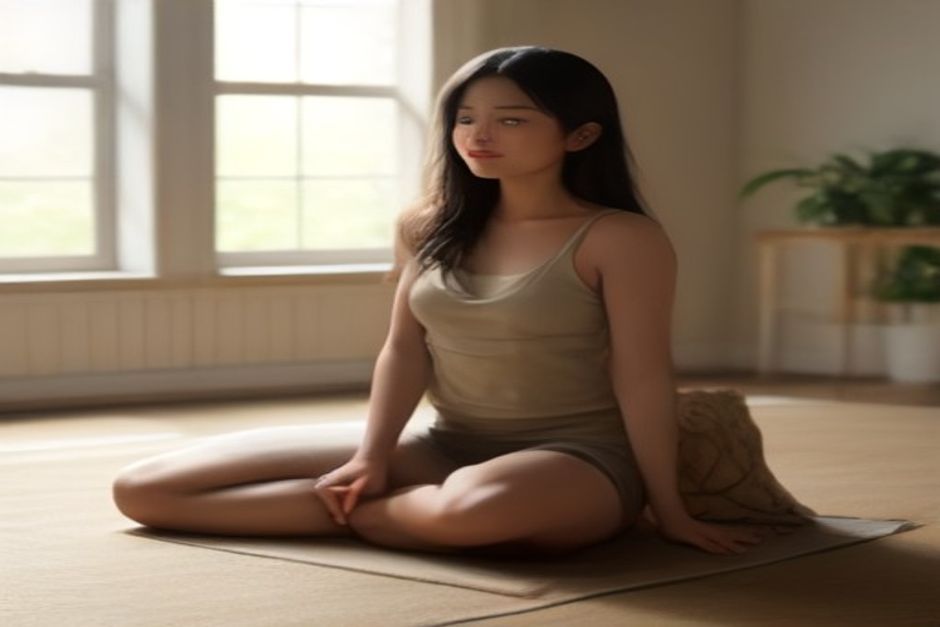
Most yoga poses ask for composure. Lion Pose — Simhasana, from simha, lion — asks for the opposite: eyes wide, tongue out, an audible exhale that in a quiet class can startle the person on the next mat. It is the least photogenic pose in the library and one of the most useful, because it targets a place almost no other pose reaches: the jaw, the tongue, the face. If you carry stress anywhere — and you do — a fair share of it is parked between your temples and your chin.
Why the face needs its own pose
The jaw is a workhorse with no off switch. We chew, we talk, and in between we clench — during traffic, during deadlines, during sleep. The masseter, the main chewing muscle, is one of the strongest muscles in the body for its size, and it rarely gets a deliberate release. The tongue, meanwhile, is a tension mirror: when the mind grips, the tongue presses the roof of the mouth. Lion Pose interrupts both habits at once, then adds an exhale that clears the whole system. It looks absurd. It works anyway. The absurdity is arguably part of the mechanism — it is hard to stay tightly wound while impersonating a lion.
Lion Pose, kneeling — Simhasana
How: Kneel and sit back on your heels (sit on a cushion between the heels if the knees or ankles object). Place your palms on your knees, fingers spread. Inhale through the nose. Then open the mouth wide, stretch the tongue down toward the chin, open the eyes as wide as they go — gaze toward the brow or the tip of the nose — and exhale with a long, open "haaaa" from the throat. Hold the expression for the full exhale. Release, breathe normally, repeat three to five times.
Why: The wide stretch of tongue and jaw lengthens muscles that spend all day shortened. The wide eyes interrupt the fixed, screen-shaped stare. The audible exhale is not decoration — it slows the breath out and gives the nervous system something to ride down on.
Lion in a chair — the office version
How: Sit tall in a chair, feet flat, hands on thighs. Do exactly the same face: inhale, then tongue out, eyes wide, long "haaa." Colleague-optional.
Why: The jaw does not care whether you are kneeling. Three lions at your desk between meetings is a legitimate reset — though consider a closed door or an empty stairwell. Or don't. Confidence is also a practice.
Lion inside other poses — the sneaky version
How: Add the lion exhale to poses that already open the front of the body: at the top of a gentle cat-cow, in a low lunge, or in child's pose before you settle. One lion per pose is plenty.
Why: Pairing the facial release with movement teaches the jaw to stay soft while the body works — which is the actual goal, since most clenching happens mid-effort, not at rest.
The breath connection
Lion Pose is really a breathing practice wearing a costume. The long, open-mouthed exhale is a cousin of lion's breath (simha pranayama), and the pairing matters: the wide mouth removes all resistance from the exhale, so it can be complete without force. Many people discover on the first lion that their usual exhale is a half-exhale — cut off, held back, polite. The roar is impolite by design.
On silliness, seriously
There is a reason this pose gets laughs in class, and the laughter is not a distraction from the practice — it is the practice arriving early. Yoga culture can get solemn: the careful mats, the careful faces. Simhasana is a built-in correction, a reminder that a spiritual tradition that cannot be funny about itself has become furniture. Make the face badly. Roar quietly if the walls are thin. The pose forgives everything except doing it with a straight face, and even that works, just less.
Three lions, twice a day, for a week: that is the experiment. Watch for the moment you catch yourself unclenching your jaw at a red light or mid-email, having finally noticed it was clenched. That noticing — not the roar — is what the pose is training. The roaring is just the fun part, and yoga could use more of those. Browse the rest of the pose library for the poses that keep a straighter face.