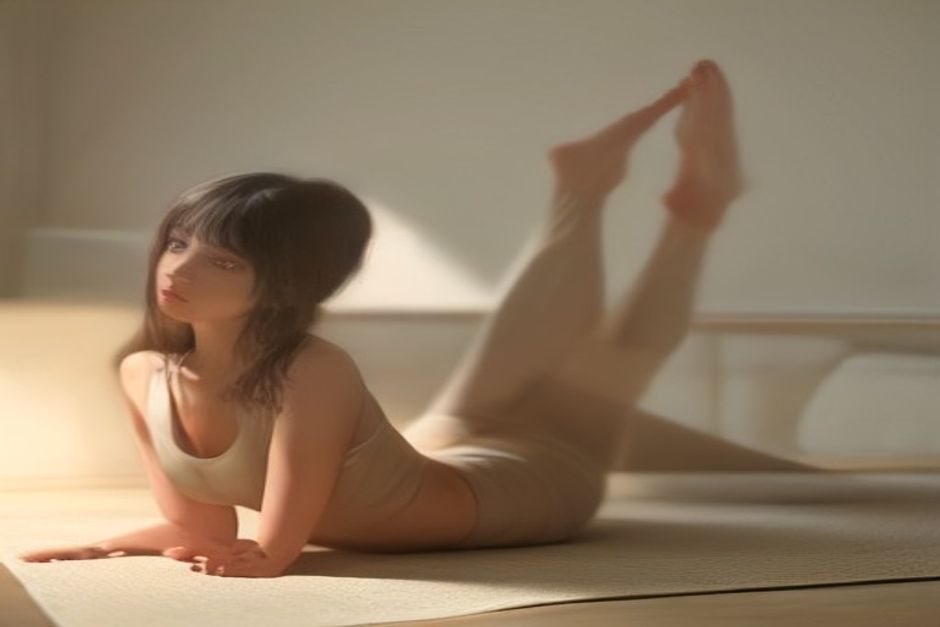
Locust Pose — Salabhasana, from salabha, grasshopper — is a prone backbend where you lie on your belly and lift your chest, arms, and legs against gravity. Unlike the flashier backbends, there is no momentum, no deep spinal compression, and no way to fake it: the muscles along your spine either do the work or nothing leaves the floor. That honesty makes it one of the safest and most useful back strengtheners in yoga.
It is also the natural counterbalance to a practice full of forward folds like Standing Forward Bend — and to a life full of sitting hunched over keyboards. If you are new to the site, the basics page sets the ground rules.
Step by step
Locust Pose — Salabhasana
How: Lie on your belly, arms alongside your body, palms up or down, forehead resting on the mat. Legs together or hip-width — whichever your lower back prefers. On an inhale, lift the head, chest, arms, and legs off the floor. Keep the neck long: gaze at the floor slightly ahead, not up. Reach the fingertips toward the feet and the toes toward the wall behind you, so the pose grows longer rather than higher. Stay 3–5 breaths, lower on an exhale, rest a breath or two, and repeat twice more.
Why: The erector spinae, glutes, hamstrings, and the muscles between the shoulder blades all work together — the entire back line of the body in one coordinated effort. This is precisely the musculature that prolonged sitting switches off. Regular practice builds the endurance that keeps you upright without effort the rest of the day.
Length over height
The single most important cue in Locust: do not chase height. Cranking the chest and legs up as far as they go compresses the lower back into a hinge and misses the point. Instead, imagine someone pulling your hands and feet in opposite directions. The lift that emerges from length — often just a few centimeters — is the training stimulus you want. Altitude is decoration; length is the work.
Build it in pieces
Locust decomposes gracefully, and the partial versions are legitimate practices in their own right:
- Half Locust, upper body. Lift only the chest and arms; legs stay down. Good for sensitive lower backs and for learning the shoulder-blade engagement.
- Half Locust, lower body. Hands under the forehead or alongside the hips; lift only the legs. This isolates the glutes and hamstrings.
- One leg at a time. Lift a single leg while the other stays grounded — the classic preparatory version and a useful diagnostic for side-to-side differences.
- Arms forward. Reaching the arms ahead like a swimmer increases the lever arm and the work considerably. A progression, not a starting point.
Common mistakes
Jacking the chin up kinks the neck; keep the gaze low and the back of the neck long. Clenching the glutes to maximum can actually limit healthy hip extension — think "firm" rather than "crushed." Holding the breath is common because the belly pressing into the floor makes breathing feel strange; breathe into the back and sides of the ribcage instead. And kicking up with momentum turns a strength pose into a flail. If you need momentum, the lift is too ambitious — do half locust instead.
Where it fits
Locust lives naturally in the prone section of a practice, after gentle warm-ups and before deeper backbends like Bridge. Three rounds of five breaths, with rest between, is a complete serving. It also pairs well as preparation for Upward-Facing Dog in sun salutations — Locust teaches the back-body engagement that keeps Up Dog out of the lower back. And as a follow-up stretch for the hip flexors, Low Lunge is a comfortable way to unwind the front body afterward.
Who should be careful: Skip Locust during pregnancy (belly pressure) and with acute lower-back injuries or recent abdominal surgery. Disc issues: practice only the half versions, and only with professional guidance. Neck problems: keep the forehead on the mat and work the legs alone. Mild muscular effort across the back is the goal; any sharp or radiating pain is a stop sign.
Nobody posts Locust Pose photos — the lift is too modest to impress. But the people who can stand tall through a long day without their back complaining are frequently the people who do unglamorous poses like this one, regularly, at sensible heights.