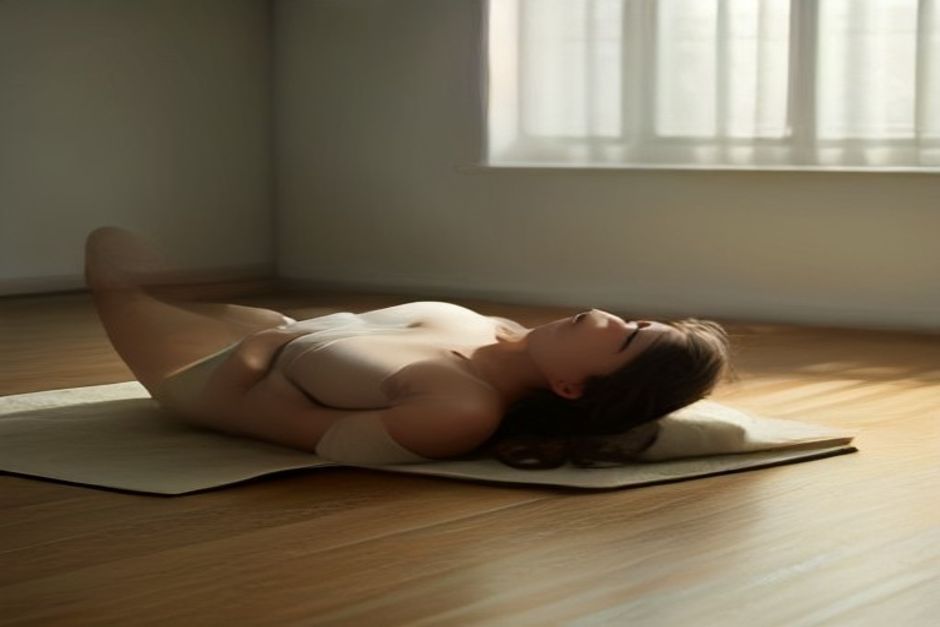
Reclined Hero — Supta Virasana, from supta (reclined) and vira (hero) — is Hero Pose taken horizontal. Kneel between your feet, then lie back. Simple to describe, and one of the most demanding stretches for the quadriceps and hip flexors in the entire canon. It is also a pose with an unusually strict entry requirement: if seated Hero on the floor is not already easy for you, the reclined version is not on today's menu. That is not gatekeeping — it is geometry. Reclining multiplies the load on the knees, and the knees are not a muscle you can stretch into compliance.
What it actually stretches
The front of the body from knee to ribs. Primarily the quadriceps — all four heads, including the rectus femoris, which crosses both the hip and the knee and gets shortened by every hour spent in a chair. Secondarily the hip flexors and the front of the ankles. For runners, cyclists, and desk workers — which is to say, most people — these tissues are chronically short, and the pose can feel like a revelation. It can also feel like a knee injury in progress. The difference between those two experiences is almost entirely a matter of setup.
The prop ladder
Do not think of Reclined Hero as one pose. Think of it as a staircase, and start at the bottom. Each step is a complete, legitimate version of the pose.
Step 1: Seated Hero, elevated — Virasana
How: Kneel with knees together, feet outside the hips, and sit on a block or a stack of folded blankets placed between the feet. Stay upright. If this already produces a strong thigh stretch, this is your pose today — and possibly for the next six months.
Why: The block is not a beginner modification; it is the correct expression of the pose for most bodies. Height transfers the stretch from the knee joint to the thigh muscles, which is where you want it.
Step 2: Hands behind — leaning back
How: From seated Hero (with or without the block), place your hands on the floor behind you, fingers pointing away, and lean back onto straight arms. Lift the chest. Stay for five to ten breaths.
Why: A modest increase in intensity with an easy exit — you can push back up at any moment. If the knees object here, the deeper steps are not for today.
Step 3: Forearms or bolster — half-reclined
How: Lower onto the forearms — or, better, recline onto a bolster laid lengthwise along the spine, with a folded blanket under the head. Arms rest by the sides, palms up. Breathe into the front of the thighs for one to two minutes.
Why: The bolster is the sweet spot for most practitioners: deep enough to matter, supported enough to relax into. A stretch you cannot relax in is mostly an endurance test.
Step 4: Full Reclined Hero — Supta Virasana
How: Only when Step 3 on a low bolster is completely easeful — no knee sensation, no low-back pinching — lower the back fully to the floor. Knees stay grounded or lift only slightly; arms extend overhead or rest by the sides. Thirty seconds to two minutes is plenty.
Why: The full pose is genuinely optional. Tradition valued it as preparation for seated meditation and pranayama; a modern body gets nearly all the benefit one step up the ladder, at a fraction of the risk.
Coming out
Reverse the way you came in: forearms, then hands, then upright. Do not sit up by yanking with the abdominal muscles while the knees are loaded. Once upright, extend the legs one at a time, bounce the knees gently, or take a soft forward bend to remind the knees that they also straighten.
Where it fits in practice
Reclined Hero belongs in the warm middle or end of a practice, never cold. It pairs naturally with backbends — it is a traditional counterpose to Camel and Bridge — and it prepares the legs beautifully for a long seated meditation, since it leaves the hip flexors long and quiet. It is also worth reading up on knee anatomy before making it a habit; understanding why the knee is a hinge makes every cue in this pose obvious.
Practiced patiently, Reclined Hero is one of the most satisfying openings in yoga — the front of the body lets go in a way that standing stretches never quite reach. Climb the ladder slowly, let your knees set the schedule, and the pose will be there, rung by rung, for years.