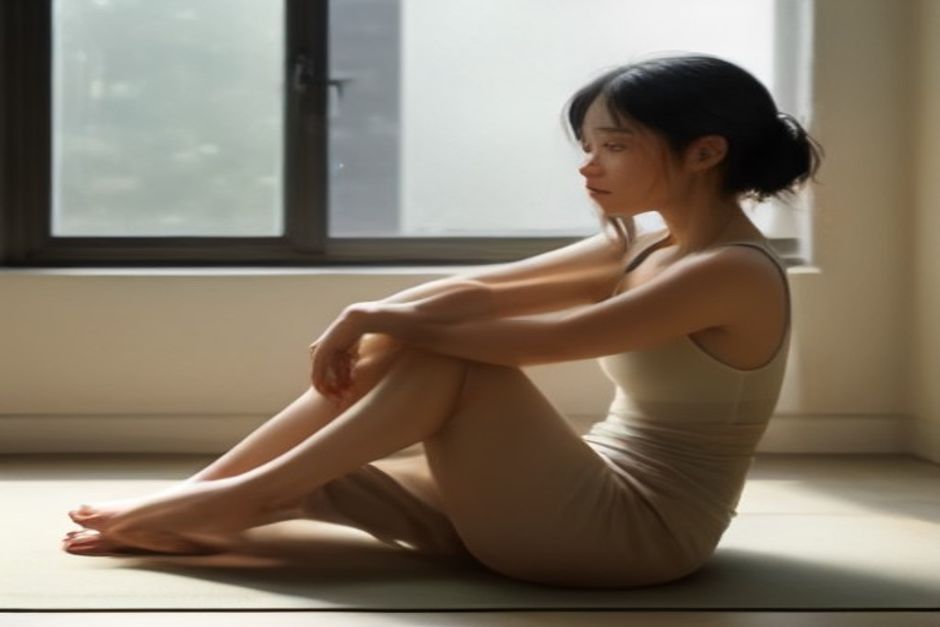
Sit on the floor with your legs straight out in front of you and you have already learned the first thing Paschimottanasana teaches: most of us can't sit upright here without effort. The hamstrings pull the pelvis backward, the low back rounds, and the pose — whose name literally means "intense stretch of the west (back) side of the body" — begins before any folding happens. That beginning is worth respecting, because the seated forward bend done well is a quiet education in where movement should come from, and done badly it's a slow argument with your lumbar spine.
Seated Forward Bend — Paschimottanasana
How: Sit with legs extended, feet hip-width, toes pointing up. Sit on the front edge of a folded blanket if your low back rounds when your legs are straight — this is most people, and the blanket is not a concession, it's the technique. Inhale and lengthen the spine, arms up if you like. Exhale and hinge from the hips, leading with the chest, keeping the back long. Take hold of wherever you reach honestly — shins, ankles, feet — or loop a strap around the balls of the feet. Stay for five to ten slow breaths, lengthening on the inhale and settling on the exhale, then come up on an inhale.
Why: It stretches the entire back line of the body — calves, hamstrings, the muscles along the spine — and gives the front body a chance to be quiet. Done with a long spine, it's also one of the clearest mirrors of hip-hinge mechanics, the same pattern that keeps standing forward bends and everyday lifting safe.
The hinge is the whole pose
The single most valuable idea in this pose is the difference between folding at the hips and folding in the spine. The hip joint is a ball and socket built for large movement; the lumbar spine is built for stability and tolerates loaded rounding poorly. When the chest leads and the pelvis tips forward, the hamstrings get the stretch they're meant to get. When the head leads and the back rounds, the stretch migrates into the ligaments of the low back — tissue that should not be stretched at all. The paradox: the person who folds halfway with a straight spine is doing more of the pose than the person who touches their nose to their knees in a curl.
Practical markers that you're hinging rather than rounding: the belly stays long and can move toward the thighs; the breastbone reaches forward, not down; the breath stays easy. If you can't breathe fully, you've gone somewhere the pose didn't ask you to go.
Variations that make it honest
With a strap — Paschimottanasana variation
How: Loop a strap (or a belt, or a bathrobe tie) around the balls of the feet and hold one end in each hand, arms long. Use the strap to keep the spine's length, not to winch yourself forward.
Why: The strap extends your arms to their true length, removing the temptation to round in order to reach the feet. Reach is irrelevant; hinge is everything.
Knees bent — Ardha Paschimottanasana, informally
How: Bend the knees as much as needed — a rolled blanket under them feels good — so the pelvis can tip forward freely. Straighten the legs gradually over weeks, never by force in a single session.
Why: Bent knees slacken the hamstrings enough for the pelvis to move, which restores the actual point of the pose. Tight hamstrings, as our hamstring anatomy piece explains, win every tug-of-war with the pelvis; bent knees change the rules of the game.
Wide-legged version — Upavistha Konasana direction
How: Open the legs to a comfortable width and fold forward between them, hands walking out ahead of you.
Why: Widening the legs shifts the stretch toward the inner thighs and often lets the pelvis tip more freely. For some bodies this is simply the more accessible fold — the wider cousin of our standing wide-legged fold.
Common mistakes, briefly
- Grabbing the feet at any cost. The feet are not the finish line. Shins are a perfectly respectable destination.
- Bouncing. Ballistic stretching triggers the muscle's protective reflex and achieves the opposite of lengthening. Slow breaths do more.
- Locking the knees hard. A micro-bend keeps the joint supported by muscle rather than hanging on ligaments.
- Holding the breath. If the breath goes quiet and strained, back out until it returns. The breath is the pose's thermostat.
Traditionally, forward folds are considered calming — an inward-turning counterpoint to a day of facing outward. You don't need to believe anything energetic to notice the effect: five unhurried minutes in a comfortable fold, eyes soft, and the nervous system downshifts on its own. It pairs naturally with a few minutes of seated meditation afterward; the body has already done half the settling.
Who should modify or skip: anyone with a disc injury or sciatica should forward-fold only with professional guidance — rounding the low back under load is precisely the movement most disc problems dislike. Hamstring tears, recent or chronic, need bent knees and patience. And if you feel the stretch only behind the knees or in the low back rather than the belly of the thigh, that's information: bend the knees, sit higher, start again.