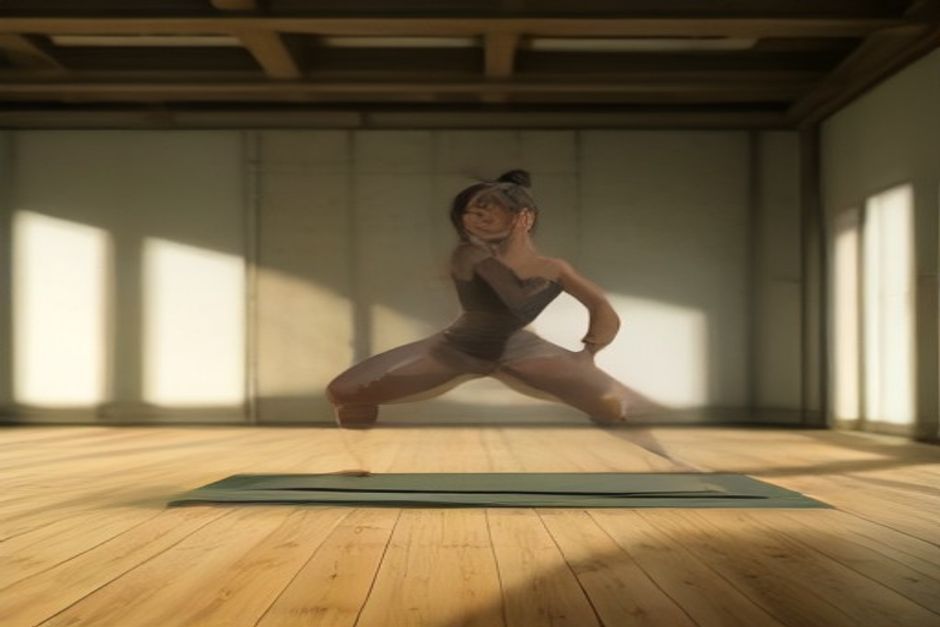
Skandasana — the side lunge, sometimes called the half-squat — looks like a warm-up drill and behaves like a deep hip opener. One leg bends into a squat while the other stretches long, and your hips get to move in a plane of motion that most yoga sequences ignore entirely. It is humbling in the best way: it shows you exactly how mobile (or not) your hips and ankles actually are, then gives you a way to work on both.
Why the sideways plane matters
Most yoga happens front-to-back: lunges step forward, folds reach down, backbends arch up. But your hip is a ball-and-socket joint built to move sideways too — and daily life (getting out of cars, stepping over things, catching your balance) uses that sideways motion constantly. The side lunge trains it directly. It loads the inner thigh of the straight leg, opens the hip of the bent leg, and asks your ankle to dorsiflex deeply, all at once. For the bigger picture on why "hip opening" means several directions, see hip anatomy for yogis.
The pose, step by step
Side lunge — Skandasana
How: Stand with your feet wide — wider than you think, roughly one leg's length apart. Turn the toes slightly out. Shift your weight toward your right foot and bend the right knee, sending your hips back and down. The left leg straightens, left foot flexes with toes turning up toward the ceiling. Hands can stay at your heart, rest on your right thigh, or come to the floor inside the right foot. Keep your chest lifted and your spine long rather than rounded.
Why: Keeping the torso long and the weight in the bent leg's heel keeps the load in the muscles instead of dumping it into the knee joint. The lifted chest is not aesthetic — it is what lets the hip, rather than the low back, do the moving.
Finding your honest depth
Depth is where side lunge goes wrong. Social media shows hips at ankle height; most bodies — especially stiff-hipped, office-shaped bodies — are not there, and forcing it means the knee collapses inward or the foot rolls onto its outer edge. Neither is flexibility; both are compensation.
- The bent knee tracks over the toes, pointing the same direction. If it drifts inward, you have gone deeper than your hips currently allow. Back up.
- The bent-leg foot stays fully grounded — heel included. A hovering heel means tight calves or limited ankle mobility; slide a folded blanket under the heel rather than muscling through.
- The straight leg stays active, foot flexed, toes up. If the straight-leg foot rolls outward, shorten your stance.
A higher side lunge done with clean alignment beats a low one done on a collapsing knee, every single time. The floor is patient. You can visit it next year.
Variations worth knowing
Hands-down side lunge
How: Same shape, but place both hands on the floor inside the bent leg. This lets you support some weight with your arms, which means you can stay longer and explore small rocking movements forward and back.
Why: The gentle rocking loads the inner thigh through a range instead of parking at one end position. Slow movement in a stretch is often worth more than a long static hold.
Flowing side to side
How: From your side lunge, shift smoothly across to the other leg without standing up — hips travel low, hands sweep the floor or stay at the heart. Move with your breath: five to eight slow passes.
Why: This is where skandasana earns its keep in a vinyasa practice. The transition itself is the training: balance, hip control, and leg strength in one continuous motion. It also pairs naturally with goddess pose as a midway resting shape and with the garland squat as a deeper destination.
Bound side lunge (advanced)
How: In the full pose, wrap the bent-leg arm inside that knee, sweep the opposite arm behind your back, and clasp hands or fingers.
Why: A shoulder and chest opener layered onto the hip work — but only once the base pose is stable. If the bind pulls your knee inward or rounds your spine, it is decoration, not progress.
Safety note: Knees are the honest referees here. Pain on the inner knee of the bent leg usually means the knee is collapsing inward — lift your hips higher and check the tracking. Pain on the straight-leg inner thigh that feels sharp rather than stretchy is a stop sign, not a challenge. Anyone with a history of groin strain or knee ligament issues should keep the range small and, ideally, get a professional's eyes on the shape first. Sharp joint pain is never the stretch working harder; it is you working in the wrong place.
Skandasana will tell you the truth about your hips in about four seconds. The nice surprise is that it also fixes what it reveals — slowly, sideways, a few inches of honest range at a time.