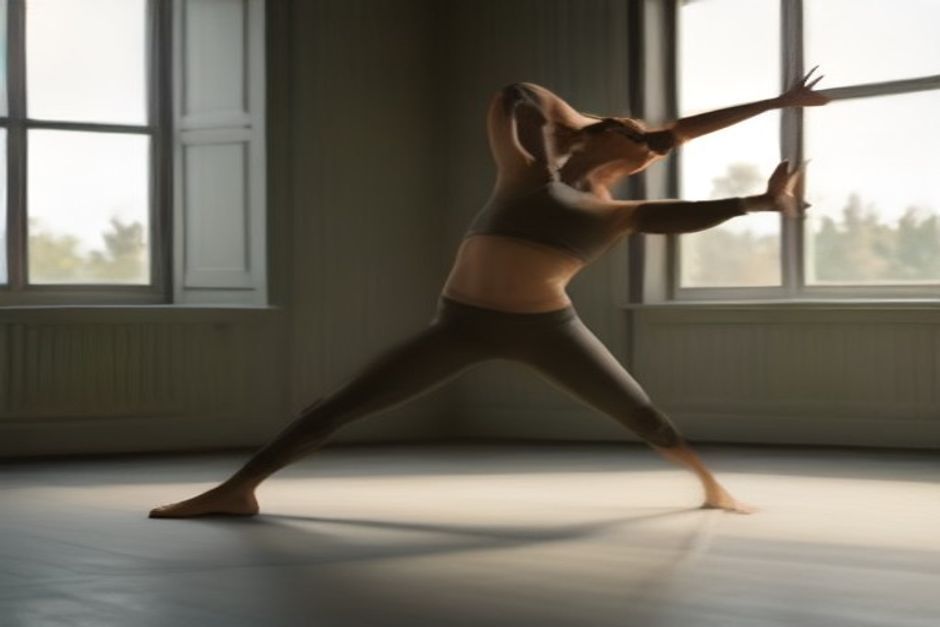
Warrior II — Virabhadrasana II — is the second of the three warriors named for Virabhadra, the fierce figure said to have sprung from a lock of Shiva's hair. Where Warrior I asks you to square your hips toward the front of the mat (an anatomically optimistic request for most pelvises), Warrior II opens the hips to the side and lets them settle where they actually live. For many people, that makes it the friendlier warrior — which is not the same as easy. Hold it for a minute and the front thigh will have opinions.
Step by step
Warrior II — Virabhadrasana II
How: From standing, step your feet wide — about a leg's length apart. Turn your right foot out 90 degrees and your left foot in slightly, maybe 10–15 degrees. Bend the right knee toward 90 degrees, tracking it over the second and third toes. Stretch both arms out at shoulder height, parallel to the floor, palms down. Gaze over the front middle finger. Keep the torso centered between the legs — not leaning forward over the bent knee. Stay for 5–10 breaths, then switch sides.
Why: The bent front leg builds strength in the quadriceps and glutes; the open pelvis stretches the inner thighs of both legs; the extended arms wake up the shoulders and upper back; the steady gaze trains concentration. It is strength and stretch and attention practice compressed into one stance.
The knee is the whole story
The most common Warrior II problem is the front knee collapsing inward, toward the big toe. This puts sideways load on a joint that is designed to hinge, not swivel, and it is usually a sign of tired outer hip muscles rather than bad intentions. The fix is not to yank the knee out with your hand — it is to press down through the outer edge of the front foot and imagine dragging the knee toward the little-toe side, using the glutes to do the work. If the knee keeps diving in anyway, bend it less. A 60-degree bend with honest alignment beats a 90-degree bend with a wobbly knee every time.
Second most common: the torso drifting forward over the front leg, usually because the back leg has quietly checked out. Press the outer edge of the back foot into the mat and firm the back thigh. Imagine your spine is a plumb line dropped exactly between your two feet. The back leg is half the pose — treat it that way.
The gaze, and why it matters
The classical instruction is to look over the front hand — drishti, the focused gaze. This is partly about the neck (a turned head balances the open hips) and partly about attention: you point your eyes somewhere and hold them there while the legs work. It is a small, useful lesson in staying with mild discomfort without fidgeting. If looking sideways strains your neck, look straight ahead instead. The neck always wins tiebreakers.
Useful variations
- Shorter stance. Bring the feet a step closer together. Less intensity, same architecture — the right choice for balance issues or very tired days.
- Peaceful (reverse) warrior. Keep the legs, tip the torso back, and slide the back hand down the back leg while the front arm reaches up. A side bend more than a backbend — keep the front knee bent and honest.
- Arms at the hips. If shoulders complain about five minutes of horizontal arms, hands on hips is a complete and respectable Warrior II.
- Into the family. Warrior II is the doorway pose: from here you can straighten the front leg into Triangle, deepen into Side Angle, or open into Goddess. Learn it well and a dozen other poses get easier.
Who should be careful
With knee problems, take a shorter stance and bend the front knee less — pain in the joint is a stop sign, not a challenge. With hip replacements or recent hip surgery, ask your physiotherapist before practicing deep open-hip standing poses. If balance is unreliable, practice near a wall or with a chair within reach. High blood pressure: some teachers suggest gazing forward rather than to the side; when in doubt, ask your doctor and your teacher, not the internet.
Warrior II won't fix your life, but it does something quietly valuable: it makes you stand wide, take up space, breathe, and stay. Most of us practice the opposite all day — shoulders rounded, stance narrow, attention scattered. A few breaths of deliberate width is a reasonable counter-argument. Browse the rest of the pose library when you're ready for the next one.