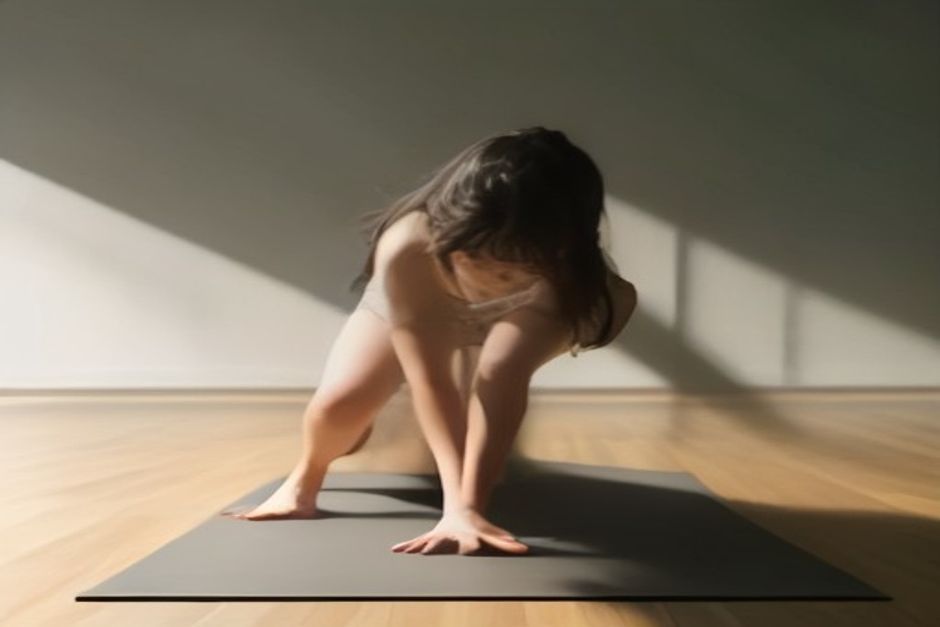
Prasarita Padottanasana is a mouthful — "spread-out foot intense stretch" — but the pose itself is refreshingly legible: stand wide, fold forward, put your head below your heart. It's the fold that shows up near the end of standing sequences, when the legs are warm and the nervous system is ready to downshift. Of all the forward bends, this is the one most likely to make people close their eyes and stay a while.
What the wide-legged fold is good for
The wide stance changes everything about the stretch. The inner thighs (adductors) — barely touched in a regular forward fold — become primary targets alongside the hamstrings. Because the legs are spread, most people can tip the pelvis further forward before the hamstrings say stop, which means the spine stays longer and the low back stays safer than in a narrow fold. And because the head drops below the heart with the legs still firmly planted, you get the settling effect of a mild inversion: breath slows, shoulders drop, and five breaths here can change the tone of an entire practice. It's also a genuine hip-opener for people who find pigeon too intense — gravity and stance do the work symmetrically.
Wide-Legged Forward Fold — Prasarita Padottanasana
How: Step the feet wide — roughly a leg's length apart. Turn the toes slightly in and the heels slightly out; press down through the outer edges of the feet. Hands on hips, inhale to lengthen the spine, then exhale and hinge forward from the hips. When the torso is about parallel to the floor, bring the hands to the mat or to blocks, fingers in line with the toes. Fold deeper on your exhales, letting the crown of the head reach toward the floor. Keep a micro-bend in the knees if the hamstrings protest. Stay five to ten breaths. Inhale the torso halfway up, hands to hips, and rise slowly.
Why: Toes slightly in protects the knees and wakes the inner legs. Hinging from the hips rather than rounding the spine keeps the stretch in the legs where it belongs. Weight even across the feet — not dumped into the heels — keeps you stable as the head drops.
Hands on Blocks
How: Set two blocks (or a chair) under your hands at whatever height lets the spine stay long — even the highest setting counts. Fold as far as the long spine allows and rest there.
Why: The floor is far away for most people, and rounding to reach it trades a leg stretch for a back strain. Blocks bring the floor up to you, which is the entire point of props.
Clasped-Hands Variation
How: In the fold, interlace the fingers behind your back and let the arms drift overhead toward the floor, keeping the shoulders broad.
Why: Adds a chest and front-shoulder opener to the leg stretch — the exact tissue that shortens over a keyboard. If the clasp isn't available, hold a strap between the hands instead. Traditionally this pose is taught as a series with four arm positions; hands on hips, hands on floor, clasped behind, and hands to big toes. One is plenty. All four is a luxury.
Common mistakes
- Feet turned out like a plié. A little toe-in is stabilizing; turnout makes the knees vulnerable in the fold. Check that the knees point the same way as the toes.
- Collapsing into hyperextended knees. If your knees lock backward, engage the fronts of the thighs gently or soften the knees. The fold deepens from the hips, not from the knee joint.
- Rushing the exit. Rising fast with the head below the heart is a recipe for seeing stars. Halfway up, pause, breathe, then finish the rise.
Where it fits in a practice
Late in the standing work, as the bridge to the floor. It flows naturally after Warrior I, Half Moon, or Goddess Pose — the legs are warm, and the fold releases what the standing poses strengthened. It pairs well with its narrow cousin, the Standing Forward Bend: wide first for the inner thighs, narrow after for the hamstrings. From here, sitting down for Pigeon Pose or lying down for a Reclined Twist is a natural next step. Sequences like this appear throughout our guided courses.
The old texts treat forward folds as poses of surrender, and the wide-legged fold makes the idea physical: head down, heart soft, legs doing quiet, honest work. You don't need to believe anything to feel it. Fold, breathe, and notice that the world looks fine from this angle too.