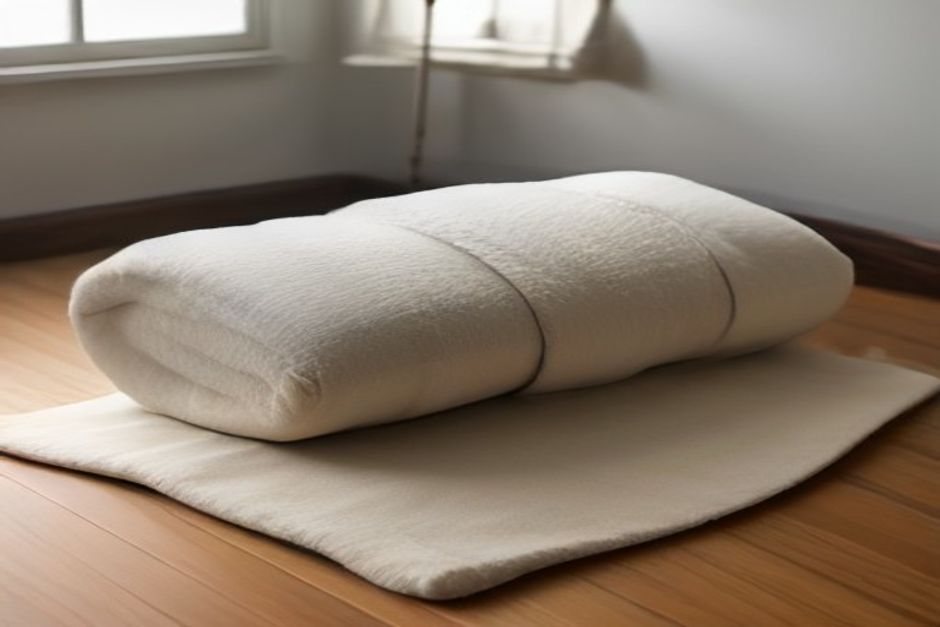
From the doorway, a restorative class and a yin class look identical: dim room, quiet people, a small mountain of props, nobody moving for minutes at a time. Students regularly wander into one expecting the other and leave confused — either bored by a practice that never asked anything of them, or rattled by one that asked more than they had to give. The two styles share a tempo and a prop closet, but their goals are not just different; in a meaningful sense they're opposite.
Restorative yoga: the practice of removing everything
Restorative yoga, developed largely from B.K.S. Iyengar's prop-supported work, has one job: to let the nervous system shift out of doing mode. Every pose is built so that no muscular effort is required to stay in it. The bolster holds your spine, the blanket holds your head, the strap holds your legs — you are, ideally, redundant. The target sensation is no sensation at all. If you feel a stretch, the standard restorative answer is to add more support until you don't.
What it's for: genuine rest. Not the rest of scrolling on the couch, but the physiological kind — slower heart rate, deeper breathing, the parasympathetic nervous system finally getting a shift at the wheel. A pose like legs up the wall or supported bridge held for ten quiet minutes is a direct intervention in a wired, tired system. People reach for it during burnout, illness recovery, grief, insomnia, and the general accumulated noise of modern life. Our restorative glossary entry traces the lineage; the practice itself needs no philosophy to work.
Yin yoga: the practice of applying almost nothing, for a long time
Yin yoga, shaped by teachers like Paul Grilley and Sarah Powers, works the other side of the street. Poses are held for three to five minutes (sometimes more) specifically to place a mild, sustained stress on the body's dense connective tissue — fascia, ligaments, joint capsules — the tissues that respond to long, low loads rather than short, strong ones. You find an edge: a moderate, tolerable sensation, maybe a four out of ten. Then you stay, and let time do what effort can't.
What it's for: maintaining and slowly improving the health and range of the joints and the tissue around them, especially the hips, pelvis, and spine. A yin pose like butterfly or sleeping pigeon is not comfortable, exactly — it's interesting. The practice also trains something less physical: staying present with dull, persistent sensation without fidgeting or fleeing. Many people find yin more mentally demanding than a fast flow class. See the yin yoga glossary page for the naming story.
The honest comparison
- Sensation: Restorative aims for none. Yin aims for a mild, sustainable edge.
- Props: Restorative uses props to eliminate effort. Yin uses props to make an edge bearable — a block under the head in a deep fold, for instance.
- Target: Restorative targets the nervous system. Yin targets connective tissue and joint health.
- Feeling afterward: Restorative leaves you drowsy and heavy, in a good way. Yin often leaves you loose and quietly energized — or, honestly, a bit creaky for a few minutes first.
- When: Restorative before bed, during illness, in exhaustion. Yin on a rest day from harder training, in the morning stiffness, after long sitting.
Which one do you need today?
A useful diagnostic: if the thought of holding a mild stretch for four minutes sounds irritating, you probably need restorative. Irritability at small demands is a reliable sign the tank is empty, and an empty tank calls for removal of load, not redistribution of it. If, on the other hand, your body feels stiff and compressed but your energy is fine — after a long flight, a week at a desk, a cold snap — yin's patient stress is likely the better tool.
They also combine well. A common and sensible evening: two or three yin poses for the hips while there's still some alertness, then a fully propped restorative pose to finish, then bed. What doesn't work well is mixing the intentions inside a single pose — half-heartedly propping a yin pose so it's neither restful nor effective, or muscling into a restorative pose until it stops being rest. Each practice is honest about what it is; let it be that.
A word on patience
Both styles frustrate people who measure practice by effort. There is no sweat to show for forty-five minutes of restorative yoga, and yin's changes happen on the timescale of months, not workouts. The return on investment is real but quiet: better sleep, calmer baseline, joints that keep working in your sixties and seventies. Pair either with a few minutes of simple breathwork and you have a complete evening practice that asks almost nothing and gives back disproportionately.
One caution: yin's long holds near joint end-range are not appropriate for everyone. Hypermobile people should stay well short of any edge, and anyone with joint injuries, osteoporosis, or pregnancy (when relaxin loosens ligaments) should get guidance before holding deep poses for minutes. Mild sensation, always — never sharp, never in the joint itself.